
We read your photo as:
Differentiate the following functions: (i) y=e^x sin 4x (ii) y = (x²+1)/(x²+x+1). Given the equation of a curve: xy² +3y−4x=7. Find dy/dx.
Mathematics
ScanSolve AI Answer
Step-by-step solution
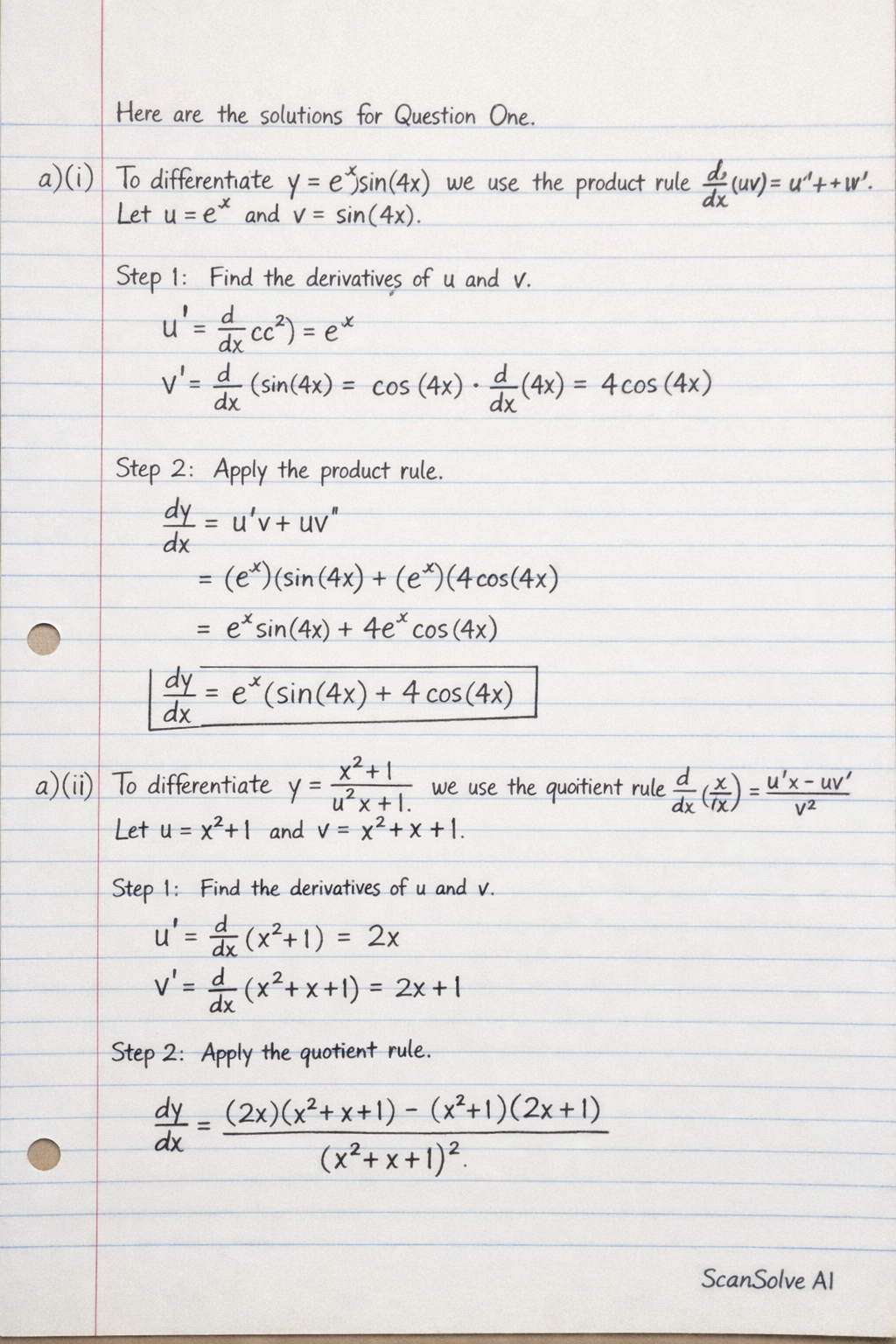
10 stepsHere are the solutions for Question One.
a) (i) To differentiate , we use the product rule .
Let and .
Find the derivatives of and .
Apply the product rule.
a) (ii) To differentiate , we use the quotient rule .
Let and .Find the derivatives of and .
Apply the quotient rule.
Expand and simplify the numerator.
Write the final derivative.
b) To find for the curve , we use implicit differentiation.
Differentiate each term with respect to .
Using the product rule for : .
Group terms containing on one side and other terms on the other side.
Factor out .
Solve for .
Was this helpful?
Still stuck on this one?
Ask a follow-up, and the answer starts from this question.
Got a different question?Ask your own question
More Mathematics Questions
QFind dy/dx for the following functions: a) y = x2+2/x+1, b) y=x2-1/x2+2, c) y = x/(x+4)3, d) y…QDifferentiate the following functions using the first principle: iii) y = 4x2 + 2x + 1 iv) y = sin xQDifferentiate the following functions: 4. (1) y = 7x4 + 5x3 - 7x (2) y = x3 (3) y = 8x2 - x + 5x (4)…QDifferentiate the following functions: 1. y = x3 + x 2. y = x2 x 3. y = (x2 + x)/(x)QDifferentiate the following functions with respect to x: a) y = x b) y = −x2 + 3 c) y = x3/3 + x2/2…
Handwritten Step-by-Step Solution
Get this as a handwritten image on WhatsApp — like a tutor wrote it for you.
Try on WhatsApp