
We read your photo as:
Differentiate the following functions using the product rule and chain rule: y = x2 x, y = e^x 3x, y = e3x nx, $y = (x
ScanSolve AI Answer
Step-by-step solution
18 stepshere are the differentiations for each function:
1)
Use the product rule, .
Let and .
Find the derivatives of and .
.
.Apply the product rule.
2)
Use the product rule, .
Let and .
Find the derivatives of and .
.
For , use the chain rule: .Apply the product rule.
3)
Use the product rule, .
Let and .
Find the derivatives of and .
For , use the chain rule: .
For , use the chain rule: .Apply the product rule.
4)
Use the chain rule.
Let . Then .
.Find using the product rule for .
Let and .
and .
.Apply the chain rule .
Using the identity :
5)
Use the product rule, .
Let and .
Find the derivatives of and .
For , use the chain rule: .
For , use the chain rule: .Apply the product rule.
6)
Use the product rule, .
Let and .
Find the derivatives of and .
.
For , use the chain rule: . Let , so .
Then .Apply the product rule.
You can factor out :
Still stuck on this one?
Ask a follow-up, and the answer starts from this question.
More Mathematics Questions
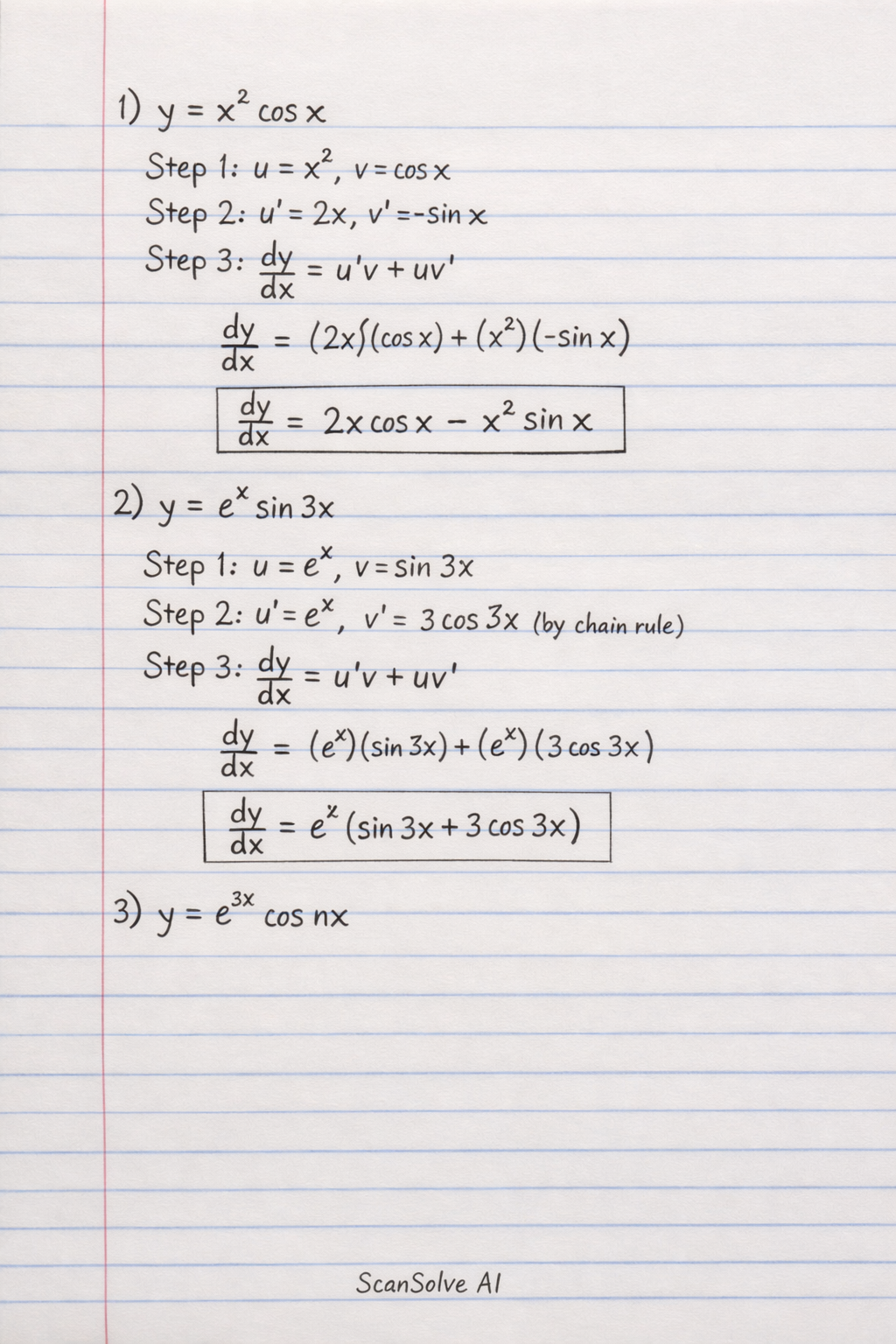
Handwritten Step-by-Step Solution
Get this as a handwritten image on WhatsApp — like a tutor wrote it for you.
Try on WhatsApp