We read your photo as:

Find dy/dx at (1,1) for x^y + yx = sin(xy).

Mathematics

ScanSolve AI Answer

Answer

cos⁡(1)−21−cos⁡(1)\frac{\cos(1) - 2}{1 - \cos(1)}

Step-by-step solution

5 steps

To find dydx\frac{dy}{dx} at the point (1,1)(1,1) for the implicitly defined function xy(x)+y(x)x=sin⁡(xy(x))x^{y(x)} + y(x)x = \sin(xy(x)), we will use implicit differentiation.

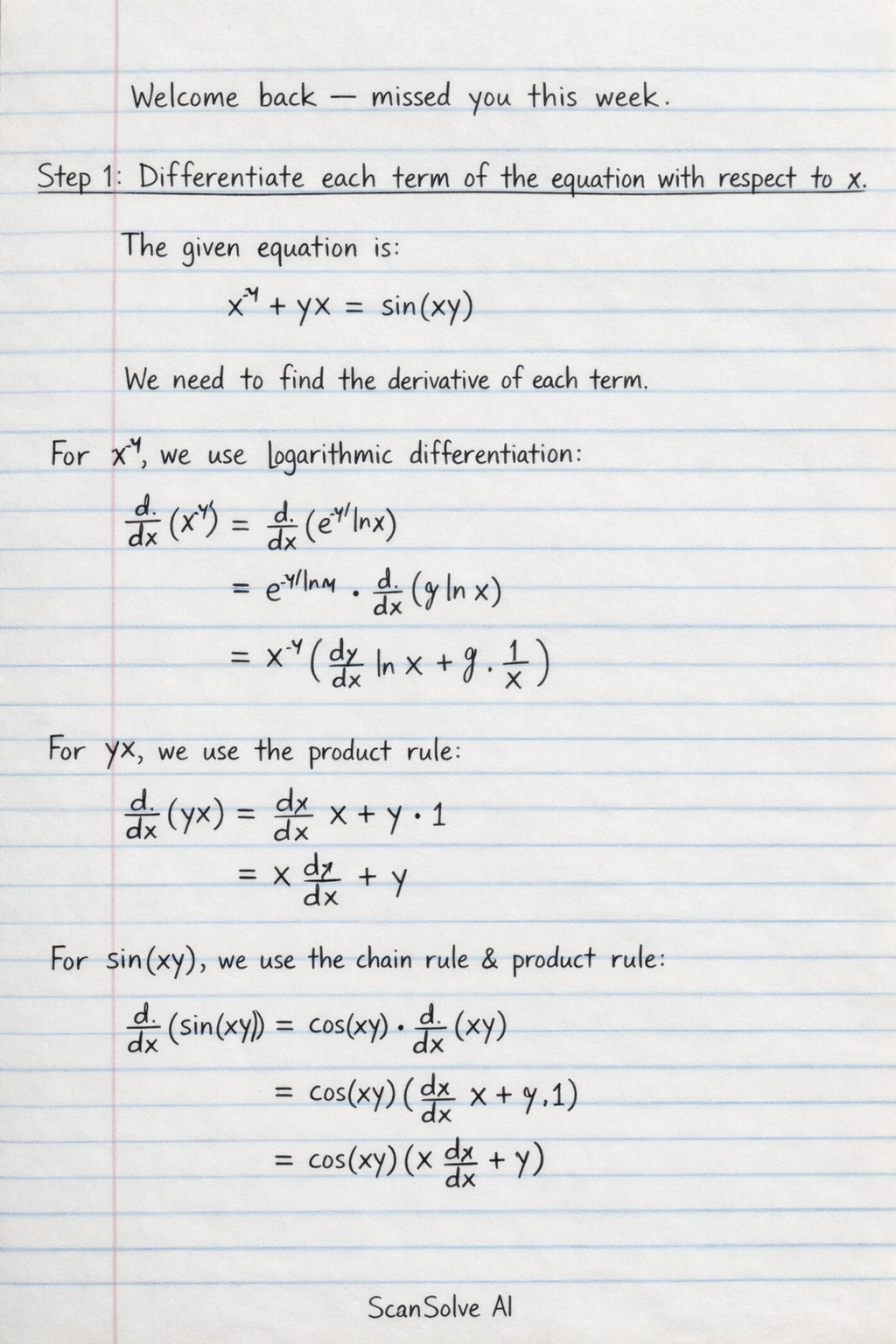
  1. Differentiate each term of the equation with respect to xx.

    The given equation is:

    xy+yx=sin⁡(xy)x^y + yx = \sin(xy)

    We need to find the derivative of each term.
    For xyx^y, we use logarithmic differentiation or the fact that xy=eyln⁡xx^y = e^{y \ln x}:

    ddx(xy)=ddx(eyln⁡x)=eyln⁡x⋅ddx(yln⁡x)=xy(dydxln⁡x+y⋅1x)\frac{d}{dx}(x^y) = \frac{d}{dx}(e^{y \ln x}) = e^{y \ln x} \cdot \frac{d}{dx}(y \ln x) = x^y \left( \frac{dy}{dx} \ln x + y \cdot \frac{1}{x} \right)

    For yxyx, we use the product rule:

    ddx(yx)=dydx⋅x+y⋅1=xdydx+y\frac{d}{dx}(yx) = \frac{dy}{dx} \cdot x + y \cdot 1 = x \frac{dy}{dx} + y

    For sin⁡(xy)\sin(xy), we use the chain rule and product rule:

    ddx(sin⁡(xy))=cos⁡(xy)⋅ddx(xy)=cos⁡(xy)(dydx⋅x+y⋅1)=cos⁡(xy)(xdydx+y)\frac{d}{dx}(\sin(xy)) = \cos(xy) \cdot \frac{d}{dx}(xy) = \cos(xy) \left( \frac{dy}{dx} \cdot x + y \cdot 1 \right) = \cos(xy) \left( x \frac{dy}{dx} + y \right)
  2. Substitute the derivatives back into the equation.

    xy(dydxln⁡x+yx)+xdydx+y=cos⁡(xy)(xdydx+y)x^y \left( \frac{dy}{dx} \ln x + \frac{y}{x} \right) + x \frac{dy}{dx} + y = \cos(xy) \left( x \frac{dy}{dx} + y \right)
  3. Substitute the point (x,y)=(1,1)(x,y) = (1,1) into the differentiated equation.

    Recall that ln⁡(1)=0\ln(1) = 0.

    11(dydxln⁡1+11)+1⋅dydx+1=cos⁡(1⋅1)(1⋅dydx+1)1^1 \left( \frac{dy}{dx} \ln 1 + \frac{1}{1} \right) + 1 \cdot \frac{dy}{dx} + 1 = \cos(1 \cdot 1) \left( 1 \cdot \frac{dy}{dx} + 1 \right) 1(dydx⋅0+1)+dydx+1=cos⁡(1)(dydx+1)1 \left( \frac{dy}{dx} \cdot 0 + 1 \right) + \frac{dy}{dx} + 1 = \cos(1) \left( \frac{dy}{dx} + 1 \right)
  4. Simplify the equation.

    1+dydx+1=cos⁡(1)dydx+cos⁡(1)1 + \frac{dy}{dx} + 1 = \cos(1) \frac{dy}{dx} + \cos(1) 2+dydx=cos⁡(1)dydx+cos⁡(1)2 + \frac{dy}{dx} = \cos(1) \frac{dy}{dx} + \cos(1)
  5. Isolate dydx\frac{dy}{dx}.

    Subtract cos⁡(1)dydx\cos(1) \frac{dy}{dx} from both sides and subtract 2 from both sides:

    dydx−cos⁡(1)dydx=cos⁡(1)−2\frac{dy}{dx} - \cos(1) \frac{dy}{dx} = \cos(1) - 2

    Factor out dydx\frac{dy}{dx}:

    dydx(1−cos⁡(1))=cos⁡(1)−2\frac{dy}{dx} (1 - \cos(1)) = \cos(1) - 2

    Divide by (1−cos⁡(1))(1 - \cos(1)):

    dydx=cos⁡(1)−21−cos⁡(1)\frac{dy}{dx} = \frac{\cos(1) - 2}{1 - \cos(1)}

    The value of dydx\frac{dy}{dx} at the point (1,1)(1,1) is:

    cos⁡(1)−21−cos⁡(1)\frac{\cos(1) - 2}{1 - \cos(1)}
Was this helpful?

Try one yourself

A new problem that tests the same skill.

Still stuck on this one?

Ask a follow-up, and the answer starts from this question.

Got a different question?Ask your own question
Handwritten step-by-step solution preview

Handwritten Step-by-Step Solution

Get this as a handwritten image on WhatsApp — like a tutor wrote it for you.

Try on WhatsApp