
We read your photo as:
Solve the equation ((2)/(3))^x + ((3)/(2))^x = (13)/(6) for x.
ScanSolve AI Answer
Answer
Step-by-step solution
4 stepsRewrite the equation using a substitution.
Notice that .
Let . Then the equation becomes:Convert the equation into a quadratic form.
Multiply the entire equation by to eliminate the denominators:
Rearrange the terms to form a standard quadratic equation:
Solve the quadratic equation for .
We can factor the quadratic equation. We need two numbers that multiply to and add up to . These numbers are and .
Factor by grouping:
This gives two possible values for :
Substitute back and solve for .
Case 1:
Since , we have:
Therefore, .
Case 2:
Since is the reciprocal of , we can write .
Therefore, .
The values of are 1 and .
Try one yourself
A new problem that tests the same skill.
Still stuck on this one?
Ask a follow-up, and the answer starts from this question.
More Mathematics Questions
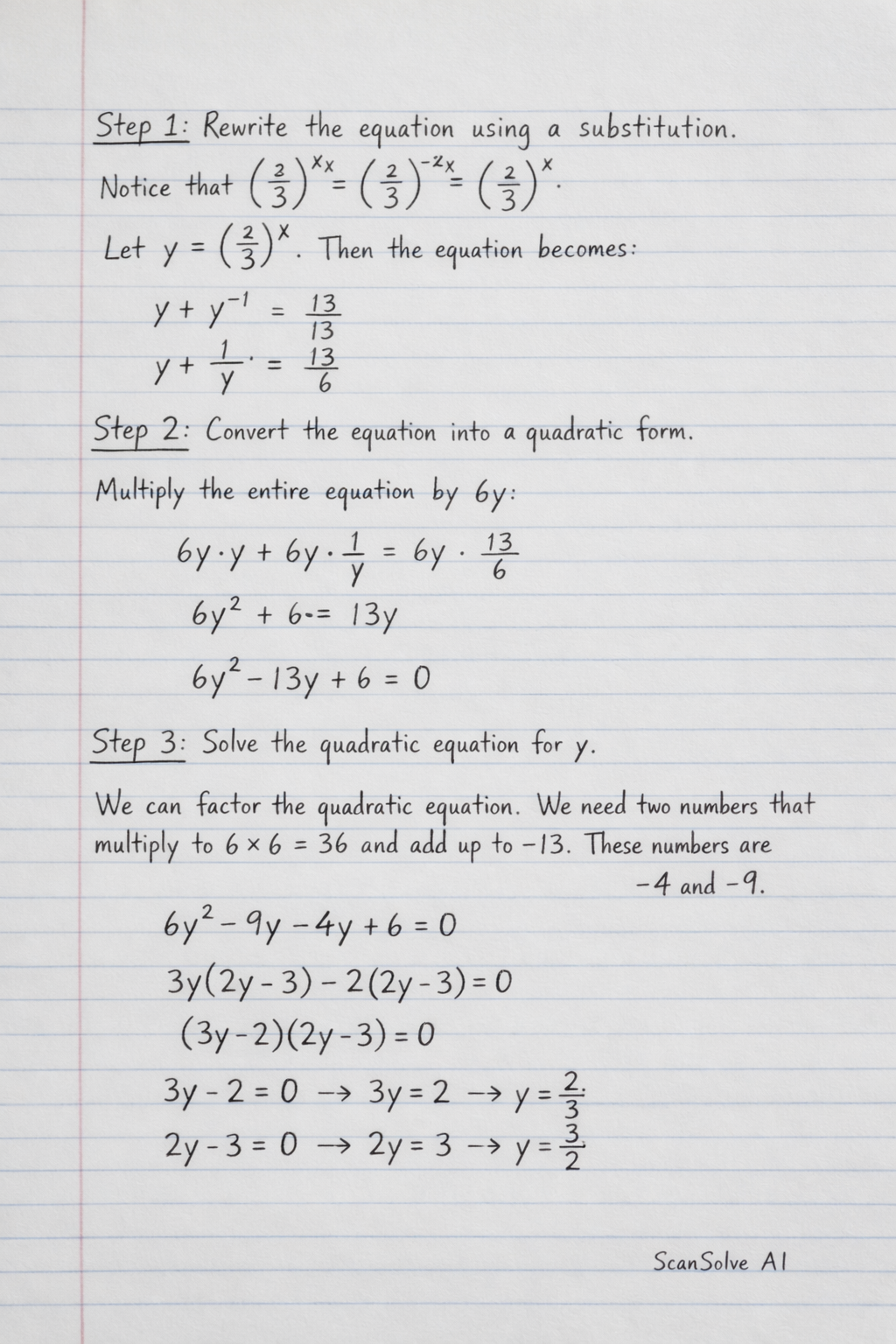
Handwritten Step-by-Step Solution
Get this as a handwritten image on WhatsApp — like a tutor wrote it for you.
Try on WhatsApp