
We read your photo as:
Solve the equation 5 x 1 - (2)/(x y) + _x y = -1 for x.
ScanSolve AI Answer
Answer
Step-by-step solution
5 stepsSimplify the first term of the equation.
We know that for any valid base .
Therefore, .Rewrite the equation with the simplified term.
The equation becomes:
Introduce a substitution to simplify the equation.
Let .
Substitute P into the equation:Solve the equation for P.
Multiply the entire equation by P (assuming ):
Rearrange the terms to form a quadratic equation:
Factor the quadratic equation:
This gives two possible values for P:
Substitute back and solve for x in each case.
Case 1:
By the definition of logarithms, .
Taking the square root of both sides, and considering that the base of a logarithm must be positive ():
Case 2:
By the definition of logarithms, .
The solutions for x are:
Try one yourself
A new problem that tests the same skill.
Still stuck on this one?
Ask a follow-up, and the answer starts from this question.
More Mathematics Questions
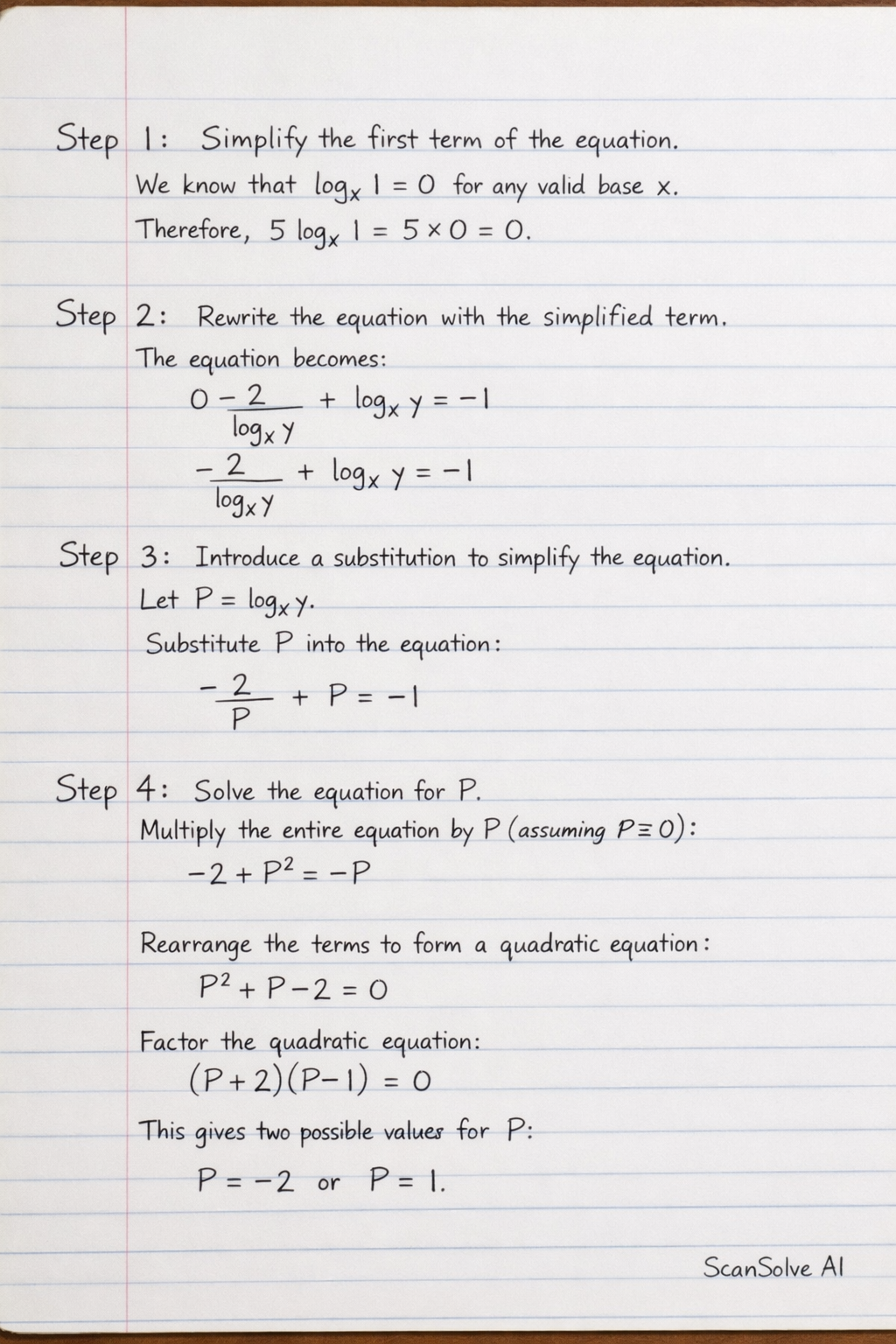
Handwritten Step-by-Step Solution
Get this as a handwritten image on WhatsApp — like a tutor wrote it for you.
Try on WhatsApp