We read your photo as:

Solve the equation (jx)/(1+jy) = (3x+j4)/(x+3y) and express z = (a+jb)/(c+jd) in the form X+jY.

Mathematics

ScanSolve AI Answer

Answers

4 parts
10

x=2,y=32andx=−2,y=−32x=2, y=\frac{3}{2} \quad \text{and} \quad x=-2, y=-\frac{3}{2}

a

cd=ab\frac{c}{d} = \frac{a}{b}

b

ab=−dc\frac{a}{b} = -\frac{d}{c}

12

a=32,b=−52a=\frac{3}{2}, b=-\frac{5}{2}

Step-by-step solution

14 steps

Here are the solutions to the problems:

Part 10· 4 steps

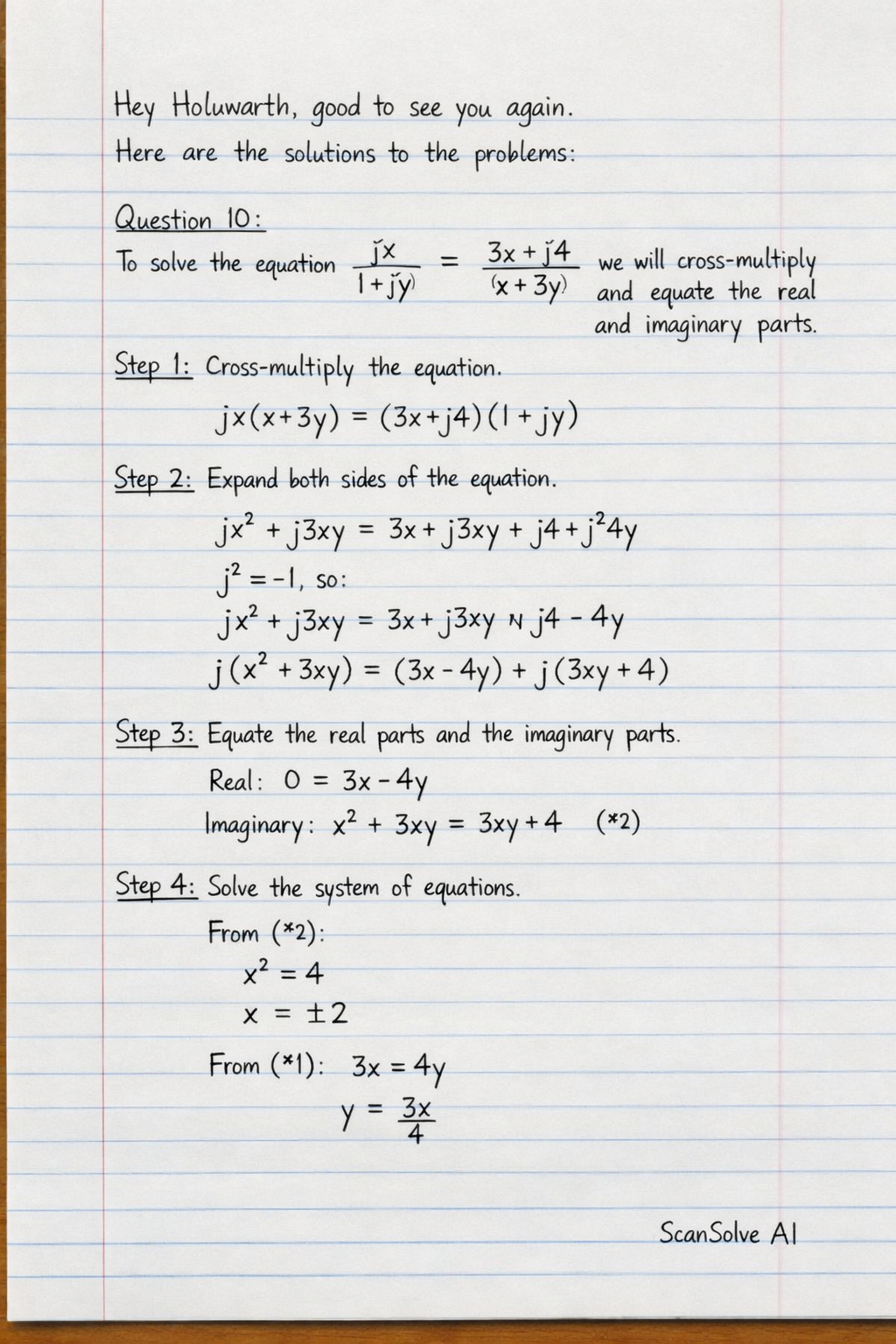
To solve the equation jx1+jy=3x+j4x+3y\frac{jx}{1+jy} = \frac{3x+j4}{x+3y}, we will cross-multiply and equate the real and imaginary parts.

  1. Cross-multiply the equation.

    jx(x+3y)=(3x+j4)(1+jy)jx(x+3y) = (3x+j4)(1+jy)
  2. Expand both sides of the equation.

    jx2+j3xy=3x+j3xy+j4+j24yjx^2 + j3xy = 3x + j3xy + j4 + j^24y

    Since j2=−1j^2 = -1, substitute this into the equation:

    jx2+j3xy=3x+j3xy+j4−4yjx^2 + j3xy = 3x + j3xy + j4 - 4y

    Rearrange the right side to group real and imaginary terms:

    j(x2+3xy)=(3x−4y)+j(3xy+4)j(x^2 + 3xy) = (3x - 4y) + j(3xy + 4)
  3. Equate the real parts and the imaginary parts.

    Equating the real parts:

    0=3x−4y(∗1)0 = 3x - 4y \quad (*1)

    Equating the imaginary parts:

    x2+3xy=3xy+4(∗2)x^2 + 3xy = 3xy + 4 \quad (*2)
  4. Solve the system of equations.

    From (∗2)(*2):

    x2=4x^2 = 4 x=±2x = \pm 2

    From (∗1)(*1), we have 3x=4y3x = 4y, so y=3x4y = \frac{3x}{4}.

    Case 1: If x=2x=2

    y=3(2)4=64=32y = \frac{3(2)}{4} = \frac{6}{4} = \frac{3}{2}

    Case 2: If x=−2x=-2

    y=3(−2)4=−64=−32y = \frac{3(-2)}{4} = \frac{-6}{4} = -\frac{3}{2}

    The solutions are:

    x=2,y=32andx=−2,y=−32\boxed{x=2, y=\frac{3}{2} \quad \text{and} \quad x=-2, y=-\frac{3}{2}}

Part 11· 1 step

Given z=a+jbc+jdz = \frac{a+jb}{c+jd}, where a,b,c,da, b, c, d are real quantities.

  1. Express zz in the form X+jYX+jY by multiplying the numerator and denominator by the conjugate of the denominator.

    z=a+jbc+jd×c−jdc−jdz = \frac{a+jb}{c+jd} \times \frac{c-jd}{c-jd} z=(a+jb)(c−jd)c2−(jd)2z = \frac{(a+jb)(c-jd)}{c^2 - (jd)^2} z=ac−ajd+jbc−j2bdc2−j2d2z = \frac{ac - ajd + jbc - j^2bd}{c^2 - j^2d^2}

    Since j2=−1j^2 = -1:

    z=ac−ajd+jbc+bdc2+d2z = \frac{ac - ajd + jbc + bd}{c^2 + d^2}

    Group the real and imaginary parts:

    z=(ac+bd)+j(bc−ad)c2+d2z = \frac{(ac+bd) + j(bc-ad)}{c^2+d^2} z=ac+bdc2+d2+jbc−adc2+d2z = \frac{ac+bd}{c^2+d^2} + j\frac{bc-ad}{c^2+d^2}

    Here, the real part is X=ac+bdc2+d2X = \frac{ac+bd}{c^2+d^2} and the imaginary part is Y=bc−adc2+d2Y = \frac{bc-ad}{c^2+d^2}.

Part a

cd=ab\frac{c}{d} = \frac{a}{b}

If zz is real

  1. If zz is real, its imaginary part must be zero.

    Y=0Y = 0 bc−adc2+d2=0\frac{bc-ad}{c^2+d^2} = 0

    Since c2+d2≠0c^2+d^2 \neq 0, the numerator must be zero:

    bc−ad=0bc-ad = 0 bc=adbc = ad

    Divide both sides by bdbd (assuming b≠0b \neq 0 and d≠0d \neq 0):

    bcbd=adbd\frac{bc}{bd} = \frac{ad}{bd} cd=ab\boxed{\frac{c}{d} = \frac{a}{b}}

Part b

ab=−dc\frac{a}{b} = -\frac{d}{c}

If zz is entirely imaginary

  1. If zz is entirely imaginary, its real part must be zero.

    X=0X = 0 ac+bdc2+d2=0\frac{ac+bd}{c^2+d^2} = 0

    Since c2+d2≠0c^2+d^2 \neq 0, the numerator must be zero:

    ac+bd=0ac+bd = 0 ac=−bdac = -bd

    Divide both sides by bcbc (assuming b≠0b \neq 0 and c≠0c \neq 0):

    acbc=−bdbc\frac{ac}{bc} = \frac{-bd}{bc} ab=−dc\boxed{\frac{a}{b} = -\frac{d}{c}}

Part 12

a=32,b=−52a=\frac{3}{2}, b=-\frac{5}{2}

Given the equation (a+b)+j(a−b)=(1+j)2+j(2+j)(a+b)+j(a-b) = (1+j)^2 + j(2+j), we need to find the values of aa and bb.

  1. Simplify the right-hand side (RHS) of the equation.

    (1+j)2+j(2+j)(1+j)^2 + j(2+j)
  2. Expand (1+j)2(1+j)^2.

    (1+j)2=12+2(1)(j)+j2(1+j)^2 = 1^2 + 2(1)(j) + j^2 =1+2j−1= 1 + 2j - 1 =2j= 2j
  3. Expand j(2+j)j(2+j).

    j(2+j)=2j+j2j(2+j) = 2j + j^2 =2j−1= 2j - 1
  4. Combine the simplified terms for the RHS.

    RHS=(2j)+(2j−1)\text{RHS} = (2j) + (2j - 1) RHS=−1+4j\text{RHS} = -1 + 4j
  5. Equate the left-hand side (LHS) with the simplified RHS.

    (a+b)+j(a−b)=−1+4j(a+b)+j(a-b) = -1 + 4j
  6. Equate the real parts and the imaginary parts.

    Equating the real parts:

    a+b=−1(∗1)a+b = -1 \quad (*1)

    Equating the imaginary parts:

    a−b=4(∗2)a-b = 4 \quad (*2)
  7. Solve the system of linear equations for aa and bb.

    Add (∗1)(*1) and (∗2)(*2):

    (a+b)+(a−b)=−1+4(a+b) + (a-b) = -1 + 4 2a=32a = 3 a=32a = \frac{3}{2}

    Substitute a=32a = \frac{3}{2} into (∗1)(*1):

    32+b=−1\frac{3}{2} + b = -1 b=−1−32b = -1 - \frac{3}{2} b=−22−32b = -\frac{2}{2} - \frac{3}{2} b=−52b = -\frac{5}{2}

    The values of aa and bb are:

    a=32,b=−52\boxed{a=\frac{3}{2}, b=-\frac{5}{2}}
Was this helpful?

Try one yourself

A new problem that tests the same skill.

Still stuck on this one?

Ask a follow-up, and the answer starts from this question.

Got a different question?Ask your own question
Handwritten step-by-step solution preview

Handwritten Step-by-Step Solution

Get this as a handwritten image on WhatsApp — like a tutor wrote it for you.

Try on WhatsApp