Find the equation passing through A(2, 4) and B(5, 13) in form y = mx + c. Solve the equation √x + 2 = x2

Mathematics
Find the equation passing through A(2, 4) and B(5, 13) in form y = mx + c. Solve the equation √x + 2 = x2

ScanSolve AI Answer

Answer

y = 3x - 2

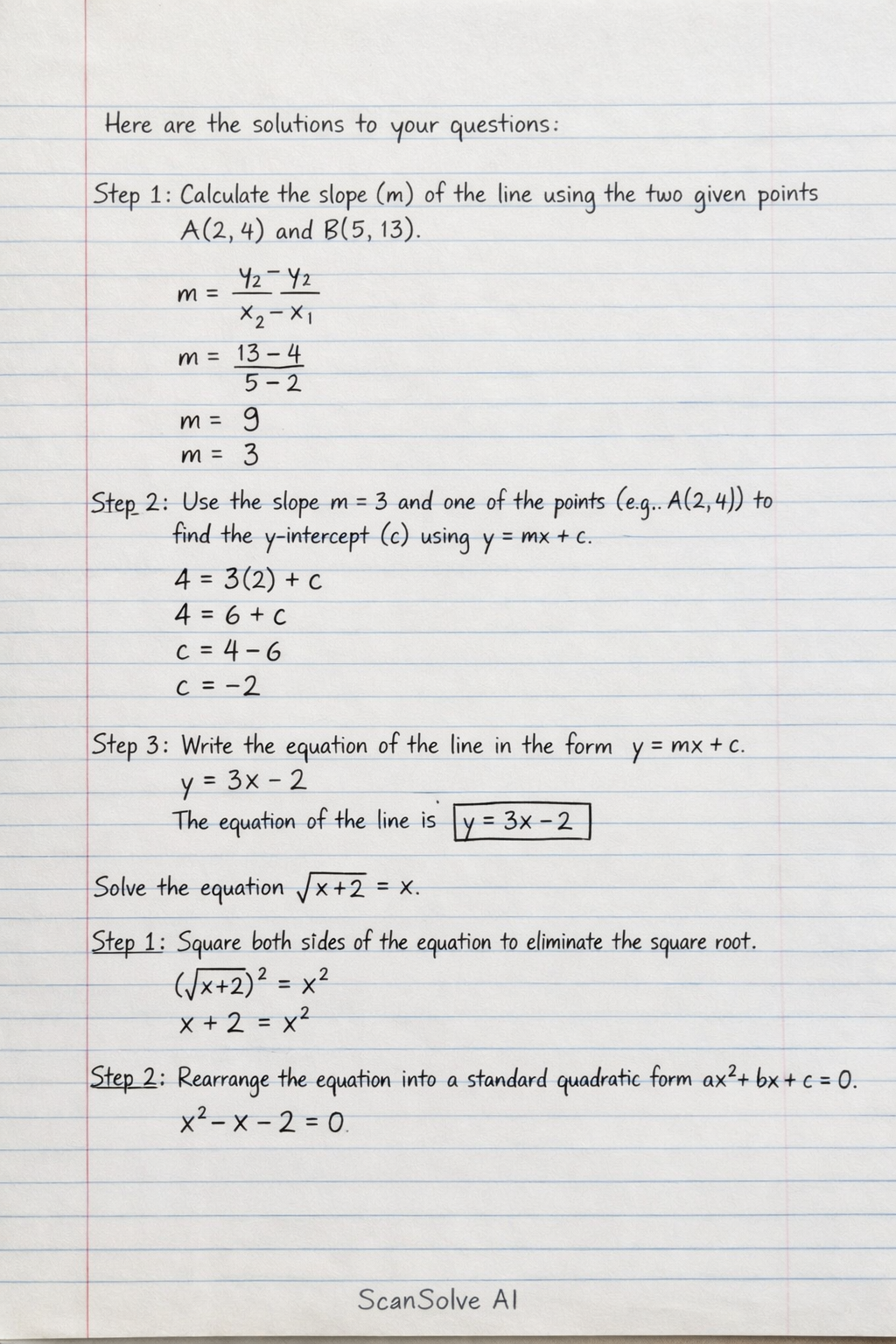
Here are the solutions to your questions:

Find the equation passing through A(2, 4) and B(5, 13) in form y=mx+cy = mx + c.

Step 1: Calculate the slope (mm) of the line using the two given points A(x1,y1)=(2,4)(x_1, y_1) = (2, 4) and B(x2,y2)=(5,13)(x_2, y_2) = (5, 13). m=y2y1x2x1m = \frac{y_2 - y_1}{x_2 - x_1} m=13452m = \frac{13 - 4}{5 - 2} m=93m = \frac{9}{3} m=3m = 3

Step 2: Use the slope m=3m=3 and one of the points (e.g., A(2, 4)) to find the y-intercept (cc) using the equation y=mx+cy = mx + c. 4=3(2)+c4 = 3(2) + c 4=6+c4 = 6 + c c=46c = 4 - 6 c=2c = -2

Step 3: Write the equation of the line in the form y=mx+cy = mx + c. y=3x2y = 3x - 2 The equation of the line is y=3x2\boxed{y = 3x - 2}.

Solve the equation x+2=x\sqrt{x+2} = x.

Step 1: Square both sides of the equation to eliminate the square root. (x+2)2=x2(\sqrt{x+2})^2 = x^2 x+2=x2x+2 = x^2

Step 2: Rearrange the equation into a standard quadratic form ax2+bx+c=0ax^2 + bx + c = 0. x2x2=0x^2 - x - 2 = 0

Step 3: Solve the quadratic equation by factoring. (x2)(x+1)=0(x - 2)(x + 1) = 0 This gives two possible solutions: x2=0    x=2x - 2 = 0 \implies x = 2 x+1=0    x=1x + 1 = 0 \implies x = -1

Step 4: Check both possible solutions in the original equation x+2=x\sqrt{x+2} = x to identify any extraneous solutions. For x=2x = 2: 2+2=4=2\sqrt{2+2} = \sqrt{4} = 2 2=22 = 2 This solution is valid.

For x=1x = -1: 1+2=1=1\sqrt{-1+2} = \sqrt{1} = 1 111 \neq -1 This solution is extraneous because the square root symbol \sqrt{} denotes the principal (non-negative) square root.

The only valid solution is x=2\boxed{x = 2}.

What's next?

Was this helpful?

Need help with your own homework?

Get instant step-by-step solutions to any question. Free to start.

Ask Your Question
Handwritten step-by-step solution preview

Handwritten Step-by-Step Solution

Get this as a handwritten image on WhatsApp — like a tutor wrote it for you.

Try on WhatsApp

Still have questions?

Quick Answer

Find the equation passing through A(2, 4) and B(5, 13) in form y = mx + c. Step 1: Calculate the slope (m) of the line using the two given points A(x_1, y_1) = (2, 4) and B(x_2, y_2) = (5, 13).

Find the equation passing through A(2, 4) and B(5, 13) in form y = mx + c. Solve the equation √x + 2 = x2
Mathematics

This mathematics problem involves applying core mathematical principles and formulas. Below you will find a complete step-by-step solution with detailed explanations for each step, helping you understand not just the answer but the method behind it.

ScanSolve AI Answer
Here are the solutions to your questions: Find the equation passing through A(2, 4) and B(5, 13) in form y = mx + c. Step 1: Calculate the slope (m) of the line using the two given points A(x_1, y_1) = (2, 4) and B(x_2, y_2) = (5, 13). m = (y_2 - y_1)/(x_2 - x_1) m = (13 - 4)/(5 - 2) m = (9)/(3) m = 3 Step 2: Use the slope m=3 and one of the points (e.g., A(2, 4)) to find the y-intercept (c) using the equation y = mx + c. 4 = 3(2) + c 4 = 6 + c c = 4 - 6 c = -2 Step 3: Write the equation of the line in the form y = mx + c. y = 3x - 2 The equation of the line is y = 3x - 2. Solve the equation sqrt(x+2) = x. Step 1: Square both sides of the equation to eliminate the square root. (sqrt(x+2))^2 = x^2 x+2 = x^2 Step 2: Rearrange the equation into a standard quadratic form ax^2 + bx + c = 0. x^2 - x - 2 = 0 Step 3: Solve the quadratic equation by factoring. (x - 2)(x + 1) = 0 This gives two possible solutions: x - 2 = 0 x = 2 x + 1 = 0 x = -1 Step 4: Check both possible solutions in the original equation sqrt(x+2) = x to identify any extraneous solutions. For x = 2: sqrt(2+2) = sqrt(4) = 2 2 = 2 This solution is valid. For x = -1: sqrt(-1+2) = sqrt(1) = 1 1 ≠ -1 This solution is extraneous because the square root symbol sqrt() denotes the principal (non-negative) square root. The only valid solution is x = 2. What's next?