
Estimate the perimeter of the land to the nearest meter. Draw straight lines joining adjacent points and use Pythagorean theorem to find the lengths QA,AR,BS,BP,QP,and ,RS
ScanSolve AI Answer
Answer
Step-by-step solution
4 stepsTo estimate the perimeter of the land, we need to calculate the length of each segment forming its boundary and then sum them up. We will use the Pythagorean theorem (distance formula) for each segment.
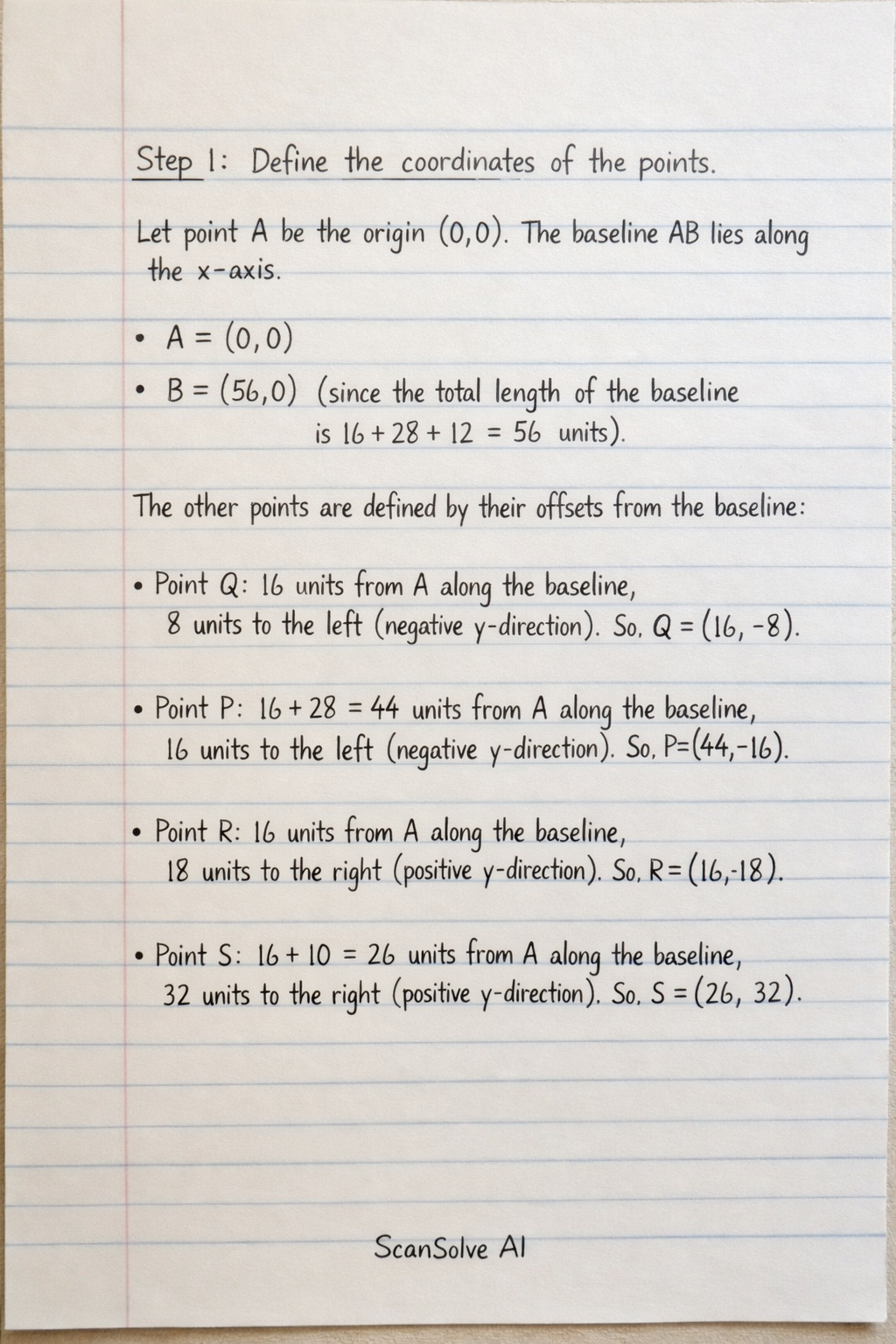
Define the coordinates of the points.
Let point A be the origin . The baseline AB lies along the x-axis.
- A =
- B = (since the total length of the baseline is units)
The other points are defined by their offsets from the baseline:
- Point Q: 16 units from A along the baseline, 8 units to the left (negative y-direction). So, Q = .
- Point P: units from A along the baseline, 16 units to the left (negative y-direction). So, P = .
- Point R: 16 units from A along the baseline, 18 units to the right (positive y-direction). So, R = .
- Point S: units from A along the baseline, 32 units to the right (positive y-direction). So, S = .
Calculate the length of each segment using the distance formula .
-
Length QA: A = , Q =
-
Length QP: Q = , P =
-
Length PB: P = , B =
-
Length BS: B = , S =
-
Length SR: S = , R =
-
Length RA: R = , A =
-
Sum the lengths of all segments to find the total perimeter.
Round the perimeter to the nearest meter.
The estimated perimeter of the land is 152 meters.
The perimeter of the land is .
Try one yourself
A new problem that tests the same skill.
Still stuck on this one?
Ask a follow-up, and the answer starts from this question.
More Mathematics Questions
Handwritten Step-by-Step Solution
Get this as a handwritten image on WhatsApp — like a tutor wrote it for you.
Try on WhatsApp