

This mathematics problem involves applying core mathematical principles and formulas. Below you will find a complete step-by-step solution with detailed explanations for each step, helping you understand not just the answer but the method behind it.
ScanSolve AI Answer
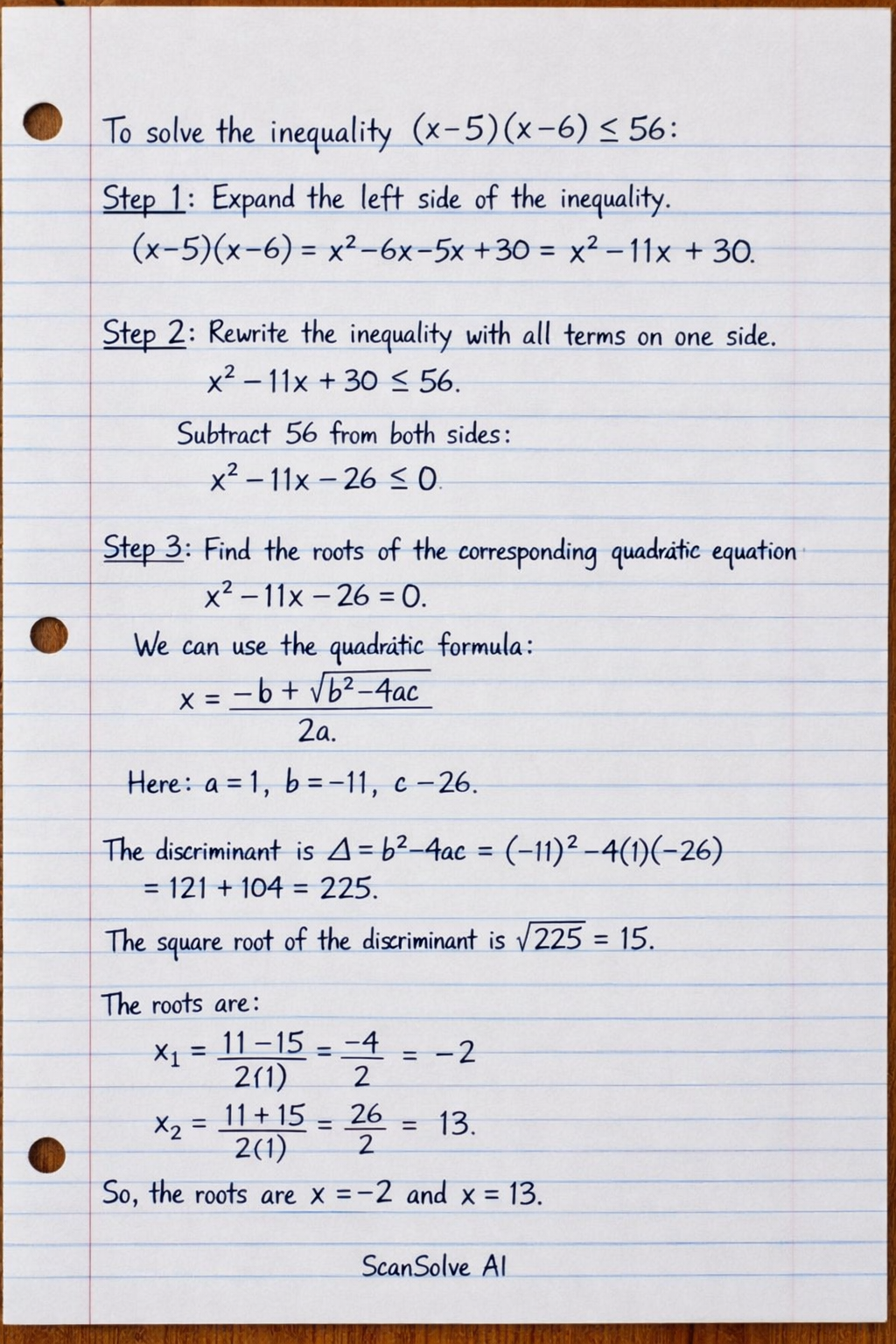
To solve the inequality (x - 5)(x - 6) 56: Step 1: Expand the left side of the inequality. (x - 5)(x - 6) = x^2 - 6x - 5x + 30 = x^2 - 11x + 30 Step 2: Rewrite the inequality with all terms on one side. x^2 - 11x + 30 56 Subtract 56 from both sides: x^2 - 11x + 30 - 56 0 x^2 - 11x - 26 0 Step 3: Find the roots of the corresponding quadratic equation x^2 - 11x - 26 = 0. We can use the quadratic formula x = -b ± sqrt(b^2 - 4ac)2a. Here, a=1, b=-11, c=-26. The discriminant is = b^2 - 4ac = (-11)^2 - 4(1)(-26) = 121 + 104 = 225. The square root of the discriminant is sqrt(225) = 15. The roots are: x_1 = (-(-11) - 15)/(2(1)) = (11 - 15)/(2) = (-4)/(2) = -2 x_2 = (-(-11) + 15)/(2(1)) = (11 + 15)/(2) = (26)/(2) = 13 So, the roots are x = -2 and x = 13. Step 4: Determine the intervals where the inequality x^2 - 11x - 26 0 holds true. Since the coefficient of x^2 is positive (a=1), the parabola opens upwards. This means the quadratic expression is less than or equal to zero between its roots, inclusive. Therefore, the solution to the inequality is: -2 x 13 The final answer is -2 x 13.