

This mathematics problem involves applying core mathematical principles and formulas. Below you will find a complete step-by-step solution with detailed explanations for each step, helping you understand not just the answer but the method behind it.
ScanSolve AI Answer
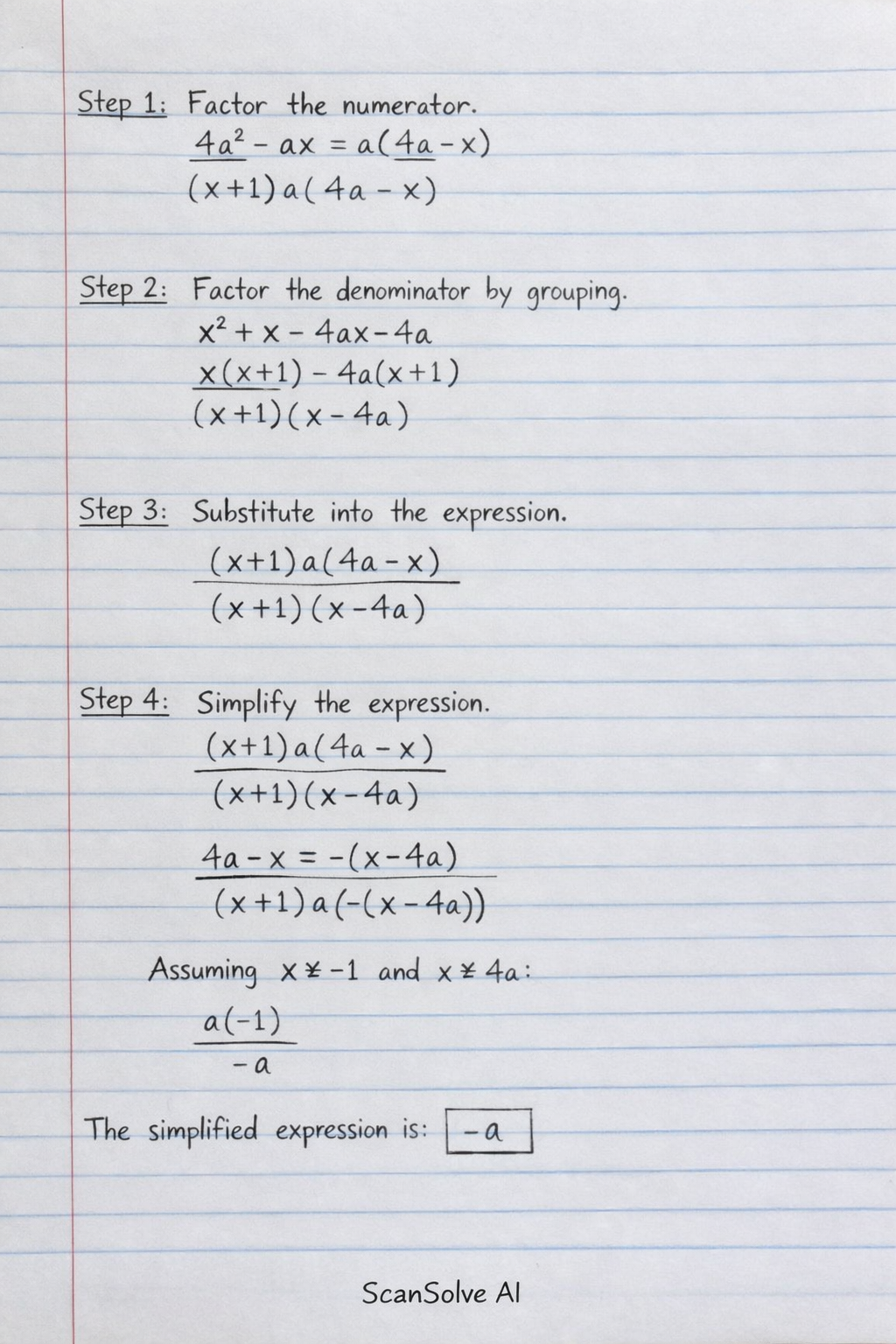
You're on a roll — Step 1: Factor the numerator. The numerator is (x+1)(4a^2 - ax). Factor out a from the second term (4a^2 - ax): 4a^2 - ax = a(4a - x) So the numerator becomes: (x+1)a(4a - x) Step 2: Factor the denominator by grouping. The denominator is x^2 - 4ax - 4a + x. Rearrange the terms to group common factors: x^2 + x - 4ax - 4a Factor x from the first two terms and -4a from the last two terms: x(x+1) - 4a(x+1) Now, factor out the common term (x+1): (x+1)(x - 4a) Step 3: Substitute the factored forms back into the original expression. ((x+1)a(4a - x))/((x+1)(x - 4a)) Step 4: Simplify the expression. Notice that (4a - x) is the negative of (x - 4a), i.e., (4a - x) = -(x - 4a). Substitute this into the expression: ((x+1)a(-(x - 4a)))/((x+1)(x - 4a)) Assuming x ≠ -1 and x ≠ 4a, we can cancel out the common factors (x+1) and (x - 4a): a(-1) -a The simplified expression is -a. 4 down, 1 left today. What's next?