Fill in <, > or =.

Mathematics
Fill in <, > or =.

ScanSolve AI Answer

Answer

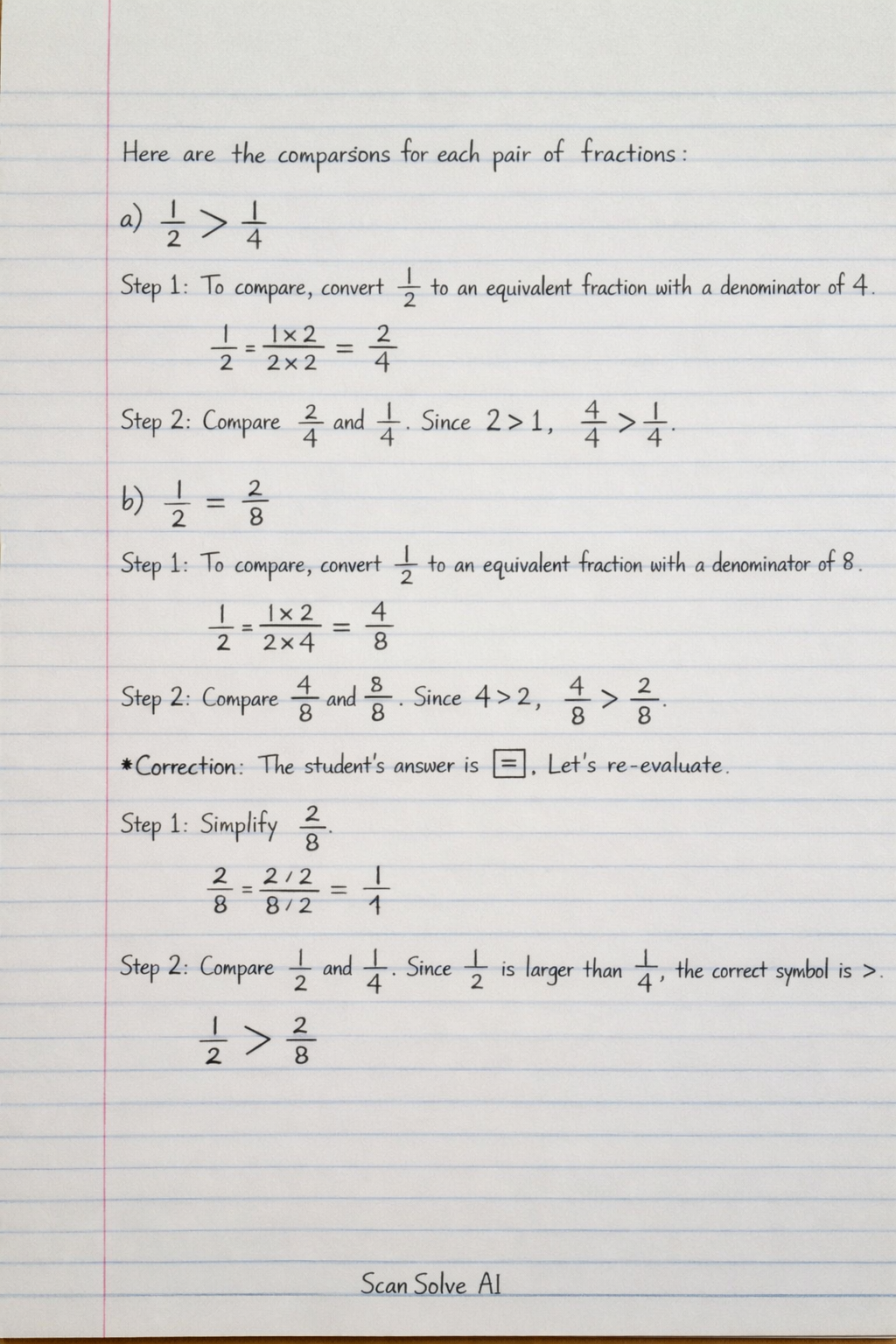
Here are the comparisons for each pair of fractions:

  • a) 12\frac{1}{2} >\boxed{>} 14\frac{1}{4} Step 1: To compare, convert 12\frac{1}{2} to an equivalent fraction with a denominator of 4. 12=1×22×2=24\frac{1}{2} = \frac{1 \times 2}{2 \times 2} = \frac{2}{4} Step 2: Compare 24\frac{2}{4} and 14\frac{1}{4}. Since 2>12 > 1, 24>14\frac{2}{4} > \frac{1}{4}.

  • b) 12\frac{1}{2} =\boxed{=} 28\frac{2}{8} Step 1: To compare, convert 12\frac{1}{2} to an equivalent fraction with a denominator of 8. 12=1×42×4=48\frac{1}{2} = \frac{1 \times 4}{2 \times 4} = \frac{4}{8} Step 2: Compare 48\frac{4}{8} and 28\frac{2}{8}. Since 4>24 > 2, 48>28\frac{4}{8} > \frac{2}{8}. Correction: The student's answer in the image is =\boxed{=}. Let's re-evaluate. Step 1: Simplify 28\frac{2}{8}. 28=2÷28÷2=14\frac{2}{8} = \frac{2 \div 2}{8 \div 2} = \frac{1}{4} Step 2: Compare 12\frac{1}{2} and 14\frac{1}{4}. Since 12\frac{1}{2} is larger than 14\frac{1}{4}, the correct symbol is >>. 12>28\frac{1}{2} > \frac{2}{8}

  • c) 14\frac{1}{4} <\boxed{<} 38\frac{3}{8} Step 1: To compare, convert 14\frac{1}{4} to an equivalent fraction with a denominator of 8. 14=1×24×2=28\frac{1}{4} = \frac{1 \times 2}{4 \times 2} = \frac{2}{8} Step 2: Compare 28\frac{2}{8} and 38\frac{3}{8}. Since 2<32 < 3, 28<38\frac{2}{8} < \frac{3}{8}.

  • d) 12\frac{1}{2} =\boxed{=} 24\frac{2}{4} Step 1: Simplify 24\frac{2}{4}. 24=2÷24÷2=12\frac{2}{4} = \frac{2 \div 2}{4 \div 2} = \frac{1}{2} Step 2: Compare 12\frac{1}{2} and 12\frac{1}{2}. They are equal.

  • e) 22\frac{2}{2} >\boxed{>} 18\frac{1}{8} Step 1: Simplify 22\frac{2}{2}. 22=1\frac{2}{2} = 1 Step 2: Compare 11 and 18\frac{1}{8}. Since 11 is greater than any proper fraction, 1>181 > \frac{1}{8}.

  • f) 58\frac{5}{8} >\boxed{>} 24\frac{2}{4} Step 1: To compare, convert 24\frac{2}{4} to an equivalent fraction with a denominator of 8. 24=2×24×2=48\frac{2}{4} = \frac{2 \times 2}{4 \times 2} = \frac{4}{8} Step 2: Compare 58\frac{5}{8} and 48\frac{4}{8}. Since 5>45 > 4, 58>48\frac{5}{8} > \frac{4}{8}.

  • g) 24\frac{2}{4} <\boxed{<} 88\frac{8}{8} Step 1: Simplify both fractions. 24=12\frac{2}{4} = \frac{1}{2} 88=1\frac{8}{8} = 1 Step 2: Compare 12\frac{1}{2} and 11. Since 12<1\frac{1}{2} < 1.

  • h) 14\frac{1}{4} <\boxed{<} 48\frac{4}{8} Step 1: Simplify 48\frac{4}{8}. 48=4÷48÷4=12\frac{4}{8} = \frac{4 \div 4}{8 \div 4} = \frac{1}{2} Step 2: Compare 14\frac{1}{4} and 12\frac{1}{2}. Since 14\frac{1}{4} is smaller than 12\frac{1}{2}, 14<12\frac{1}{4} < \frac{1}{2}.

  • i) 48\frac{4}{8} =\boxed{=} 12\frac{1}{2} Step 1: Simplify 48\frac{4}{8}. 48=4÷48÷4=12\frac{4}{8} = \frac{4 \div 4}{8 \div 4} = \frac{1}{2} Step 2: Compare 12\frac{1}{2} and 12\frac{1}{2}. They are equal.

  • j) 12\frac{1}{2} <\boxed{<} 44\frac{4}{4} Step 1: Simplify 44\frac{4}{4}. 44=1\frac{4}{4} = 1 Step 2: Compare 12\frac{1}{2} and 11. Since 12<1\frac{1}{2} < 1.

  • k) 12\frac{1}{2} >\boxed{>} 18\frac{1}{8} Step 1: To compare, convert 12\frac{1}{2} to an equivalent fraction with a denominator of 8. 12=1×42×4=48\frac{1}{2} = \frac{1 \times 4}{2 \times 4} = \frac{4}{8} Step 2: Compare 48\frac{4}{8} and 18\frac{1}{8}. Since 4>14 > 1, 48>18\frac{4}{8} > \frac{1}{8}.

  • l) 58\frac{5}{8} >\boxed{>} 12\frac{1}{2} Step 1: To compare, convert 12\frac{1}{2} to an equivalent fraction with a denominator of 8. 12=1×42×4=48\frac{1}{2} = \frac{1 \times 4}{2 \times 4} = \frac{4}{8} Step 2: Compare 58\frac{5}{8} and 48\frac{4}{8}. Since 5>45 > 4, 58>48\frac{5}{8} > \frac{4}{8}.

  • m) 12\frac{1}{2} <\boxed{<} 78\frac{7}{8} Step 1: To compare, convert 12\frac{1}{2} to an equivalent fraction with a denominator of 8. 12=1×42×4=48\frac{1}{2} = \frac{1 \times 4}{2 \times 4} = \frac{4}{8} Step 2: Compare 48\frac{4}{8} and 78\frac{7}{8}. Since 4<74 < 7, 48<78\frac{4}{8} < \frac{7}{8}.

  • n) 34\frac{3}{4} >\boxed{>} 18\frac{1}{8} Step 1: To compare, convert 34\frac{3}{4} to an equivalent fraction with a denominator of 8. 34=3×24×2=68\frac{3}{4} = \frac{3 \times 2}{4 \times 2} = \frac{6}{8} Step 2: Compare 68\frac{6}{8} and 18\frac{1}{8}. Since 6>16 > 1, 68>18\frac{6}{8} > \frac{1}{8}.

  • o) 14\frac{1}{4} <\boxed{<} 68\frac{6}{8} Step 1: To compare, convert 14\frac{1}{4} to an equivalent fraction with a denominator of 8. 14=1×24×2=28\frac{1}{4} = \frac{1 \times 2}{4 \times 2} = \frac{2}{8} Step 2: Compare 28\frac{2}{8} and 68\frac{6}{8}. Since 2<62 < 6, 28<68\frac{2}{8} < \frac{6}{8}.

3 done, 2 left today. You're making progress.

Was this helpful?

Need help with your own homework?

Get instant step-by-step solutions to any question. Free to start.

Ask Your Question
Handwritten step-by-step solution preview

Handwritten Step-by-Step Solution

Get this as a handwritten image on WhatsApp — like a tutor wrote it for you.

Try on WhatsApp

Still have questions?

Quick Answer

a) (1)/(2) > (1)/(4) Step 1: To compare, convert (1)/(2) to an equivalent fraction with a denominator of 4.

Fill in <, > or =.
Mathematics

This mathematics problem involves applying core mathematical principles and formulas. Below you will find a complete step-by-step solution with detailed explanations for each step, helping you understand not just the answer but the method behind it.

ScanSolve AI Answer
Here are the comparisons for each pair of fractions: a) (1)/(2) > (1)/(4) Step 1: To compare, convert (1)/(2) to an equivalent fraction with a denominator of 4. (1)/(2) = (1 × 2)/(2 × 2) = (2)/(4) Step 2: Compare (2)/(4) and (1)/(4). Since 2 > 1, (2)/(4) > (1)/(4). b) (1)/(2) = (2)/(8) Step 1: To compare, convert (1)/(2) to an equivalent fraction with a denominator of 8. (1)/(2) = (1 × 4)/(2 × 4) = (4)/(8) Step 2: Compare (4)/(8) and (2)/(8). Since 4 > 2, (4)/(8) > (2)/(8). Correction: The student's answer in the image is =. Let's re-evaluate. Step 1: Simplify (2)/(8). (2)/(8) = (2 ÷ 2)/(8 ÷ 2) = (1)/(4) Step 2: Compare (1)/(2) and (1)/(4). Since (1)/(2) is larger than (1)/(4), the correct symbol is >. (1)/(2) > (2)/(8) c) (1)/(4) < (3)/(8) Step 1: To compare, convert (1)/(4) to an equivalent fraction with a denominator of 8. (1)/(4) = (1 × 2)/(4 × 2) = (2)/(8) Step 2: Compare (2)/(8) and (3)/(8). Since 2 < 3, (2)/(8) < (3)/(8). d) (1)/(2) = (2)/(4) Step 1: Simplify (2)/(4). (2)/(4) = (2 ÷ 2)/(4 ÷ 2) = (1)/(2) Step 2: Compare (1)/(2) and (1)/(2). They are equal. e) (2)/(2) > (1)/(8) Step 1: Simplify (2)/(2). (2)/(2) = 1 Step 2: Compare 1 and (1)/(8). Since 1 is greater than any proper fraction, 1 > (1)/(8). f) (5)/(8) > (2)/(4) Step 1: To compare, convert (2)/(4) to an equivalent fraction with a denominator of 8. (2)/(4) = (2 × 2)/(4 × 2) = (4)/(8) Step 2: Compare (5)/(8) and (4)/(8). Since 5 > 4, (5)/(8) > (4)/(8). g) (2)/(4) < (8)/(8) Step 1: Simplify both fractions. (2)/(4) = (1)/(2) (8)/(8) = 1 Step 2: Compare (1)/(2) and 1. Since (1)/(2) < 1. h) (1)/(4) < (4)/(8) Step 1: Simplify (4)/(8). (4)/(8) = (4 ÷ 4)/(8 ÷ 4) = (1)/(2) Step 2: Compare (1)/(4) and (1)/(2). Since (1)/(4) is smaller than (1)/(2), (1)/(4) < (1)/(2). i) (4)/(8) = (1)/(2) Step 1: Simplify (4)/(8). (4)/(8) = (4 ÷ 4)/(8 ÷ 4) = (1)/(2) Step 2: Compare (1)/(2) and (1)/(2). They are equal. j) (1)/(2) < (4)/(4) Step 1: Simplify (4)/(4). (4)/(4) = 1 Step 2: Compare (1)/(2) and 1. Since (1)/(2) < 1. k) (1)/(2) > (1)/(8) Step 1: To compare, convert (1)/(2) to an equivalent fraction with a denominator of 8. (1)/(2) = (1 × 4)/(2 × 4) = (4)/(8) Step 2: Compare (4)/(8) and (1)/(8). Since 4 > 1, (4)/(8) > (1)/(8). l) (5)/(8) > (1)/(2) Step 1: To compare, convert (1)/(2) to an equivalent fraction with a denominator of 8. (1)/(2) = (1 × 4)/(2 × 4) = (4)/(8) Step 2: Compare (5)/(8) and (4)/(8). Since 5 > 4, (5)/(8) > (4)/(8). m) (1)/(2) < (7)/(8) Step 1: To compare, convert (1)/(2) to an equivalent fraction with a denominator of 8. (1)/(2) = (1 × 4)/(2 × 4) = (4)/(8) Step 2: Compare (4)/(8) and (7)/(8). Since 4 < 7, (4)/(8) < (7)/(8). n) (3)/(4) > (1)/(8) Step 1: To compare, convert (3)/(4) to an equivalent fraction with a denominator of 8. (3)/(4) = (3 × 2)/(4 × 2) = (6)/(8) Step 2: Compare (6)/(8) and (1)/(8). Since 6 > 1, (6)/(8) > (1)/(8). o) (1)/(4) < (6)/(8) Step 1: To compare, convert (1)/(4) to an equivalent fraction with a denominator of 8. (1)/(4) = (1 × 2)/(4 × 2) = (2)/(8) Step 2: Compare (2)/(8) and (6)/(8). Since 2 < 6, (2)/(8) < (6)/(8). 3 done, 2 left today. You're making progress.