
We read your photo as:
Evaluate the following factorial expressions: a) 5! b) 8!/5! c) (10-3)!/(9-6)! d) (n-1)!/(n-3)! e) (n+2)!/(n+2)
ScanSolve AI Answer
Step-by-step solution
28 stepsHere are the solutions to the problems.
Examples: Evaluate
a) Evaluate $5!$
Expand the factorial.
Calculate the product.
The value is .
b) Evaluate
Expand the numerator until the denominator's factorial.
Cancel out the common factorial.
Calculate the product.
The value is .
c) Evaluate
Simplify the expressions inside the factorials.
Substitute the simplified factorials into the expression.
Cancel out the common factorial.
The value is .
d) Evaluate
Expand the numerator until the denominator's factorial.
Cancel out the common factorial.
The value is .
e) Evaluate
Expand the numerator.
Cancel out the common term.
The value is .
f) If , find the value of .
Find a common denominator for the left side, which is $9!$.
Substitute these into the equation.
Combine the terms on the left side.
Since the denominators are equal, the numerators must be equal.
The value of is .
Examples: Exponent of a Prime P in (n)!
The exponent of a prime in is given by Legendre's formula:a) Find the exponent of 5 in
Apply Legendre's formula for and .
Calculate the floor values.
Sum the values.
The exponent of 5 in is .
b) Find the exponent of 3 in
Apply Legendre's formula for and .
Calculate the floor values.
Sum the values.
The exponent of 3 in is .
c) Find the exponent of 7 in
Apply Legendre's formula for and .
Calculate the floor values.
Sum the values.
The exponent of 7 in is .
d) What is the highest power of 7 that can divide without leaving a remainder?
This is equivalent to finding the exponent of 7 in .Apply Legendre's formula for and .
Calculate the floor values.
Sum the values.
The highest power of 7 that can divide is .
The highest power is .
Still stuck on this one?
Ask a follow-up, and the answer starts from this question.
More Mathematics Questions
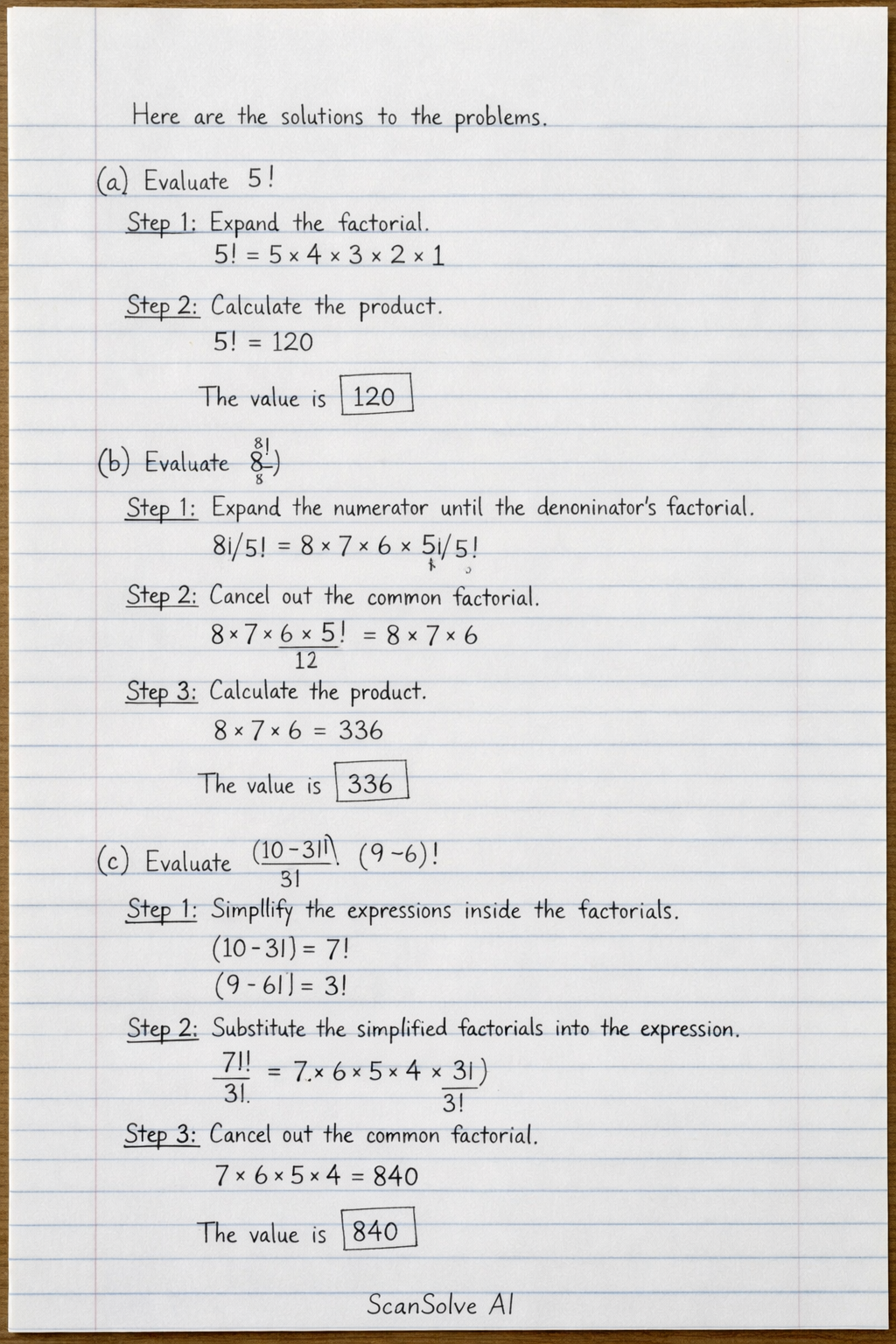
Handwritten Step-by-Step Solution
Get this as a handwritten image on WhatsApp — like a tutor wrote it for you.
Try on WhatsApp