
We read your photo as:
Evaluate the following limit problems: lim (sin x)/x as x approaches 0 lim (1-cos x)/(x2) as x approaches 0 lim (ln x)/x as x approaches infinity lim x/(e^x) as x approaches infinity
ScanSolve AI Answer
Step-by-step solution
19 stepshere are the solutions for these limit problems.
1. Evaluate:
This is a fundamental trigonometric limit.
The limit is .
2. Evaluate:
This is a fundamental trigonometric limit.
The limit is .
3. Evaluate:
As , both and , which is an indeterminate form .
Apply L'Hôpital's Rule.
Differentiate the numerator and the denominator.
Evaluate the limit.
The limit is .
4. Evaluate:
As , both and , which is an indeterminate form .
Apply L'Hôpital's Rule.
Differentiate the numerator and the denominator.
Evaluate the limit.
As , , so .
The limit is .
5. Evaluate:
This is a fundamental limit related to the exponential function.
The limit is .
6. Evaluate:
As , and , which is an indeterminate form .
Apply L'Hôpital's Rule.
Differentiate the numerator and the denominator.
Substitute into the expression.
The limit is .
7. Evaluate:
As , and , which is an indeterminate form .
Apply L'Hôpital's Rule.
This is still an indeterminate form since .
Apply L'Hôpital's Rule again.
This is still an indeterminate form .
Apply L'Hôpital's Rule a third time.
Substitute .
The limit is .
8. Evaluate:
As , both and , which is an indeterminate form .
Apply L'Hôpital's Rule.
This is still an indeterminate form .
Apply L'Hôpital's Rule again.
Evaluate the limit.
As , , so .
The limit is .
Still stuck on this one?
Ask a follow-up, and the answer starts from this question.
More Mathematics Questions
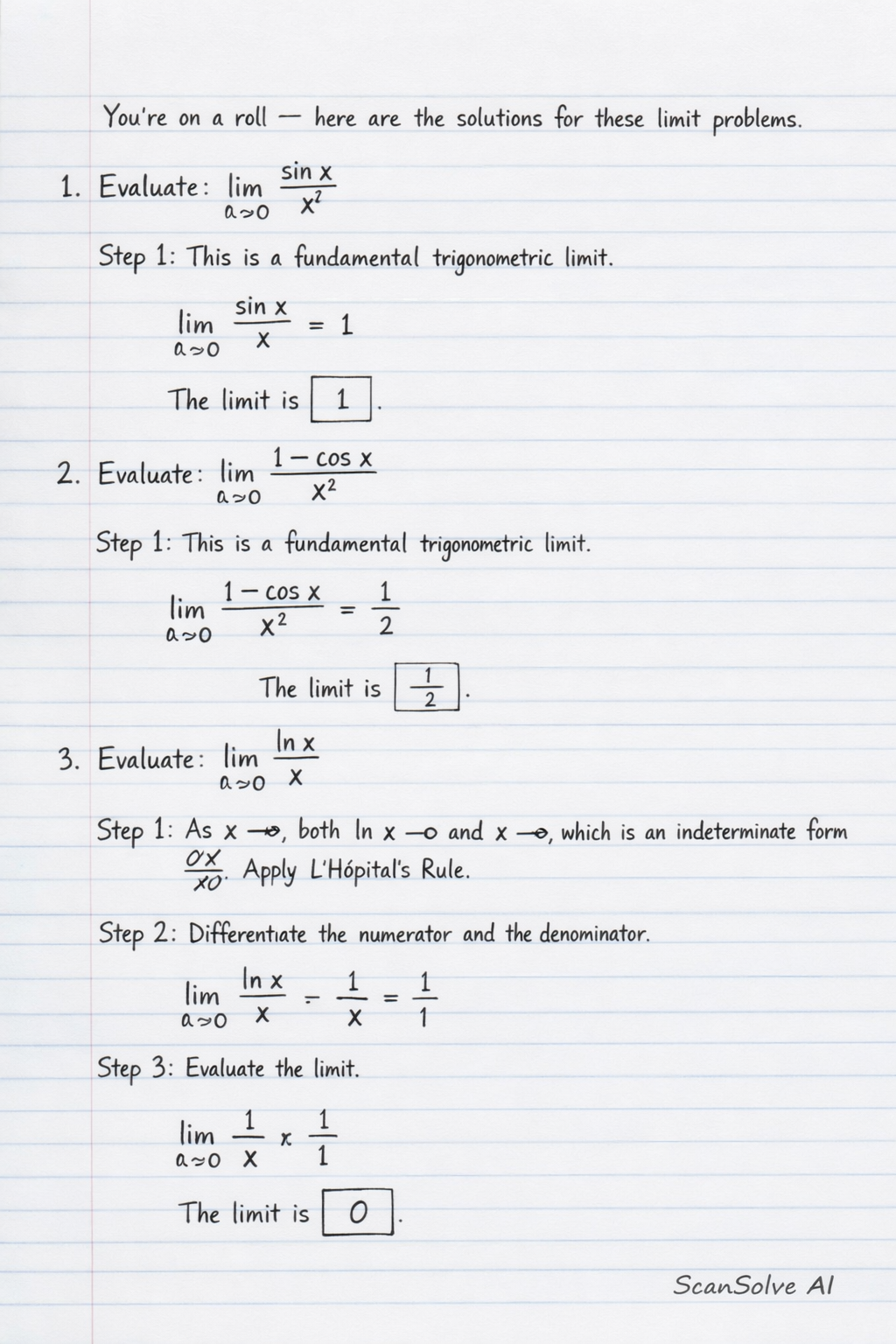
Handwritten Step-by-Step Solution
Get this as a handwritten image on WhatsApp — like a tutor wrote it for you.
Try on WhatsApp