
We read your photo as:
Solve the following problems: 1. A car's value decreased by 2/7 of its original value. If the original value was $7700, what is its new value? 2. If the LCM of two numbers is 2079 and their GCF is 27,
ScanSolve AI Answer
Answer
Step-by-step solution
13 stepsHere are the solutions to the problems.
1.
Calculate the amount by which the car's value decreased.
The value decreased by of its original value.
Calculate the new value of the car.
The new value is the original value minus the decrease. The correct option is B.
The new value of the car is\boxed{\text{\5500}}$.2.
Recall the relationship between LCM, GCF, and two numbers.
For two numbers and , their product is equal to the product of their LCM and GCF:
Substitute the given values into the formula.
Given , , and .
Solve for the other number, .
We can simplify by noting that .
The correct option is E.
The other number is .3.
Evaluate the division inside the first parenthesis.
Evaluate the multiplication inside the second parenthesis.
Substitute these results back into the original expression.
Perform the addition and subtraction from left to right.
The correct option is B.
The evaluated expression is .4.
Define the original fraction using a variable.
Let the numerator of the original fraction be .
The denominator exceeds the numerator by 3, so the denominator is .
The original fraction is .Set up an equation based on the given condition.
If 1 is added to the numerator, the new numerator is . The denominator remains unchanged.
The new fraction is .
This new fraction is equal to .Solve the equation for .
Cross-multiply:
Subtract from both sides:
Subtract 4 from both sides:
Find the original fraction.
The numerator is .
The denominator is .
The original fraction is .
The correct option is A (or C, as they are identical).
The original fraction is .
Try one yourself
A new problem that tests the same skill.
Still stuck on this one?
Ask a follow-up, and the answer starts from this question.
More Mathematics Questions
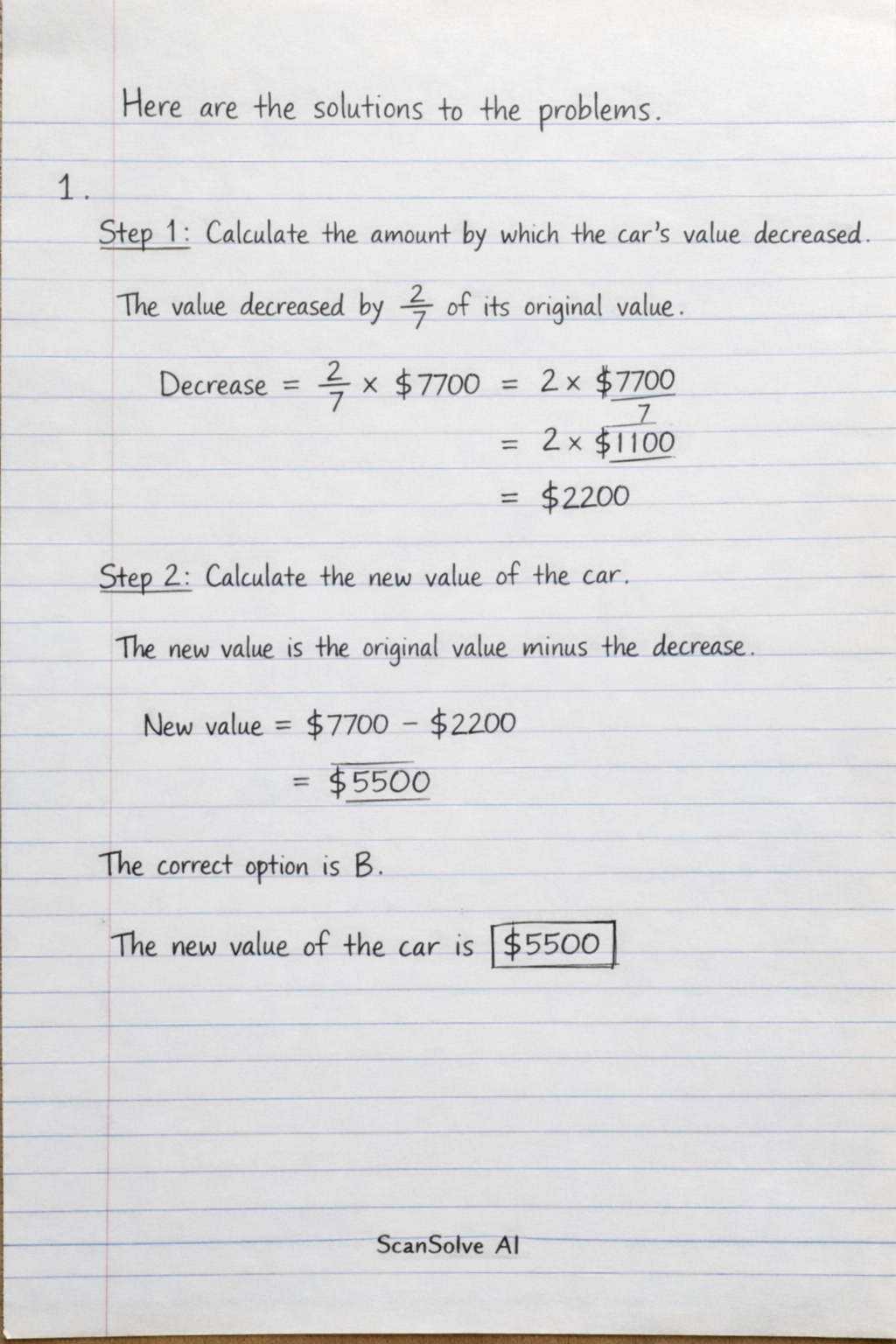
Handwritten Step-by-Step Solution
Get this as a handwritten image on WhatsApp — like a tutor wrote it for you.
Try on WhatsApp