
We read your photo as:
For any two events, A and B, it is given that P(A and B) = 0,12, P(A or B) = 0,83 and P(B) = 4 P(A). Are events A and B mutually exclusive? Justify your answer. Calculate P(B). Calculate P(not A).
ScanSolve AI Answer
Step-by-step solution
7 steps9.2.1 Are events A and B mutually exclusive? Justify your answer.
Understand the condition for mutually exclusive events.
Events A and B are mutually exclusive if the probability of both events occurring, , is 0.
Compare the given probability with the condition.
We are given .
Since , the events are not mutually exclusive.No, events A and B are not mutually exclusive.
This is because , which is not equal to 0.9.2.2 Calculate P(B).
Write down the Addition Rule for probabilities.
The Addition Rule states:
Substitute the given values into the formula.
We are given and . We also know , which implies .
Solve the equation for .
First, add 0.12 to both sides:
Combine the terms with :
Multiply both sides by to find :
9.2.3 Calculate P(not A).
Find using the relationship .
From the previous calculation, we found .
Calculate using the complement rule.
The probability of an event not occurring is 1 minus the probability of the event occurring:
Still stuck on this one?
Ask a follow-up, and the answer starts from this question.
More Mathematics Questions
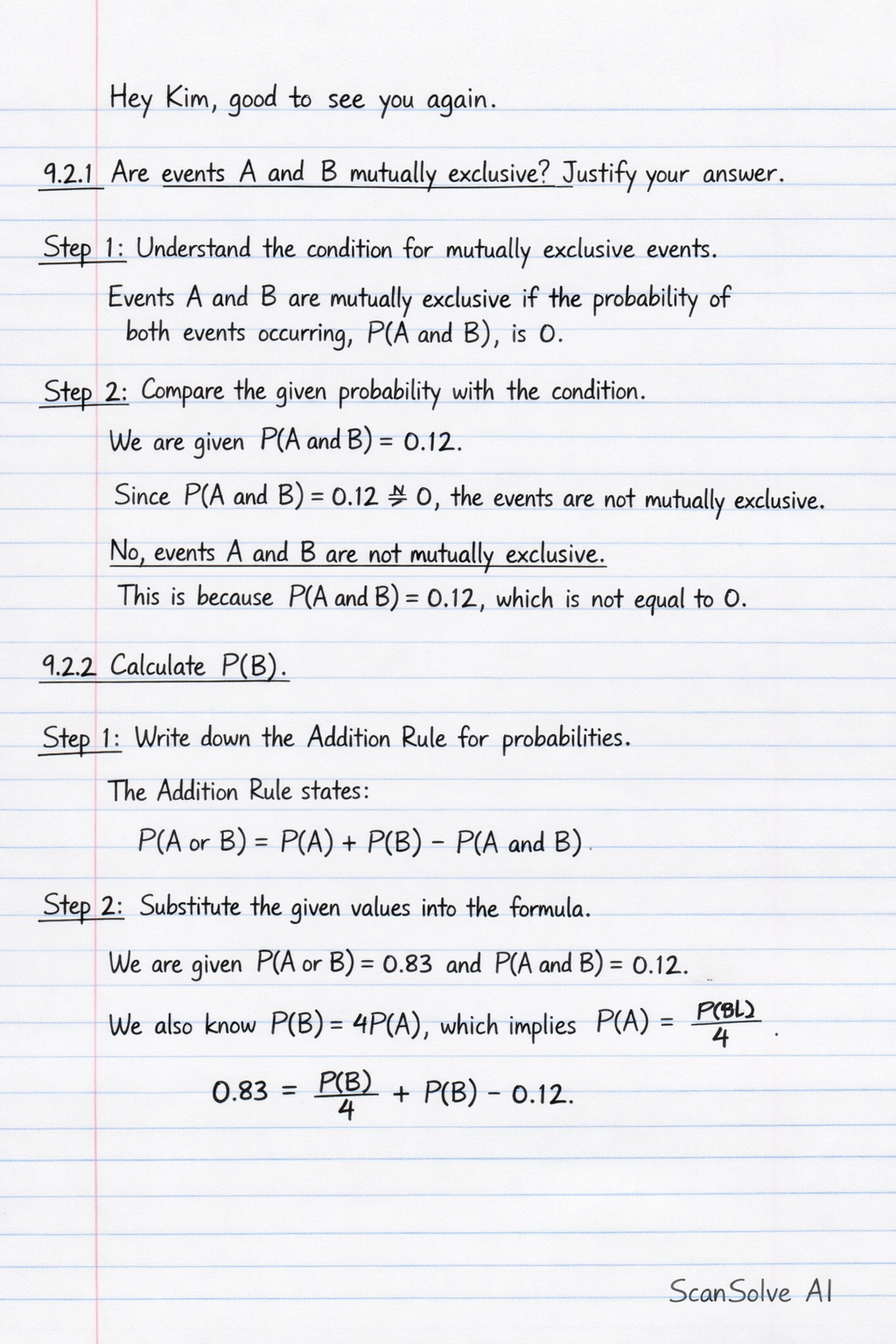
Handwritten Step-by-Step Solution
Get this as a handwritten image on WhatsApp — like a tutor wrote it for you.
Try on WhatsApp