
We read your photo as:
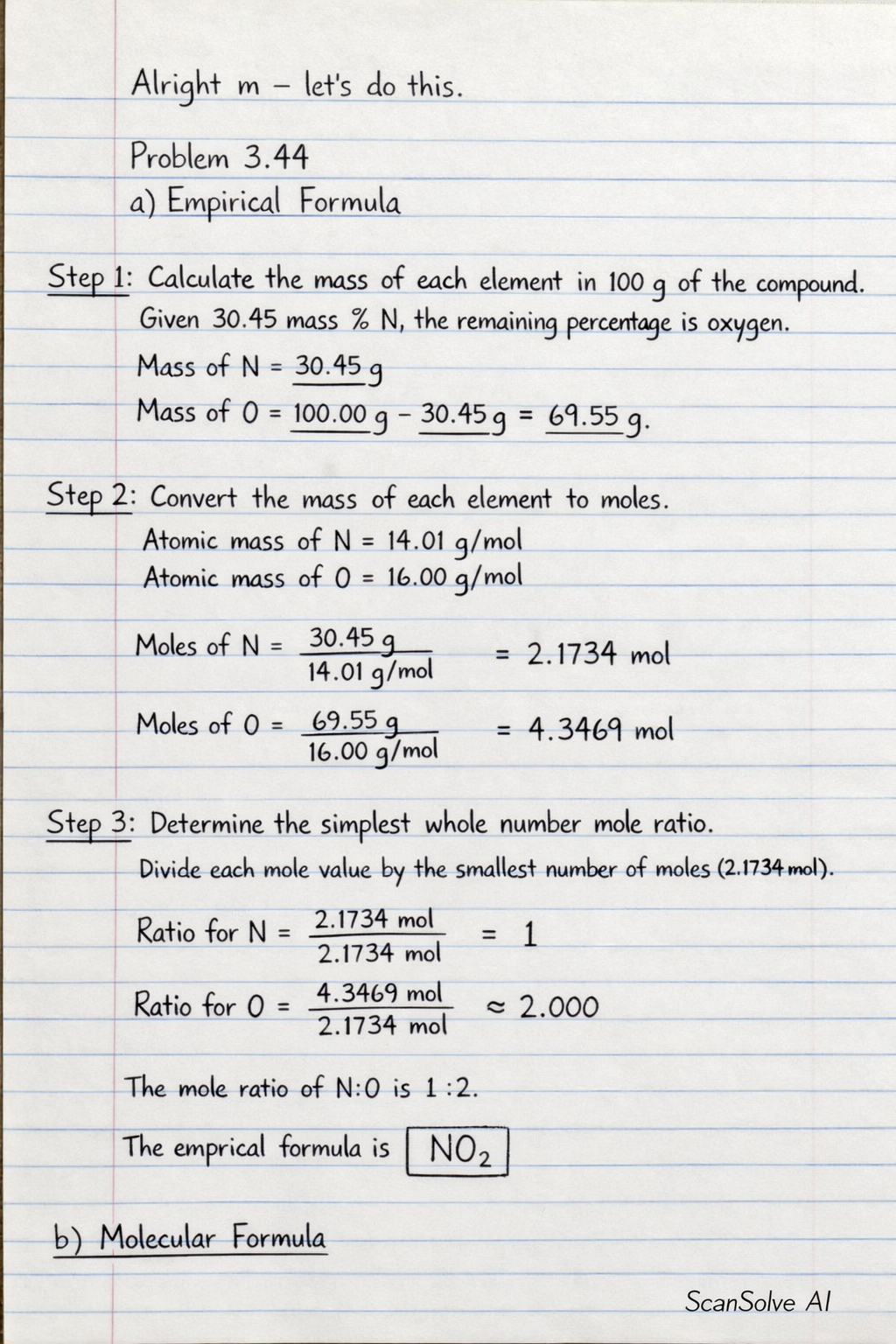
Given 30.45 mass % N, the remaining percentage is oxygen.
ScanSolve AI Answer
Step-by-step solution
10 steps.44
a) Empirical Formula
Calculate the mass of each element in 100 g of the compound.
Given 30.45 mass % N, the remaining percentage is oxygen.
Mass of N = 30.45 g
Mass of O =Convert the mass of each element to moles.
Atomic mass of N = 14.01 g/mol
Atomic mass of O = 16.00 g/molDetermine the simplest whole-number mole ratio.
Divide each mole value by the smallest number of moles (2.1734 mol).
The mole ratio of N:O is 1:2.
The empirical formula is .b) Molecular Formula
Calculate the empirical formula mass.
Empirical formula mass of
Determine the multiplier () and the molecular formula.
Given molar mass = g/mol. We will use 90 g/mol for the calculation.
Multiply the subscripts in the empirical formula by .
Molecular formula = .
The molar mass of is g/mol, which is within the g/mol range.
The molecular formula is ..45
a) Empirical Formula
Calculate the mass of each element in 100 g of the compound.
Given 79.1 mass % Cl, the remaining percentage is silicon.
Mass of Cl = 79.1 g
Mass of Si =Convert the mass of each element to moles.
Atomic mass of Si = 28.09 g/mol
Atomic mass of Cl = 35.45 g/molDetermine the simplest whole-number mole ratio.
Divide each mole value by the smallest number of moles (0.7440 mol).
The mole ratio of Si:Cl is 1:3.
The empirical formula is .b) Molecular Formula
Calculate the empirical formula mass.
Empirical formula mass of
Determine the multiplier () and the molecular formula.
Given molar mass = 269 g/mol.
Multiply the subscripts in the empirical formula by .
Molecular formula = .
The molar mass of is g/mol, which is very close to 269 g/mol.
The molecular formula is .
Still stuck on this one?
Ask a follow-up, and the answer starts from this question.
More Mathematics Questions
Handwritten Step-by-Step Solution
Get this as a handwritten image on WhatsApp — like a tutor wrote it for you.
Try on WhatsApp