
We read your photo as:
Given cosh x = 1/2(e^x + e^-x) and sinh x = 1/2(e^x - e^-x), Use these definitions to show cosh2 x - sinh2 x = 1, Show that cosh x + sinh x = e^x and simplify cosh x - sinh x.
Mathematics
ScanSolve AI Answer
Answer
Step-by-step solution
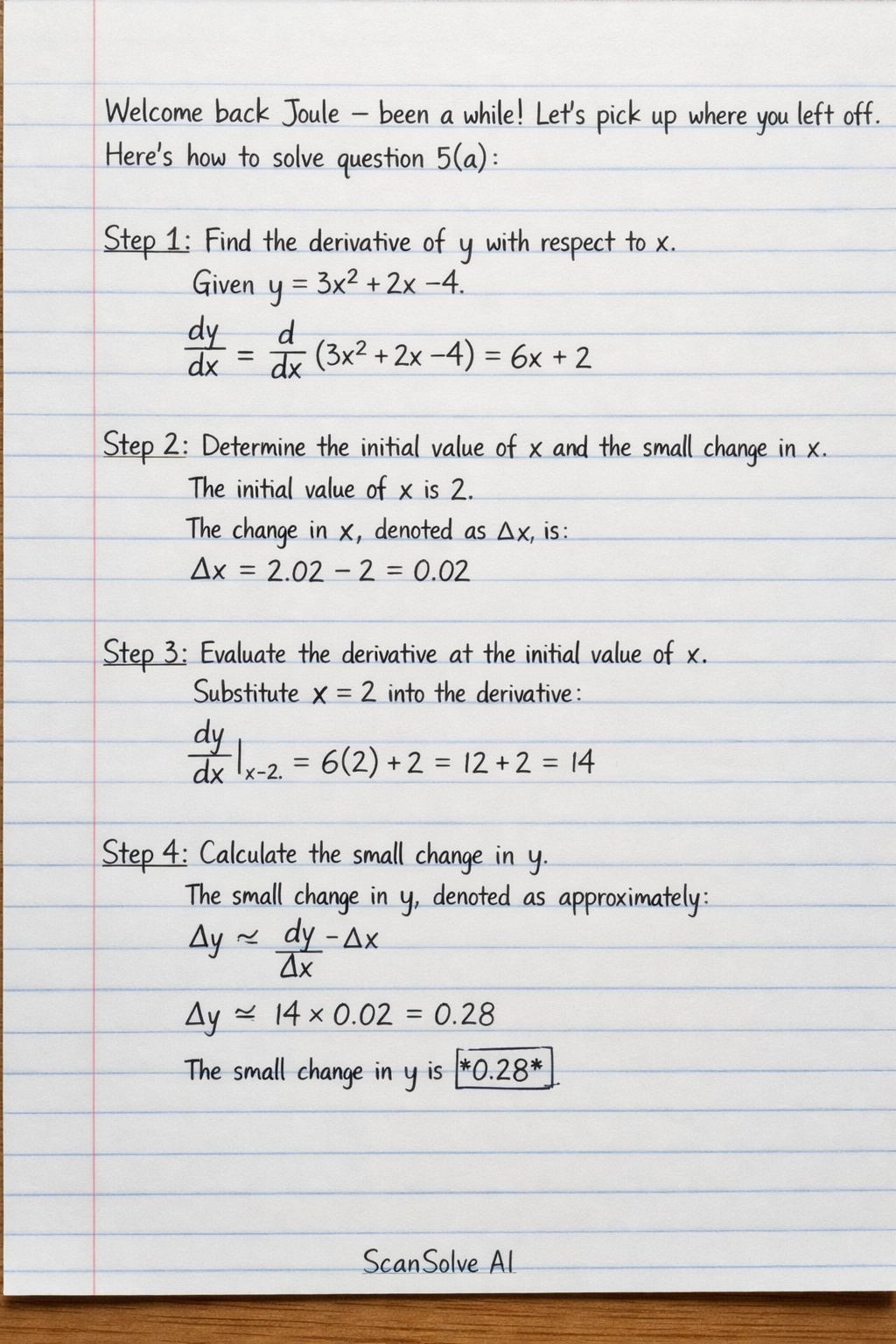
4 stepsHere's how to solve question 5(a):
Find the derivative of with respect to .
Given .
Determine the initial value of and the small change in .
The initial value of is 2.
The change in , denoted as , is the difference between the new value and the initial value:Evaluate the derivative at the initial value of .
Substitute into the derivative:
Calculate the small change in .
The small change in , denoted as , is approximately given by .
The small change in is .
Was this helpful?
Try one yourself
A new problem that tests the same skill.
Still stuck on this one?
Ask a follow-up, and the answer starts from this question.
Got a different question?Ask your own question
More Mathematics Questions
QFind the exact value of sinh(ln 2) and solve cosh2(x) = 1 for x.QProve that cos 2x − 1 cos 2x + 1 = cosec x + cotx Show that cos 2x − 1 cos 2x + 1 = -tan x If tan…QSimplify the trigonometric expression: (1 - cos 2x)/(sin 2x) * (sin 2x)/(1 + cos 2x)QProve that cos 7x + cos 5x / cos 7x - cos 5x = cot x Prove that sin 2x / sin 2 x + cos 2 x = 2 sin xQI. (Cos x)/(1+Cos x) + (1+Sin x)/(Cos x) = 2Sec x ii. (Sin x+Tan x)/(1+Cos x) = Tan x
Browse by topic:Algebra
Handwritten Step-by-Step Solution
Get this as a handwritten image on WhatsApp — like a tutor wrote it for you.
Try on WhatsApp