
We read your photo as:
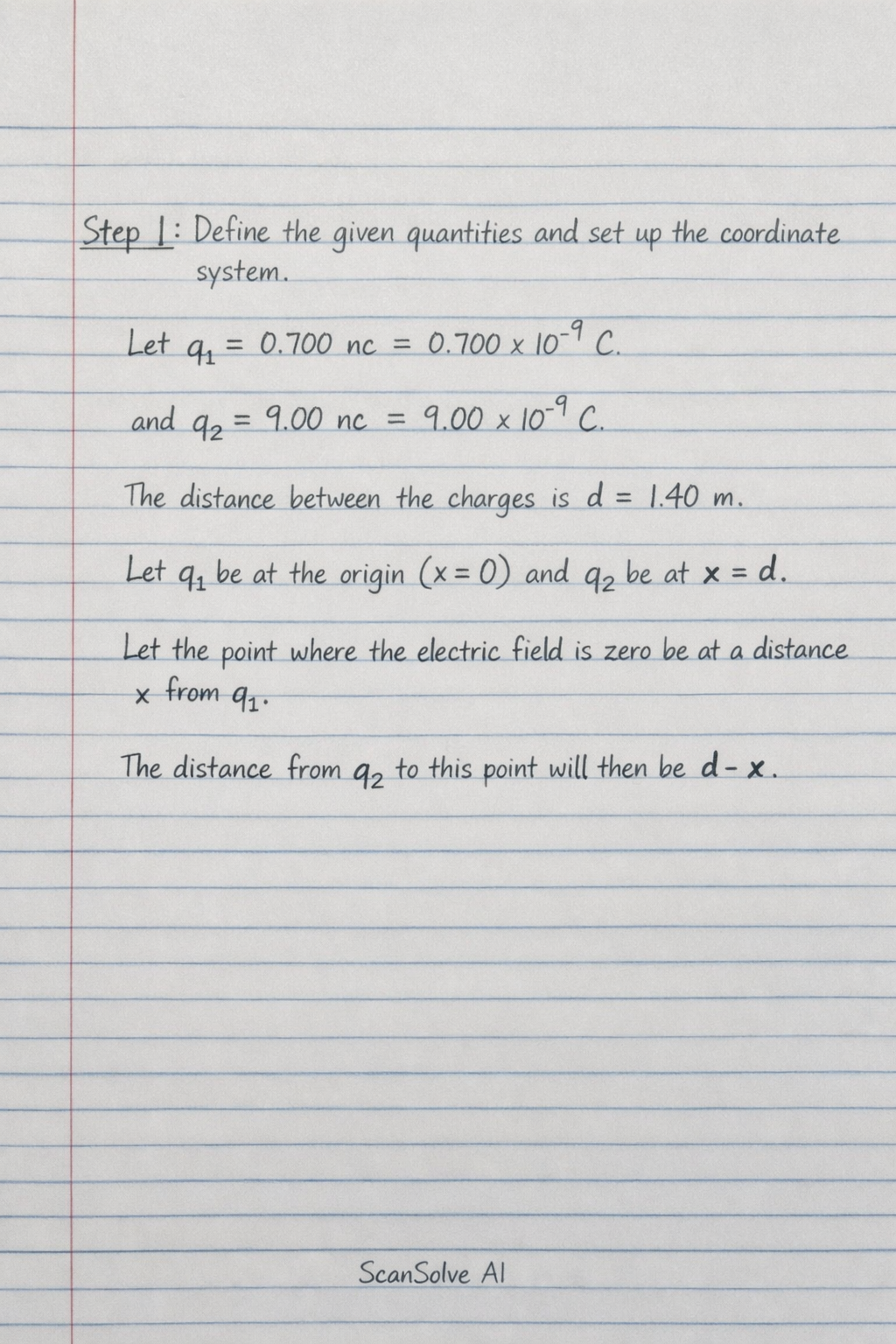
Define the given quantities and set up the coordinate system.
ScanSolve AI Answer
Answer
Step-by-step solution
5 stepsTo find the point where the total electric field is zero, we need to find a location where the electric fields due to and are equal in magnitude and opposite in direction. Since both charges are positive, this point must lie between the two charges.
Define the given quantities and set up the coordinate system.
Let and .
The distance between the charges is .
Let be at the origin () and be at .
Let the point where the electric field is zero be at a distance from .
The distance from to this point will then be .State the condition for the total electric field to be zero.
The magnitude of the electric field due to a point charge at a distance is given by , where is Coulomb's constant.
For the total electric field to be zero at point , the electric field due to () must be equal in magnitude to the electric field due to ().Write the expressions for and and set them equal.
We can cancel from both sides:
Substitute the given values and solve for .
Cancel from both sides:
Take the square root of both sides:
Cross-multiply:
State the final answer.
Rounding to three significant figures, the point where the total electric field is zero is:
Try one yourself
A new problem that tests the same skill.
Still stuck on this one?
Ask a follow-up, and the answer starts from this question.
More Mathematics Questions
Handwritten Step-by-Step Solution
Get this as a handwritten image on WhatsApp — like a tutor wrote it for you.
Try on WhatsApp