We read your photo as:

Given that y = Sec'x. a) Show that d²y/dx² = 6Sec⁴x − 4Sec²x. b) Find a Taylor series expansion of Sec²x in ascending powers of (x - π/4), up to and including the term in (x - π/4)³.

Mathematics

ScanSolve AI Answer

Step-by-step solution

6 steps

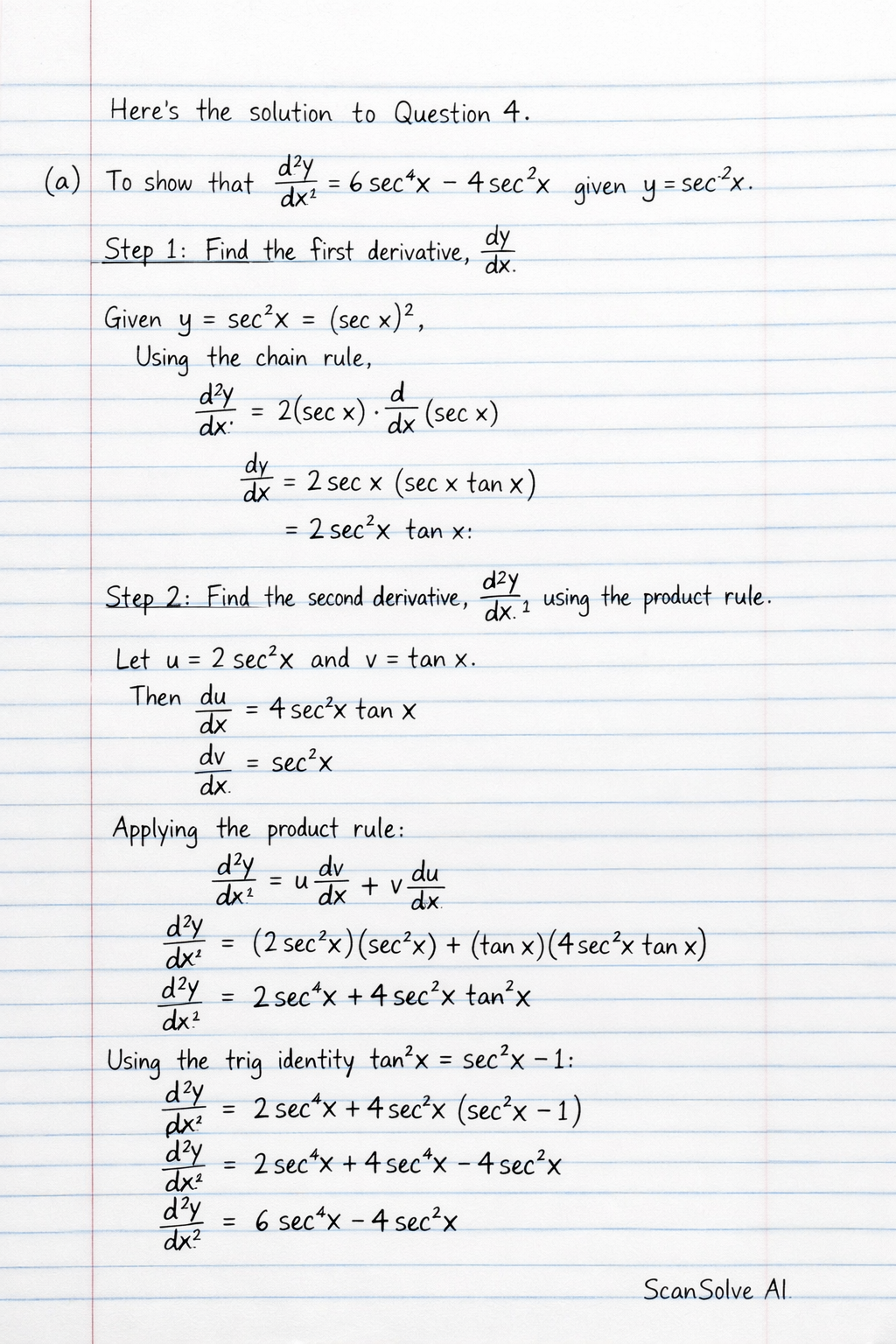
Here's the solution to Question 4.

Part a· 2 steps

To show that d2ydx2=6sec⁡4x−4sec⁡2x\frac{d^2y}{dx^2} = 6\sec^4 x - 4\sec^2 x given y=sec⁡2xy = \sec^2 x.

  1. Find the first derivative, dydx\frac{dy}{dx}.

    Given y=sec⁡2x=(sec⁡x)2y = \sec^2 x = (\sec x)^2.
    Using the chain rule, dydx=2(sec⁡x)⋅ddx(sec⁡x)\frac{dy}{dx} = 2(\sec x) \cdot \frac{d}{dx}(\sec x).
    Since ddx(sec⁡x)=sec⁡xtan⁡x\frac{d}{dx}(\sec x) = \sec x \tan x:

    dydx=2sec⁡x(sec⁡xtan⁡x)=2sec⁡2xtan⁡x\frac{dy}{dx} = 2\sec x (\sec x \tan x) = 2\sec^2 x \tan x
  2. Find the second derivative, d2ydx2\frac{d^2y}{dx^2}, using the product rule.

    Let u=2sec⁡2xu = 2\sec^2 x and v=tan⁡xv = \tan x.
    Then dudx=2⋅(2sec⁡x⋅sec⁡xtan⁡x)=4sec⁡2xtan⁡x\frac{du}{dx} = 2 \cdot (2\sec x \cdot \sec x \tan x) = 4\sec^2 x \tan x.
    And dvdx=sec⁡2x\frac{dv}{dx} = \sec^2 x.
    Applying the product rule, d2ydx2=udvdx+vdudx\frac{d^2y}{dx^2} = u \frac{dv}{dx} + v \frac{du}{dx}:

    d2ydx2=(2sec⁡2x)(sec⁡2x)+(tan⁡x)(4sec⁡2xtan⁡x)\frac{d^2y}{dx^2} = (2\sec^2 x)(\sec^2 x) + (\tan x)(4\sec^2 x \tan x) d2ydx2=2sec⁡4x+4sec⁡2xtan⁡2x\frac{d^2y}{dx^2} = 2\sec^4 x + 4\sec^2 x \tan^2 x

    Using the trigonometric identity tan⁡2x=sec⁡2x−1\tan^2 x = \sec^2 x - 1:

    d2ydx2=2sec⁡4x+4sec⁡2x(sec⁡2x−1)\frac{d^2y}{dx^2} = 2\sec^4 x + 4\sec^2 x (\sec^2 x - 1) d2ydx2=2sec⁡4x+4sec⁡4x−4sec⁡2x\frac{d^2y}{dx^2} = 2\sec^4 x + 4\sec^4 x - 4\sec^2 x d2ydx2=6sec⁡4x−4sec⁡2x\frac{d^2y}{dx^2} = 6\sec^4 x - 4\sec^2 x

    This matches the required expression.

Part b· 4 steps

To find a Taylor series expansion of sec⁡2x\sec^2 x in ascending powers of (x−π4)(x - \frac{\pi}{4}), up to and including the term in (x−π4)3(x - \frac{\pi}{4})^3.

  1. Recall the Taylor series expansion formula around x=ax=a.

    f(x)=f(a)+f′(a)(x−a)+f′′(a)2!(x−a)2+f′′′(a)3!(x−a)3+…f(x) = f(a) + f'(a)(x-a) + \frac{f''(a)}{2!}(x-a)^2 + \frac{f'''(a)}{3!}(x-a)^3 + \dots

    Here, f(x)=sec⁡2xf(x) = \sec^2 x and a=π4a = \frac{\pi}{4}.

  2. Evaluate f(x)f(x) and its derivatives at x=π4x = \frac{\pi}{4}.

    We know sec⁡(π4)=2\sec(\frac{\pi}{4}) = \sqrt{2} and tan⁡(π4)=1\tan(\frac{\pi}{4}) = 1.

    f(x)=sec⁡2x  ⟹  f(π4)=sec⁡2(π4)=(2)2=2f(x) = \sec^2 x \implies f\left(\frac{\pi}{4}\right) = \sec^2\left(\frac{\pi}{4}\right) = (\sqrt{2})^2 = 2

    From part (a), we have the derivatives:

    f′(x)=2sec⁡2xtan⁡x  ⟹  f′(π4)=2sec⁡2(π4)tan⁡(π4)=2(2)(1)=4f'(x) = 2\sec^2 x \tan x \implies f'\left(\frac{\pi}{4}\right) = 2\sec^2\left(\frac{\pi}{4}\right) \tan\left(\frac{\pi}{4}\right) = 2(2)(1) = 4 f′′(x)=6sec⁡4x−4sec⁡2x  ⟹  f′′(π4)=6sec⁡4(π4)−4sec⁡2(π4)=6(2)4−4(2)2=6(4)−4(2)=24−8=16f''(x) = 6\sec^4 x - 4\sec^2 x \implies f''\left(\frac{\pi}{4}\right) = 6\sec^4\left(\frac{\pi}{4}\right) - 4\sec^2\left(\frac{\pi}{4}\right) = 6(\sqrt{2})^4 - 4(\sqrt{2})^2 = 6(4) - 4(2) = 24 - 8 = 16

    Now, find the third derivative:

    f′′′(x)=ddx(6sec⁡4x−4sec⁡2x)f'''(x) = \frac{d}{dx}(6\sec^4 x - 4\sec^2 x) f′′′(x)=6(4sec⁡3x⋅sec⁡xtan⁡x)−4(2sec⁡x⋅sec⁡xtan⁡x)f'''(x) = 6(4\sec^3 x \cdot \sec x \tan x) - 4(2\sec x \cdot \sec x \tan x) f′′′(x)=24sec⁡4xtan⁡x−8sec⁡2xtan⁡xf'''(x) = 24\sec^4 x \tan x - 8\sec^2 x \tan x f′′′(π4)=24sec⁡4(π4)tan⁡(π4)−8sec⁡2(π4)tan⁡(π4)f'''\left(\frac{\pi}{4}\right) = 24\sec^4\left(\frac{\pi}{4}\right) \tan\left(\frac{\pi}{4}\right) - 8\sec^2\left(\frac{\pi}{4}\right) \tan\left(\frac{\pi}{4}\right) f′′′(π4)=24(2)4(1)−8(2)2(1)=24(4)−8(2)=96−16=80f'''\left(\frac{\pi}{4}\right) = 24(\sqrt{2})^4 (1) - 8(\sqrt{2})^2 (1) = 24(4) - 8(2) = 96 - 16 = 80
  3. Substitute these values into the Taylor series formula.

    f(x)=2+4(x−π4)+162!(x−π4)2+803!(x−π4)3+…f(x) = 2 + 4\left(x-\frac{\pi}{4}\right) + \frac{16}{2!}\left(x-\frac{\pi}{4}\right)^2 + \frac{80}{3!}\left(x-\frac{\pi}{4}\right)^3 + \dots
  4. Simplify the terms.

    f(x)=2+4(x−π4)+162(x−π4)2+806(x−π4)3+…f(x) = 2 + 4\left(x-\frac{\pi}{4}\right) + \frac{16}{2}\left(x-\frac{\pi}{4}\right)^2 + \frac{80}{6}\left(x-\frac{\pi}{4}\right)^3 + \dots f(x)=2+4(x−π4)+8(x−π4)2+403(x−π4)3+…f(x) = 2 + 4\left(x-\frac{\pi}{4}\right) + 8\left(x-\frac{\pi}{4}\right)^2 + \frac{40}{3}\left(x-\frac{\pi}{4}\right)^3 + \dots

    The Taylor series expansion up to and including the term in (x−π4)3(x - \frac{\pi}{4})^3 is:

    2+4(x−π4)+8(x−π4)2+403(x−π4)3\boxed{2 + 4\left(x-\frac{\pi}{4}\right) + 8\left(x-\frac{\pi}{4}\right)^2 + \frac{40}{3}\left(x-\frac{\pi}{4}\right)^3}
Was this helpful?

Still stuck on this one?

Ask a follow-up, and the answer starts from this question.

Got a different question?Ask your own question
Handwritten step-by-step solution preview

Handwritten Step-by-Step Solution

Get this as a handwritten image on WhatsApp — like a tutor wrote it for you.

Try on WhatsApp