Given the equation 2x²−3x−6= are alpha and beta find (alpha square+1/beta square) are beta square+1/alpha square

Mathematics

ScanSolve AI Answer

Answer

α2+1β2=55+55712\alpha^2 + \frac{1}{\beta^2} = \frac{55 + 5\sqrt{57}}{12}

β2+1α2=55−55712\beta^2 + \frac{1}{\alpha^2} = \frac{55 - 5\sqrt{57}}{12}

Step-by-step solution

5 steps

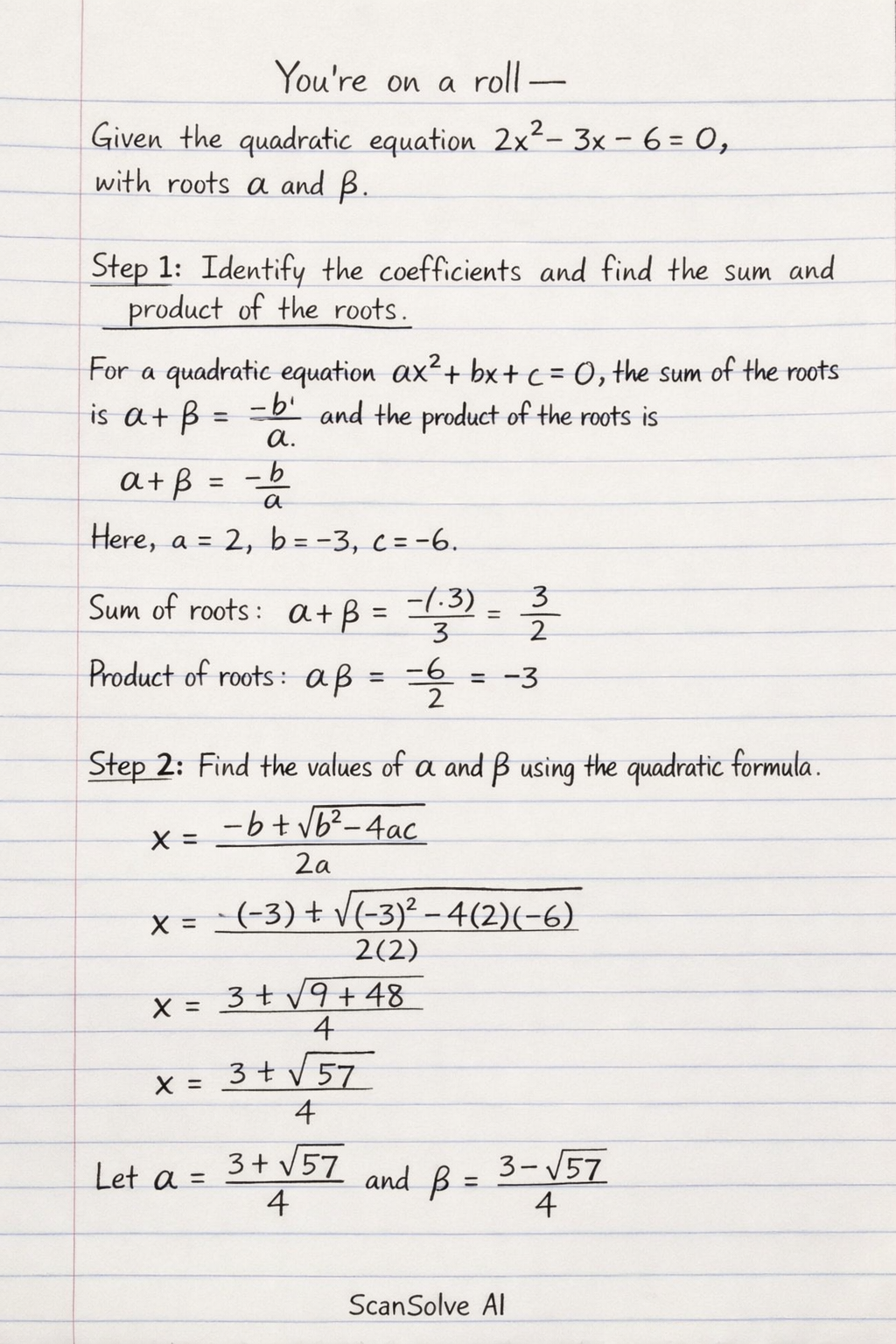
Given the quadratic equation 2x2−3x−6=02x^2 - 3x - 6 = 0, with roots α\alpha and β\beta.

  1. Identify the coefficients and find the sum and product of the roots.

    For a quadratic equation ax2+bx+c=0ax^2 + bx + c = 0, the sum of the roots is α+β=−ba\alpha + \beta = -\frac{b}{a} and the product of the roots is αβ=ca\alpha \beta = \frac{c}{a}.
    Here, a=2a=2, b=−3b=-3, c=−6c=-6.
    Sum of roots: α+β=−−32=32\alpha + \beta = -\frac{-3}{2} = \frac{3}{2}
    Product of roots: αβ=−62=−3\alpha \beta = \frac{-6}{2} = -3

  2. Find the values of α\alpha and β\beta using the quadratic formula.

    x=−b±b2−4ac2ax = \frac{-b \pm \sqrt{b^2 - 4ac}}{2a} x=−(−3)±(−3)2−4(2)(−6)2(2)x = \frac{-(-3) \pm \sqrt{(-3)^2 - 4(2)(-6)}}{2(2)} x=3±9+484x = \frac{3 \pm \sqrt{9 + 48}}{4} x=3±574x = \frac{3 \pm \sqrt{57}}{4}

    Let α=3+574\alpha = \frac{3 + \sqrt{57}}{4} and β=3−574\beta = \frac{3 - \sqrt{57}}{4}.

  3. Calculate α2\alpha^2 and β2\beta^2.

    α2=(3+574)2=32+2(3)57+(57)216=9+657+5716=66+65716=33+3578\alpha^2 = \left(\frac{3 + \sqrt{57}}{4}\right)^2 = \frac{3^2 + 2(3)\sqrt{57} + (\sqrt{57})^2}{16} = \frac{9 + 6\sqrt{57} + 57}{16} = \frac{66 + 6\sqrt{57}}{16} = \frac{33 + 3\sqrt{57}}{8} β2=(3−574)2=32−2(3)57+(57)216=9−657+5716=66−65716=33−3578\beta^2 = \left(\frac{3 - \sqrt{57}}{4}\right)^2 = \frac{3^2 - 2(3)\sqrt{57} + (\sqrt{57})^2}{16} = \frac{9 - 6\sqrt{57} + 57}{16} = \frac{66 - 6\sqrt{57}}{16} = \frac{33 - 3\sqrt{57}}{8}
  4. Evaluate the first expression

    α2+1β2\alpha^2 + \frac{1}{\beta^2}.
    We know αβ=−3\alpha\beta = -3, so 1β=−α3\frac{1}{\beta} = -\frac{\alpha}{3}.
    Therefore, 1β2=(−α3)2=α29\frac{1}{\beta^2} = \left(-\frac{\alpha}{3}\right)^2 = \frac{\alpha^2}{9}.
    Substitute this into the expression:

    α2+1β2=α2+α29=9α2+α29=10α29\alpha^2 + \frac{1}{\beta^2} = \alpha^2 + \frac{\alpha^2}{9} = \frac{9\alpha^2 + \alpha^2}{9} = \frac{10\alpha^2}{9}

    Now substitute the value of α2\alpha^2:

    α2+1β2=109(33+3578)=10×3(11+57)9×8=10(11+57)3×8=5(11+57)3×4=55+55712\alpha^2 + \frac{1}{\beta^2} = \frac{10}{9} \left(\frac{33 + 3\sqrt{57}}{8}\right) = \frac{10 \times 3(11 + \sqrt{57})}{9 \times 8} = \frac{10(11 + \sqrt{57})}{3 \times 8} = \frac{5(11 + \sqrt{57})}{3 \times 4} = \frac{55 + 5\sqrt{57}}{12}
  5. Evaluate the second expression

    β2+1α2\beta^2 + \frac{1}{\alpha^2}.
    Similarly, 1α=−β3\frac{1}{\alpha} = -\frac{\beta}{3}.
    Therefore, 1α2=(−β3)2=β29\frac{1}{\alpha^2} = \left(-\frac{\beta}{3}\right)^2 = \frac{\beta^2}{9}.
    Substitute this into the expression:

    β2+1α2=β2+β29=9β2+β29=10β29\beta^2 + \frac{1}{\alpha^2} = \beta^2 + \frac{\beta^2}{9} = \frac{9\beta^2 + \beta^2}{9} = \frac{10\beta^2}{9}

    Now substitute the value of β2\beta^2:

    β2+1α2=109(33−3578)=10×3(11−57)9×8=10(11−57)3×8=5(11−57)3×4=55−55712\beta^2 + \frac{1}{\alpha^2} = \frac{10}{9} \left(\frac{33 - 3\sqrt{57}}{8}\right) = \frac{10 \times 3(11 - \sqrt{57})}{9 \times 8} = \frac{10(11 - \sqrt{57})}{3 \times 8} = \frac{5(11 - \sqrt{57})}{3 \times 4} = \frac{55 - 5\sqrt{57}}{12}

    The values are:

    α2+1β2=55+55712\alpha^2 + \frac{1}{\beta^2} = \boxed{\frac{55 + 5\sqrt{57}}{12}} β2+1α2=55−55712\beta^2 + \frac{1}{\alpha^2} = \boxed{\frac{55 - 5\sqrt{57}}{12}}
Was this helpful?

Still stuck on this one?

Ask a follow-up, and the answer starts from this question.

Got a different question?Ask your own question
Handwritten step-by-step solution preview

Handwritten Step-by-Step Solution

Get this as a handwritten image on WhatsApp — like a tutor wrote it for you.

Try on WhatsApp