

This mathematics problem involves applying core mathematical principles and formulas. Below you will find a complete step-by-step solution with detailed explanations for each step, helping you understand not just the answer but the method behind it.
ScanSolve AI Answer
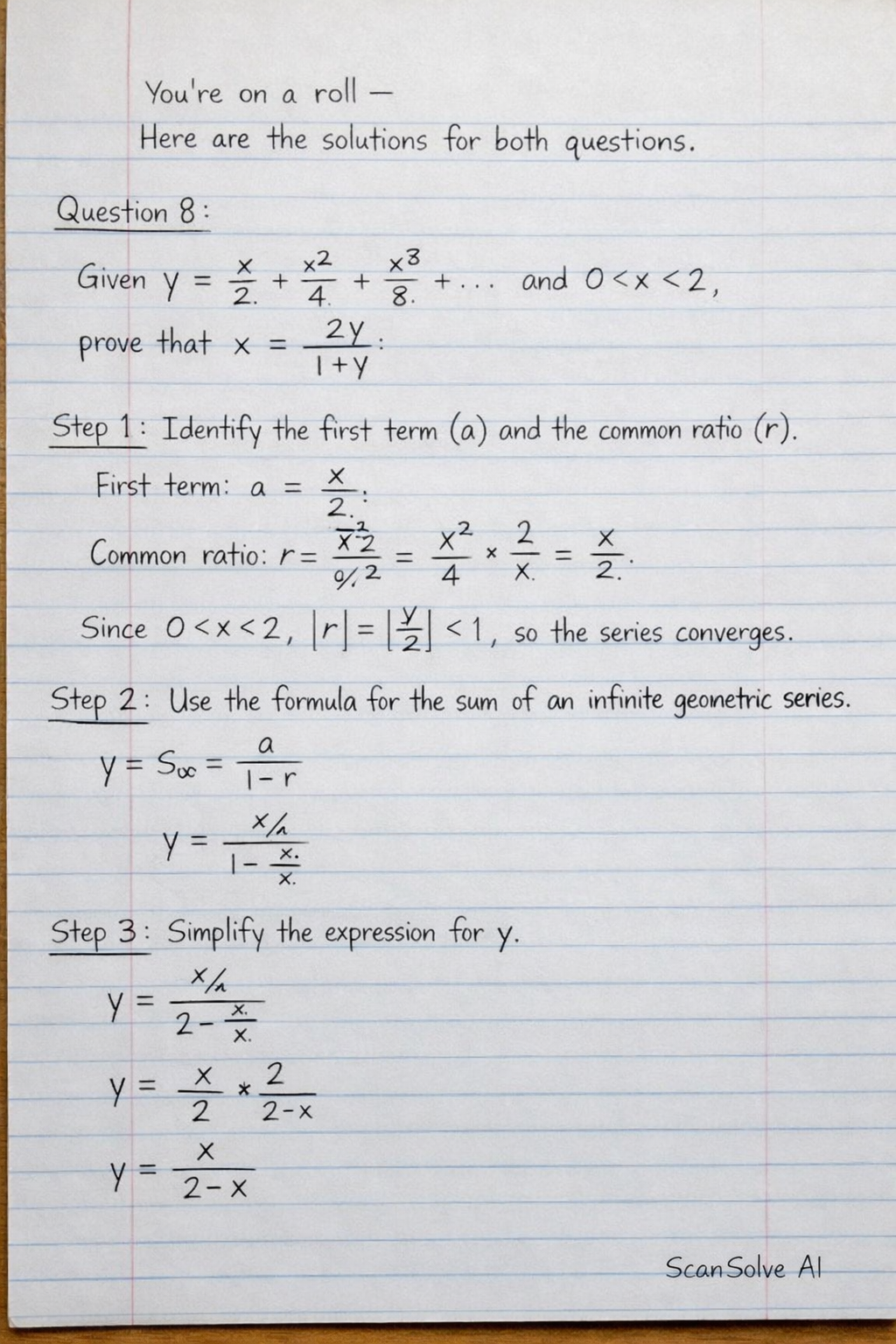
You're on a roll — Here are the solutions for both questions. Question 8: Given the infinite series y = (x)/(2) + (x^2)/(4) + (x^3)/(8) + and 0 < x < 2, we need to prove that x = (2y)/(1+y). Step 1: Identify the first term (a) and the common ratio (r) of the geometric series. The first term is a = (x)/(2). The common ratio is r = (x^2/4)/(x/2) = (x^2)/(4) · (2)/(x) = (x)/(2). The condition 0 < x < 2 ensures that |r| = |(x)/(2)| < 1, so the series converges. Step 2: Use the formula for the sum of an infinite geometric series, S_ = (a)/(1-r). y = (x)/(2)1 - (x)/(2) Step 3: Simplify the expression for y. y = (x)/(2)(2-x)/(2) y = (x)/(2) · (2)/(2-x) y = (x)/(2-x) Step 4: Rearrange the equation to solve for x in terms of y. Multiply both sides by (2-x): y(2-x) = x Distribute y: 2y - xy = x Move all terms containing x to one side: 2y = x + xy Factor out x: 2y = x(1+y) Divide by (1+y) to solve for x: x = (2y)/(1+y) This proves the required relationship. x = (2y)/(1+y) --- Question 9: Given the infinite series y = (2)/(3)x + (4)/(9)x^2 + (8)/(27)x^3 + and 0 < x < (3)/(2), we need to show that x = (3y)/(2(1+y)). Step 1: Identify the first term (a) and the common ratio (r) of the geometric series. The first term is a = (2)/(3)x. The common ratio is r = (4)/(9)x^2(2)/(3)x = (4x^2)/(9) · (3)/(2x) = (2x)/(3). The condition 0 < x < (3)/(2) ensures that |r| = |(2x)/(3)| < 1, so the series converges. Step 2: Use the formula for the sum of an infinite geometric series, S_ = (a)/(1-r). y = (2)/(3)x1 - (2)/(3)x Step 3: Simplify the expression for y. y = (2x)/(3)(3-2x)/(3) y = (2x)/(3) · (3)/(3-2x) y = (2x)/(3-2x) Step 4: Rearrange the equation to solve for x in terms of y. Multiply both sides by (3-2x): y(3-2x) = 2x Distribute y: 3y - 2xy = 2x Move all terms containing x to one side: 3y = 2x + 2xy Factor out 2x: 3y = 2x(1+y) Divide by 2(1+y) to solve for x: x = (3y)/(2(1+y)) This shows the required relationship. x = (3y)/(2(1+y)) Got more? Send 'em!