We read your photo as:

Given the matrices P = [[2, 1, -2], [-1, 1, 1], [2, 4, 1]] and Q = [[3, -2, 1], [2, 1, 1], [1, 1, -2]]. Determine: (P + Q)² + 3Q.

Mathematics

ScanSolve AI Answer

Step-by-step solution

3 steps

Here's the solution for question 12.b:

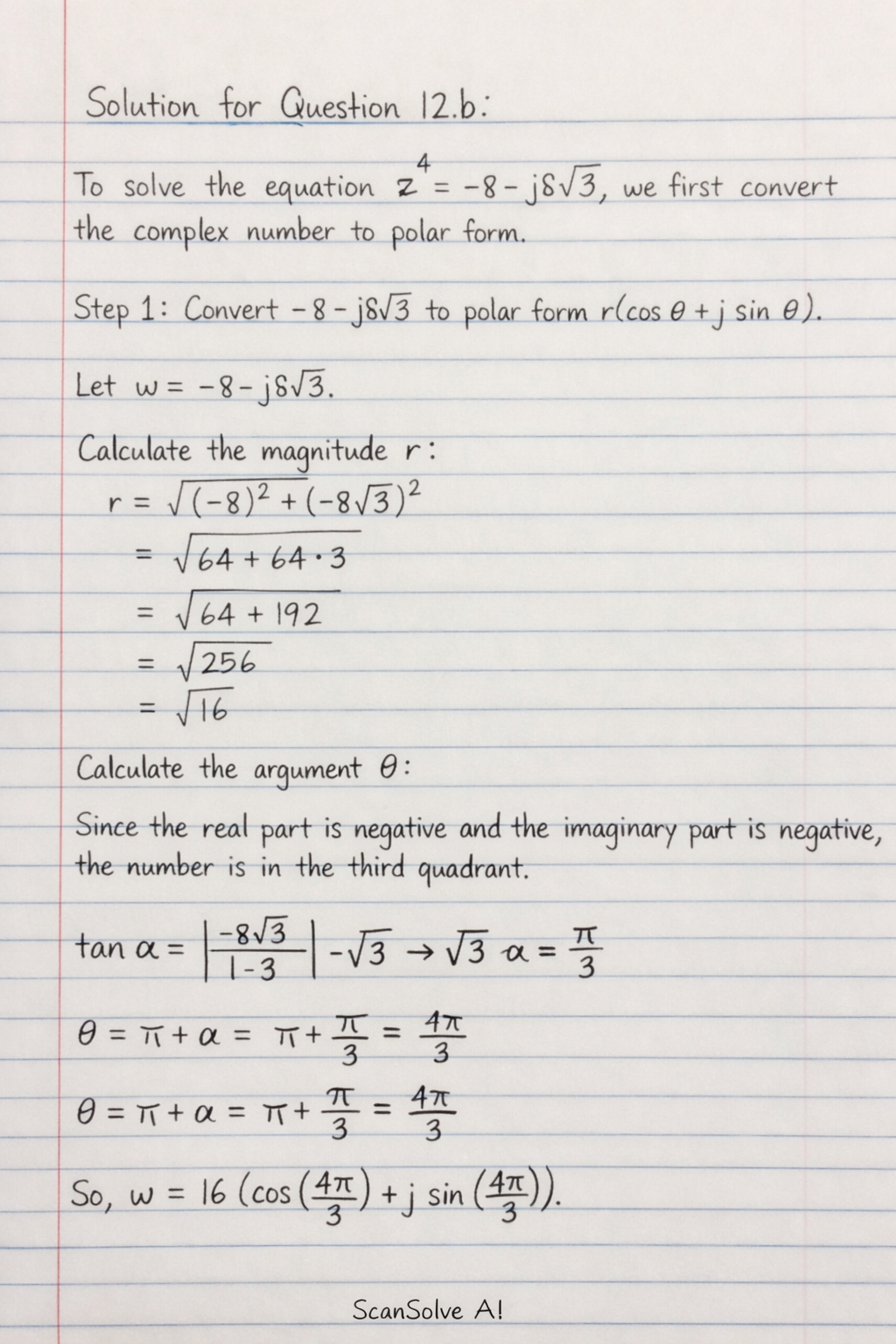
To solve the equation z4=−8−j83z^4 = -8 - j8\sqrt{3}, we first convert the complex number on the right-hand side to polar form.

  1. Convert −8−j83-8 - j8\sqrt{3} to polar form r(cos⁡θ+jsin⁡θ)r(\cos \theta + j \sin \theta).

    Let w=−8−j83w = -8 - j8\sqrt{3}.
    Calculate the magnitude rr:

    r=(−8)2+(−83)2=64+64×3=64+192=256=16r = \sqrt{(-8)^2 + (-8\sqrt{3})^2} = \sqrt{64 + 64 \times 3} = \sqrt{64 + 192} = \sqrt{256} = 16

    Calculate the argument θ\theta. Since the real part is negative and the imaginary part is negative, the number is in the third quadrant.

    tan⁡α=∣−83∣∣−8∣=3  ⟹  α=π3\tan \alpha = \frac{|-8\sqrt{3}|}{|-8|} = \sqrt{3} \implies \alpha = \frac{\pi}{3} θ=π+α=π+π3=4π3\theta = \pi + \alpha = \pi + \frac{\pi}{3} = \frac{4\pi}{3}

    So, w=16(cos⁡(4π3)+jsin⁡(4π3))w = 16 \left( \cos\left(\frac{4\pi}{3}\right) + j \sin\left(\frac{4\pi}{3}\right) \right).

  2. Apply De Moivre's theorem for roots.

    The equation is z4=16(cos⁡(4π3)+jsin⁡(4π3))z^4 = 16 \left( \cos\left(\frac{4\pi}{3}\right) + j \sin\left(\frac{4\pi}{3}\right) \right).
    The four roots are given by the formula:

    zk=r1/n(cos⁡(θ+2kπn)+jsin⁡(θ+2kπn))z_k = r^{1/n} \left( \cos\left(\frac{\theta + 2k\pi}{n}\right) + j \sin\left(\frac{\theta + 2k\pi}{n}\right) \right)

    Here, n=4n=4, r=16r=16, θ=4π3\theta=\frac{4\pi}{3}, and k=0,1,2,3k=0, 1, 2, 3.
    The magnitude of each root is 161/4=216^{1/4} = 2.
    The arguments are 4π3+2kπ4=4π+6kπ12=(4+6k)π12\frac{\frac{4\pi}{3} + 2k\pi}{4} = \frac{4\pi + 6k\pi}{12} = \frac{(4+6k)\pi}{12}.

  3. Calculate each root for k=0,1,2,3k=0, 1, 2, 3.

    • For k=0k=0: Angle: (4+6×0)π12=4π12=π3\frac{(4+6 \times 0)\pi}{12} = \frac{4\pi}{12} = \frac{\pi}{3}.

      z0=2(cos⁡(π3)+jsin⁡(π3))=2(12+j32)=1+j3z_0 = 2 \left( \cos\left(\frac{\pi}{3}\right) + j \sin\left(\frac{\pi}{3}\right) \right) = 2 \left( \frac{1}{2} + j \frac{\sqrt{3}}{2} \right) = 1 + j\sqrt{3}
    • For k=1k=1: Angle: (4+6×1)π12=10π12=5π6\frac{(4+6 \times 1)\pi}{12} = \frac{10\pi}{12} = \frac{5\pi}{6}.

      z1=2(cos⁡(5π6)+jsin⁡(5π6))=2(−32+j12)=−3+jz_1 = 2 \left( \cos\left(\frac{5\pi}{6}\right) + j \sin\left(\frac{5\pi}{6}\right) \right) = 2 \left( -\frac{\sqrt{3}}{2} + j \frac{1}{2} \right) = -\sqrt{3} + j
    • For k=2k=2: Angle: (4+6×2)π12=16π12=4π3\frac{(4+6 \times 2)\pi}{12} = \frac{16\pi}{12} = \frac{4\pi}{3}.

      z2=2(cos⁡(4π3)+jsin⁡(4π3))=2(−12−j32)=−1−j3z_2 = 2 \left( \cos\left(\frac{4\pi}{3}\right) + j \sin\left(\frac{4\pi}{3}\right) \right) = 2 \left( -\frac{1}{2} - j \frac{\sqrt{3}}{2} \right) = -1 - j\sqrt{3}
    • For k=3k=3: Angle: (4+6×3)π12=22π12=11π6\frac{(4+6 \times 3)\pi}{12} = \frac{22\pi}{12} = \frac{11\pi}{6}.

      z3=2(cos⁡(11π6)+jsin⁡(11π6))=2(32−j12)=3−jz_3 = 2 \left( \cos\left(\frac{11\pi}{6}\right) + j \sin\left(\frac{11\pi}{6}\right) \right) = 2 \left( \frac{\sqrt{3}}{2} - j \frac{1}{2} \right) = \sqrt{3} - j

    The solutions are:

    z0=1+j3,z1=−3+j,z2=−1−j3,z3=3−j\boxed{z_0 = 1 + j\sqrt{3}, \quad z_1 = -\sqrt{3} + j, \quad z_2 = -1 - j\sqrt{3}, \quad z_3 = \sqrt{3} - j}

    3 zimekamilika, zimebaki 2 leo. Unapiga hatua.

Was this helpful?

Still stuck on this one?

Ask a follow-up, and the answer starts from this question.

Got a different question?Ask your own question
Handwritten step-by-step solution preview

Handwritten Step-by-Step Solution

Get this as a handwritten image on WhatsApp — like a tutor wrote it for you.

Try on WhatsApp