
We read your photo as:
Given the quadratic equation x² − 14x + 36 = 0.
ScanSolve AI Answer
Step-by-step solution
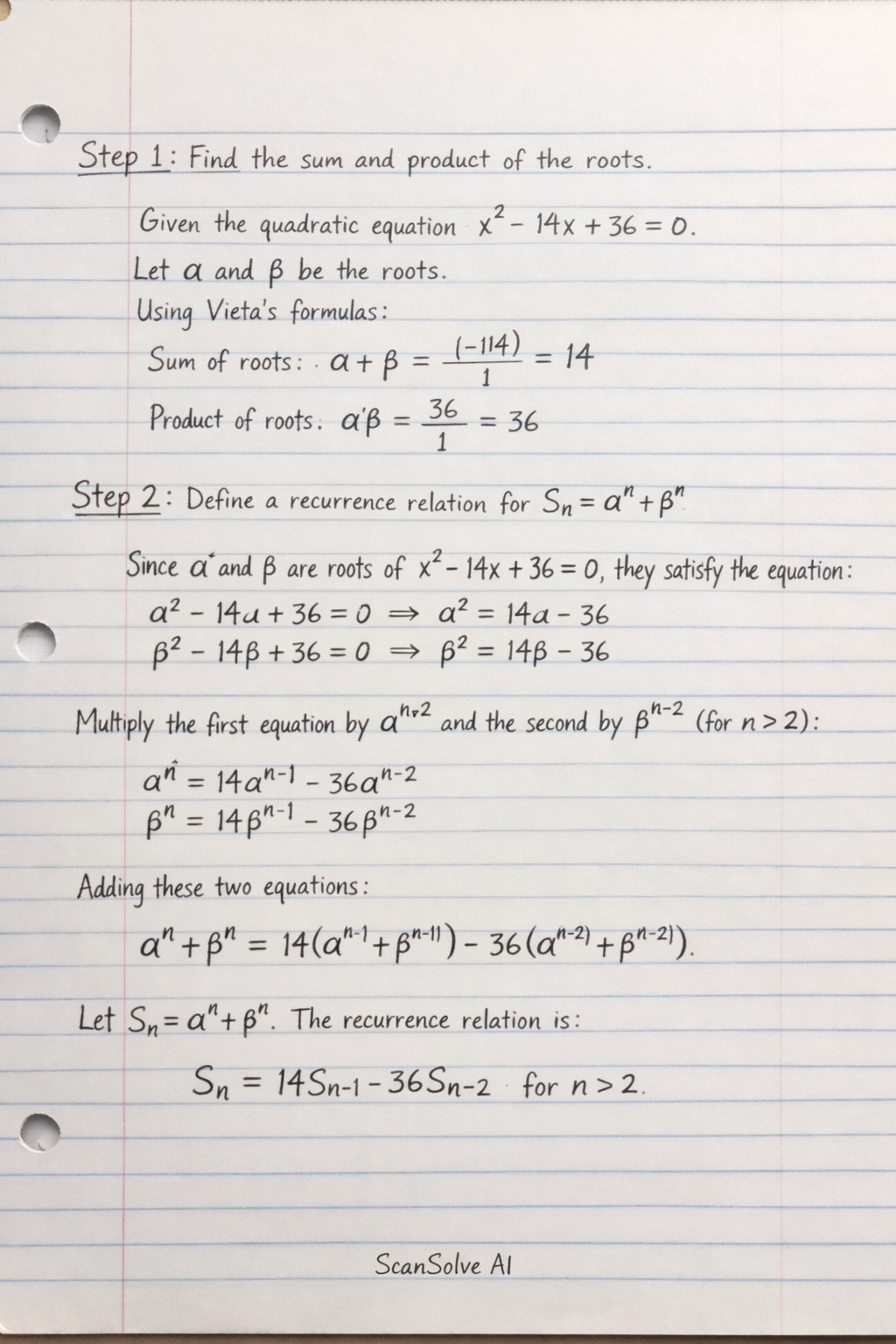
3 stepsFind the sum and product of the roots.
Given the quadratic equation .
Let and be the roots.
Using Vieta's formulas:
Sum of roots:
Product of roots:Define a recurrence relation for .
Since and are roots of , they satisfy the equation:
Multiply the first equation by and the second by (for ):
Adding these two equations:
Let . The recurrence relation is:Prove by induction that is divisible by .
Base Cases:
For :
.
.
14 is divisible by 2 (). So, is divisible by .For :
.
.
124 is divisible by 4 (). So, is divisible by .Inductive Hypothesis:
Assume that for some integer , is divisible by and is divisible by .
This means and for some integers and .Inductive Step:
We need to show that is divisible by .
Using the recurrence relation:Substitute the inductive hypothesis:
Factor out :
Since and are integers, is also an integer.
Therefore, is divisible by .By the principle of mathematical induction, is divisible by for all .
The final answer is
Still stuck on this one?
Ask a follow-up, and the answer starts from this question.
More Mathematics Questions
Handwritten Step-by-Step Solution
Get this as a handwritten image on WhatsApp — like a tutor wrote it for you.
Try on WhatsApp