

This mathematics problem involves applying core mathematical principles and formulas. Below you will find a complete step-by-step solution with detailed explanations for each step, helping you understand not just the answer but the method behind it.
ScanSolve AI Answer
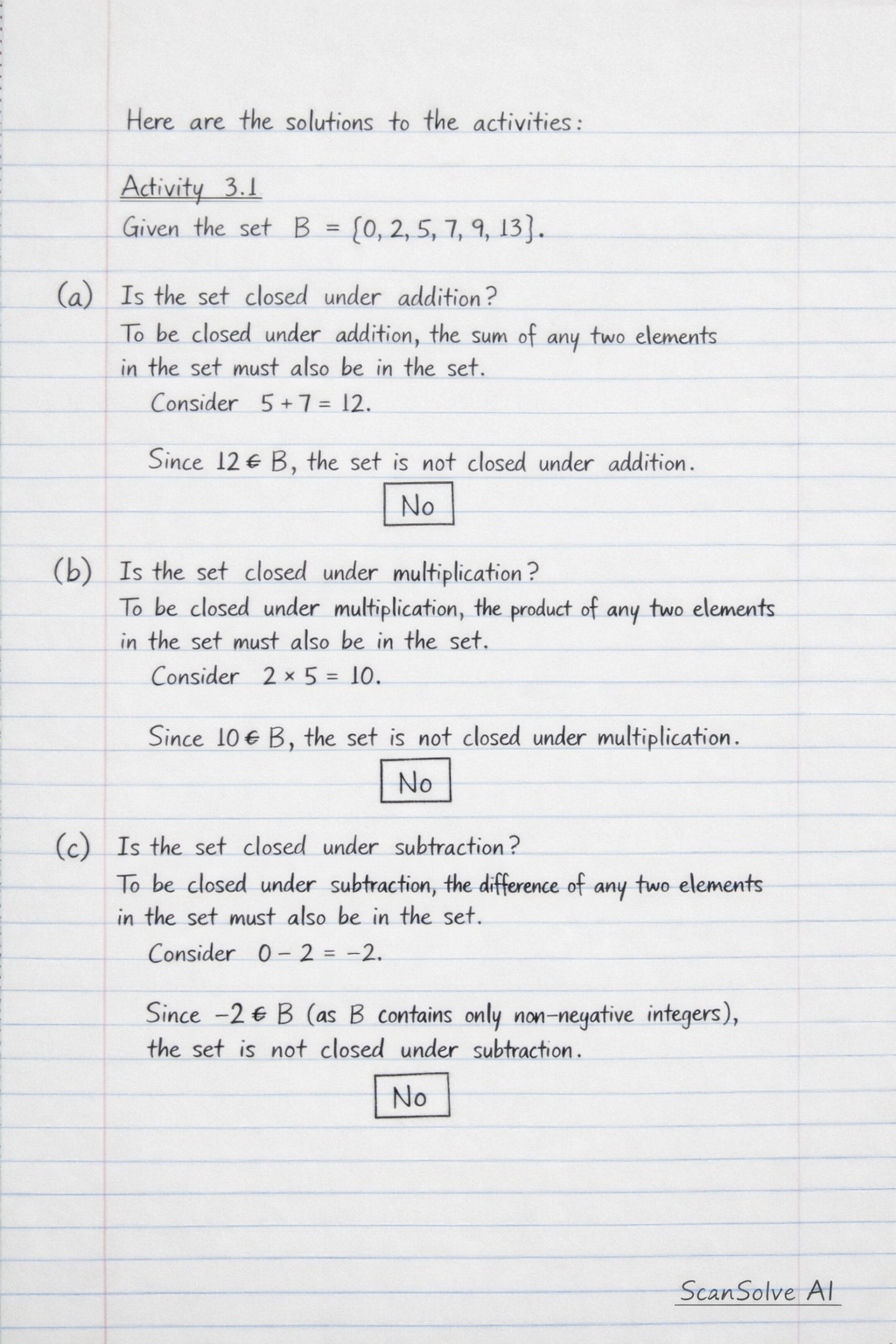
Here are the solutions to the activities: Activity 3.1 Given the set B = \0, 2, 5, 7, 9, 13\. a) Is the set closed under addition? To be closed under addition, the sum of any two elements in the set must also be in the set. Consider 5 + 7 = 12. Since 12 B, the set is not closed under addition. No b) Is the set closed under multiplication? To be closed under multiplication, the product of any two elements in the set must also be in the set. Consider 2 × 5 = 10. Since 10 B, the set is not closed under multiplication. No c) Is the set closed under subtraction? To be closed under subtraction, the difference of any two elements in the set must also be in the set. Consider 0 - 2 = -2. Since -2 B (as B contains only non-negative integers), the set is not closed under subtraction. No d) Is the set closed under division? To be closed under division, the quotient of any two elements in the set (where the divisor is not zero) must also be in the set. Consider 2 ÷ 2 = 1. Since 1 B, the set is not closed under division. No Activity 3.2 1. What is the difference between natural and whole numbers? Natural numbers* (also called counting numbers) are the positive integers: 1, 2, 3, 4, . The smallest natural number is 1. Whole numbers* are the natural numbers including zero: 0, 1, 2, 3, 4, . The smallest whole number is 0. The key difference is that whole numbers include zero, while natural numbers do not. 2. How will you justify to your pupils that zero is a number? I would justify that zero is a number by explaining its various roles: Placeholder:* Zero acts as a placeholder in our number system, showing that there are no tens, hundreds, etc., in a particular place value (e.g., in 10, the zero indicates no units). Quantity:* It represents the absence of quantity or "nothing" (e.g., if you have 3 apples and eat all 3, you have 0 apples left). Identity Element for Addition:* When you add zero to any number, the number remains unchanged (e.g., 5 + 0 = 5). Origin on a Number Line:* Zero is the central point on a number line, separating positive numbers from negative numbers. 3. Given the set B = \0, 2, 5, 7, 9, 13\. Is the set closed under addition, multiplication, and subtraction? This question refers back to Activity 3.1. Addition: No, because 5 + 7 = 12, and 12 B. Multiplication: No, because 2 × 5 = 10, and 10 B. Subtraction: No, because 0 - 2 = -2, and -2 B.