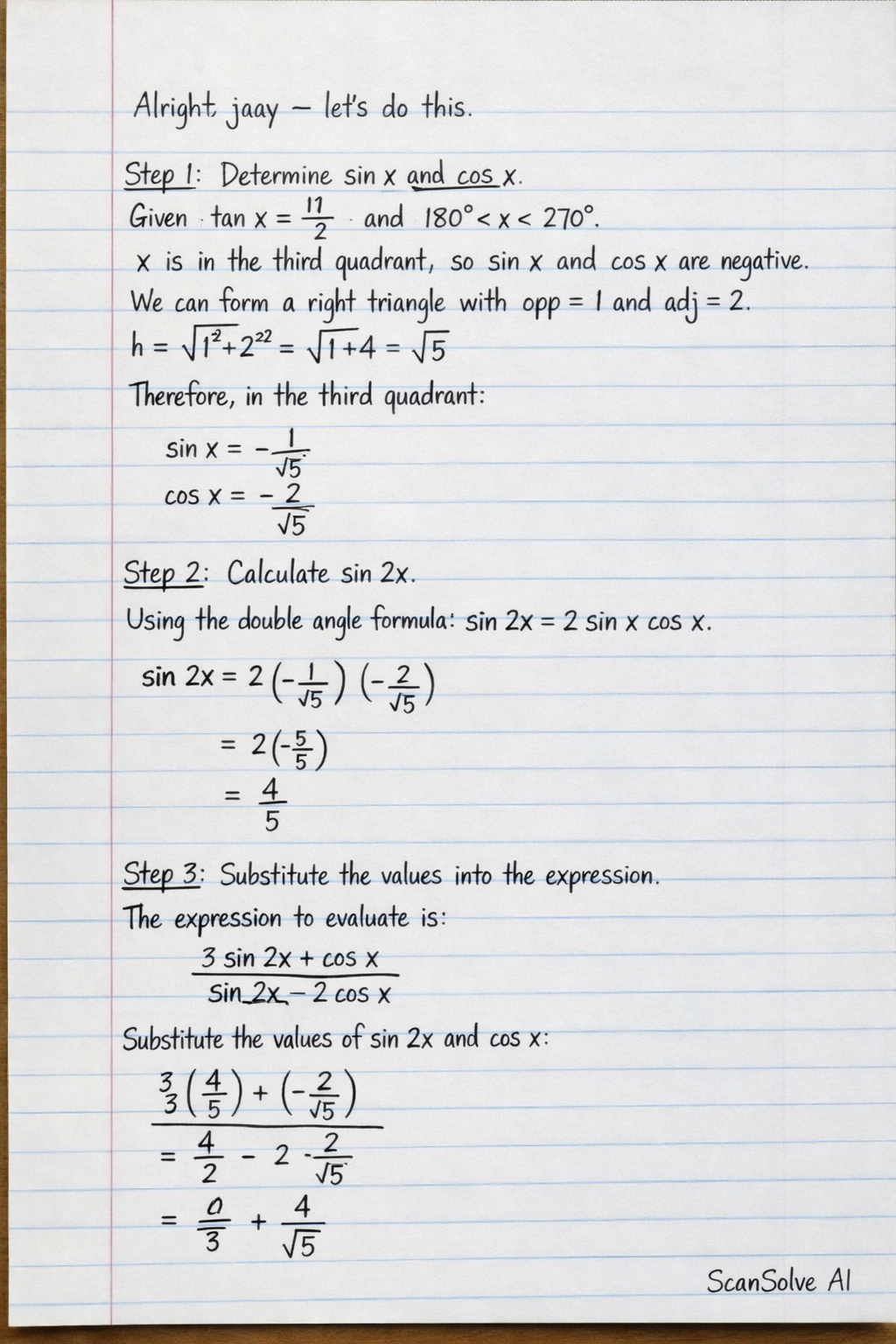
We read your photo as:

Given x = (1)/(2) and 180^ < x < 270^. This means x is in the third quadrant, where both x and x are negative.

Mathematics

ScanSolve AI Answer

Answer

75−118\frac{7\sqrt{5} - 11}{8}

Step-by-step solution

6 steps
  1. Determine sin⁡x\sin x and cos⁡x\cos x.

    Given tan⁡x=12\tan x = \frac{1}{2} and 180∘<x<270∘180^\circ < x < 270^\circ. This means xx is in the third quadrant, where both sin⁡x\sin x and cos⁡x\cos x are negative.
    We can form a right-angled triangle where the opposite side is 1 and the adjacent side is 2.
    The hypotenuse h=12+22=1+4=5h = \sqrt{1^2 + 2^2} = \sqrt{1+4} = \sqrt{5}.
    Therefore, in the third quadrant:

    sin⁡x=−15\sin x = -\frac{1}{\sqrt{5}} cos⁡x=−25\cos x = -\frac{2}{\sqrt{5}}
  2. Calculate sin⁡2x\sin 2x.

    Using the double angle formula sin⁡2x=2sin⁡xcos⁡x\sin 2x = 2 \sin x \cos x:

    sin⁡2x=2(−15)(−25)=2(25)=45\sin 2x = 2 \left(-\frac{1}{\sqrt{5}}\right) \left(-\frac{2}{\sqrt{5}}\right) = 2 \left(\frac{2}{5}\right) = \frac{4}{5}
  3. Substitute the values into the expression.

    The expression to evaluate is 3sin⁡2x+cos⁡xsin⁡2x−2cos⁡x\frac{3 \sin 2x + \cos x}{\sin 2x - 2 \cos x}.
    Substitute the values of sin⁡2x\sin 2x and cos⁡x\cos x:

    3(45)+(−25)(45)−2(−25)=125−2545+45\frac{3 \left(\frac{4}{5}\right) + \left(-\frac{2}{\sqrt{5}}\right)}{\left(\frac{4}{5}\right) - 2 \left(-\frac{2}{\sqrt{5}}\right)} = \frac{\frac{12}{5} - \frac{2}{\sqrt{5}}}{\frac{4}{5} + \frac{4}{\sqrt{5}}}
  4. Simplify the complex fraction.

    To combine the terms in the numerator and denominator, we rationalize the 5\sqrt{5} terms:

    25=255and45=455\frac{2}{\sqrt{5}} = \frac{2\sqrt{5}}{5} \quad \text{and} \quad \frac{4}{\sqrt{5}} = \frac{4\sqrt{5}}{5}

    Substitute these back:

    125−25545+455=12−2554+455=12−254+45\frac{\frac{12}{5} - \frac{2\sqrt{5}}{5}}{\frac{4}{5} + \frac{4\sqrt{5}}{5}} = \frac{\frac{12 - 2\sqrt{5}}{5}}{\frac{4 + 4\sqrt{5}}{5}} = \frac{12 - 2\sqrt{5}}{4 + 4\sqrt{5}}
  5. Rationalize the denominator.

    Factor out common terms and then multiply the numerator and denominator by the conjugate of the denominator, which is (1−5)(1 - \sqrt{5}):

    2(6−5)4(1+5)=6−52(1+5)\frac{2(6 - \sqrt{5})}{4(1 + \sqrt{5})} = \frac{6 - \sqrt{5}}{2(1 + \sqrt{5})} 6−52(1+5)×1−51−5\frac{6 - \sqrt{5}}{2(1 + \sqrt{5})} \times \frac{1 - \sqrt{5}}{1 - \sqrt{5}}

    Numerator: (6−5)(1−5)=6−65−5+(5)2=6−75+5=11−75(6 - \sqrt{5})(1 - \sqrt{5}) = 6 - 6\sqrt{5} - \sqrt{5} + (\sqrt{5})^2 = 6 - 7\sqrt{5} + 5 = 11 - 7\sqrt{5}
    Denominator: 2(1+5)(1−5)=2(12−(5)2)=2(1−5)=2(−4)=−82(1 + \sqrt{5})(1 - \sqrt{5}) = 2(1^2 - (\sqrt{5})^2) = 2(1 - 5) = 2(-4) = -8

  6. Write the final expression in surd form.

    11−75−8=−11−758=−(11−75)8=−11+758\frac{11 - 7\sqrt{5}}{-8} = -\frac{11 - 7\sqrt{5}}{8} = \frac{-(11 - 7\sqrt{5})}{8} = \frac{-11 + 7\sqrt{5}}{8} =75−118= \boxed{\frac{7\sqrt{5} - 11}{8}}
Was this helpful?

Try one yourself

A new problem that tests the same skill.

Still stuck on this one?

Ask a follow-up, and the answer starts from this question.

Got a different question?Ask your own question
Handwritten step-by-step solution preview

Handwritten Step-by-Step Solution

Get this as a handwritten image on WhatsApp — like a tutor wrote it for you.

Try on WhatsApp