

This mathematics problem involves applying core mathematical principles and formulas. Below you will find a complete step-by-step solution with detailed explanations for each step, helping you understand not just the answer but the method behind it.
ScanSolve AI Answer
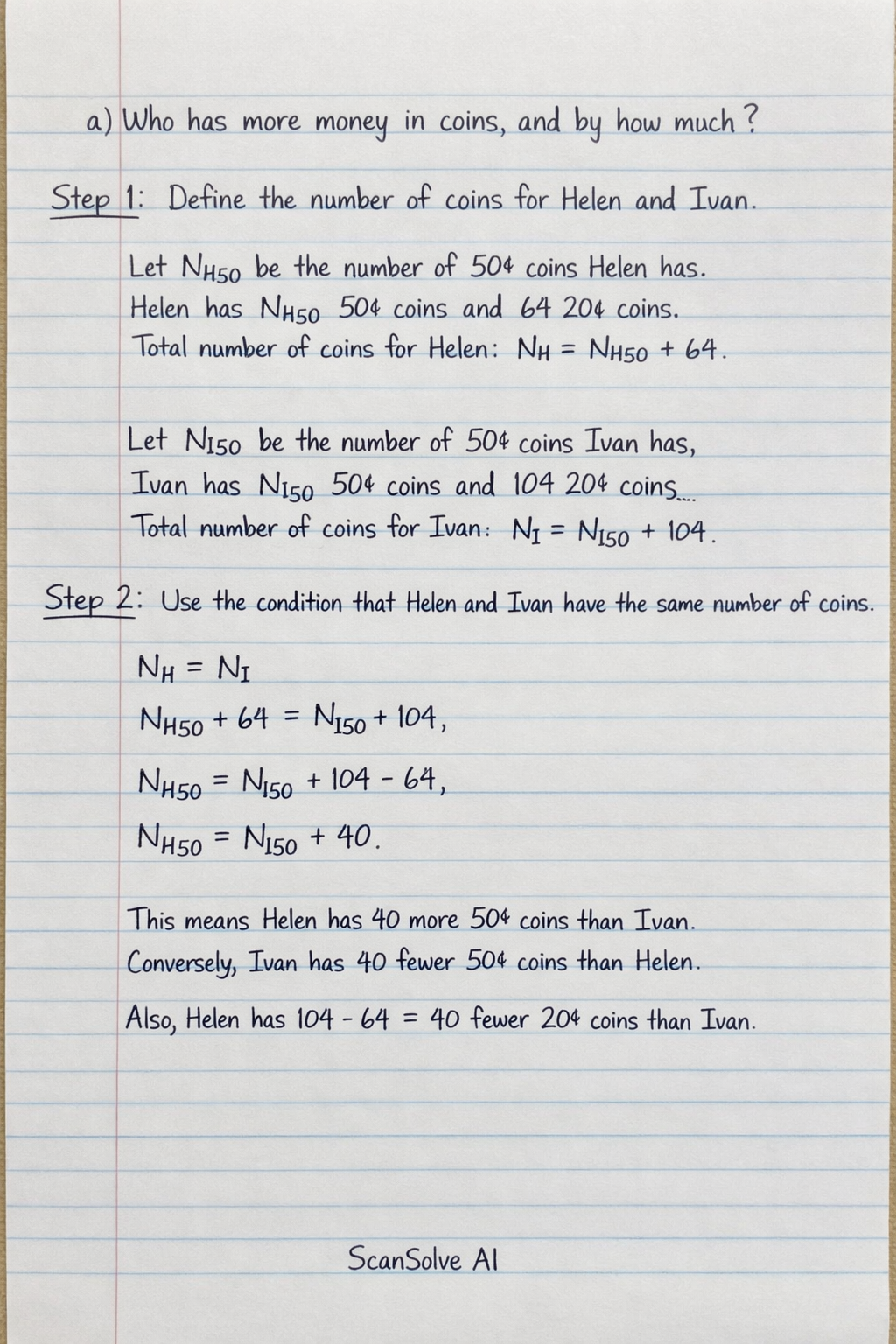
a) Who has more money in coins, and by how much? Step 1: Define the number of coins for Helen and Ivan. Let N_H50 be the number of 50-cent coins Helen has. Helen has N_H50 50-cent coins and 64 20-cent coins. Total number of coins for Helen: N_H = N_H50 + 64. Let N_I50 be the number of 50-cent coins Ivan has. Ivan has N_I50 50-cent coins and 104 20-cent coins. Total number of coins for Ivan: N_I = N_I50 + 104. Step 2: Use the condition that Helen and Ivan have the same number of coins. N_H = N_I N_H50 + 64 = N_I50 + 104 N_H50 = N_I50 + 104 - 64 N_H50 = N_I50 + 40 This means Helen has 40 more 50-cent coins than Ivan. Conversely, Ivan has 40 fewer 50-cent coins than Helen. Also, Helen has 104 - 64 = 40 fewer 20-cent coins than Ivan. Step 3: Calculate the difference in total money. The difference in their coin composition is that Helen has 40 more 50-cent coins and 40 fewer 20-cent coins compared to Ivan. This means Helen effectively exchanged 40 20-cent coins for 40 50-cent coins. The value difference per coin exchange is 50 cents - 20 cents = 30 cents. Since Helen has 40 such "exchanges" in her favor, the total difference in money is: Difference = 40 × (50 cents - 20 cents) Difference = 40 × 30 cents Difference = 1200 cents Converting to dollars: Difference = (1200)/(100) dollars = \12.00 Since Helen has the higher value coins in this exchange, Helen has more money. Helen has more money in coins, by \12.00. b) Given that each 50-cent coin is 2.7 g heavier than a 20-cent coin, what is the total mass of Ivan's coins in kilograms? Step 1: Define the masses of the coins. Let $m_50