
We read your photo as:
Find the vector PM, given that the position vectors of P and Q are p and q respectively, and M is the midpoint of PQ.
Mathematics
ScanSolve AI Answer
Answer
Step-by-step solution
4 stepsHere is the solution to part 7 (b) (i):
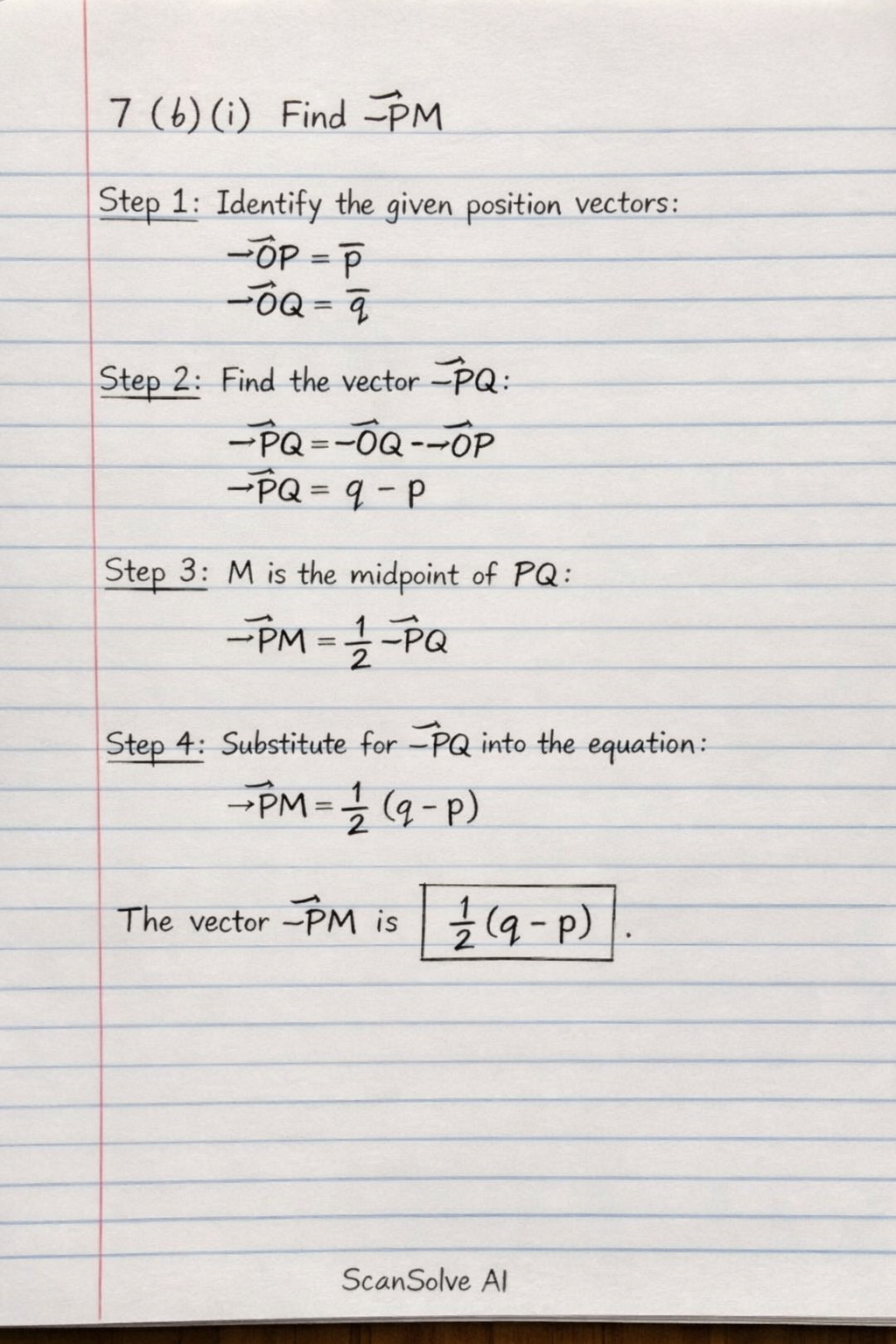
7. (b) (i) Find
Identify the given position vectors.
The position vector of P from O is .
The position vector of Q from O is .Find the vector .
The vector from P to Q can be expressed as the difference between the position vector of Q and the position vector of P:
Use the information that M is the midpoint of PQ.
If M is the midpoint of PQ, then the vector is half of the vector .
Substitute the expression for into the equation for .
The vector is .
Was this helpful?
Try one yourself
A new problem that tests the same skill.
Still stuck on this one?
Ask a follow-up, and the answer starts from this question.
Got a different question?Ask your own question
More Mathematics Questions
QFURTHER MATH. The position vectors of the points P and Q are P = −i + 3j and q = 2i + 2j. Find (i)…QGiven points P and Q, express the vector PQ as a column vector and find the coordinates of Q given…QTwo sides of a triangle are represented by the vectors m=(2/3) and n=(3/2). If r=pm+qn where…QThe coordinate of P, Q and R are (2, m), (−3, 1) and (6, n) respectively. If the length of PQ is…QFind the position vector of M.
Browse by topic:Linear Algebra
Handwritten Step-by-Step Solution
Get this as a handwritten image on WhatsApp — like a tutor wrote it for you.
Try on WhatsApp