
I want everything on permutation and combination
ScanSolve AI Answer
Answer
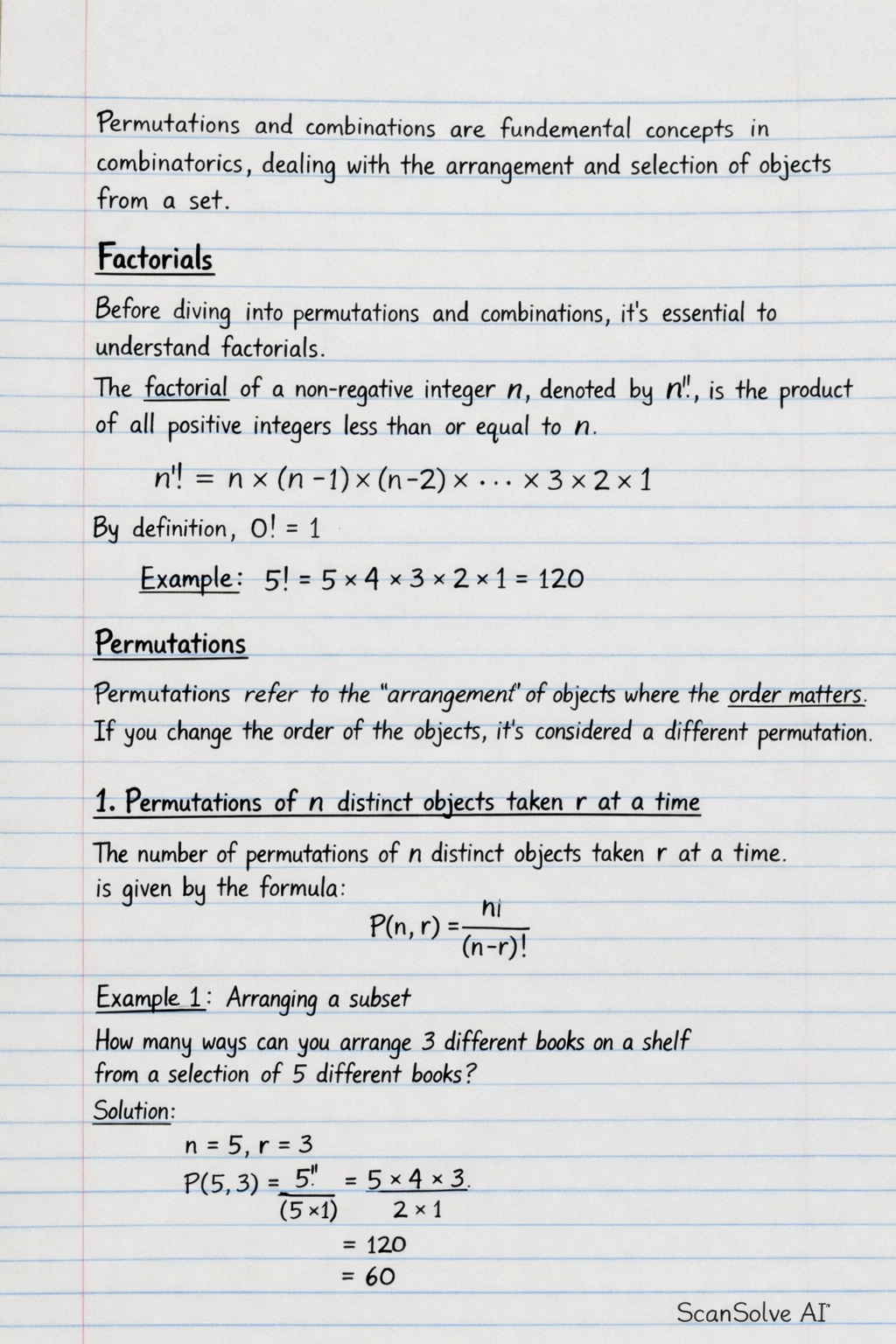
Permutations and combinations are fundamental concepts in combinatorics, dealing with the arrangement and selection of objects from a set.
Factorials
Before diving into permutations and combinations, it's essential to understand factorials.
The factorial of a non-negative integer , denoted by , is the product of all positive integers less than or equal to .
By definition, .
Example:
Permutations
Permutations refer to the arrangement of objects where the order matters. If you change the order of the objects, it's considered a different permutation.
1. Permutations of distinct objects taken at a time
The number of permutations of distinct objects taken at a time is given by the formula:
Example 1: Arranging a subset
How many ways can you arrange 3 different books on a shelf from a selection of 5 different books?
Here, (total books) and (books to arrange).
There are 60 ways to arrange the books.
2. Permutations of distinct objects taken at a time
This is a special case where . The formula simplifies to:
Example 2: Arranging all objects
How many different ways can the letters of the word "MATH" be arranged?
Here, (total letters) and (all letters are used).
There are 24 different arrangements.
3. Permutations with Repetition (Identical Objects)
If there are objects where are of one type, are of a second type, ..., are of a -th type, and , then the number of distinct permutations is:
Example 3: Arranging letters with repetition
How many distinct arrangements can be made from the letters of the word "MISSISSIPPI"?
Here, (total letters).
M: 1 ()
I: 4 ()
S: 4 ()
P: 2 ()
Number of distinct arrangements =
There are 34,650 distinct arrangements.
Combinations
Combinations refer to the selection of objects where the order does not matter. If you select a group of objects, changing the order in which you picked them does not create a new combination.
1. Combinations of distinct objects taken at a time
The number of combinations of distinct objects taken at a time is given by the formula:
Note that . This shows that for every permutations, there is only 1 combination.
Example 4: Selecting a committee
A committee of 3 people is to be chosen from a group of 7 people. How many different committees can be formed?
Here, (total people) and (people to choose). The order of selection does not matter for a committee.
There are 35 different committees that can be formed.
Example 5: Selecting items from a menu
A student needs to choose 2 subjects from a list of 4 optional subjects. How many ways can the student choose the subjects?
Here, (total subjects) and (subjects to choose). The order of choosing subjects does not matter.
There are 6 ways to choose the subjects.
Key Difference: Order Matters vs. Order Does Not Matter
- Permutations: Use when the order or arrangement of the selected items is important (e.g., arranging books, forming a password, assigning positions).
- Combinations: Use when only the selection or group of items is important, and their order does not change the outcome (e.g., choosing a committee, selecting lottery numbers, picking cards).
Still stuck on this one?
Ask a follow-up, and the answer starts from this question.
More Mathematics Questions
Handwritten Step-by-Step Solution
Get this as a handwritten image on WhatsApp — like a tutor wrote it for you.
Try on WhatsApp