

This mathematics problem involves applying core mathematical principles and formulas. Below you will find a complete step-by-step solution with detailed explanations for each step, helping you understand not just the answer but the method behind it.
ScanSolve AI Answer
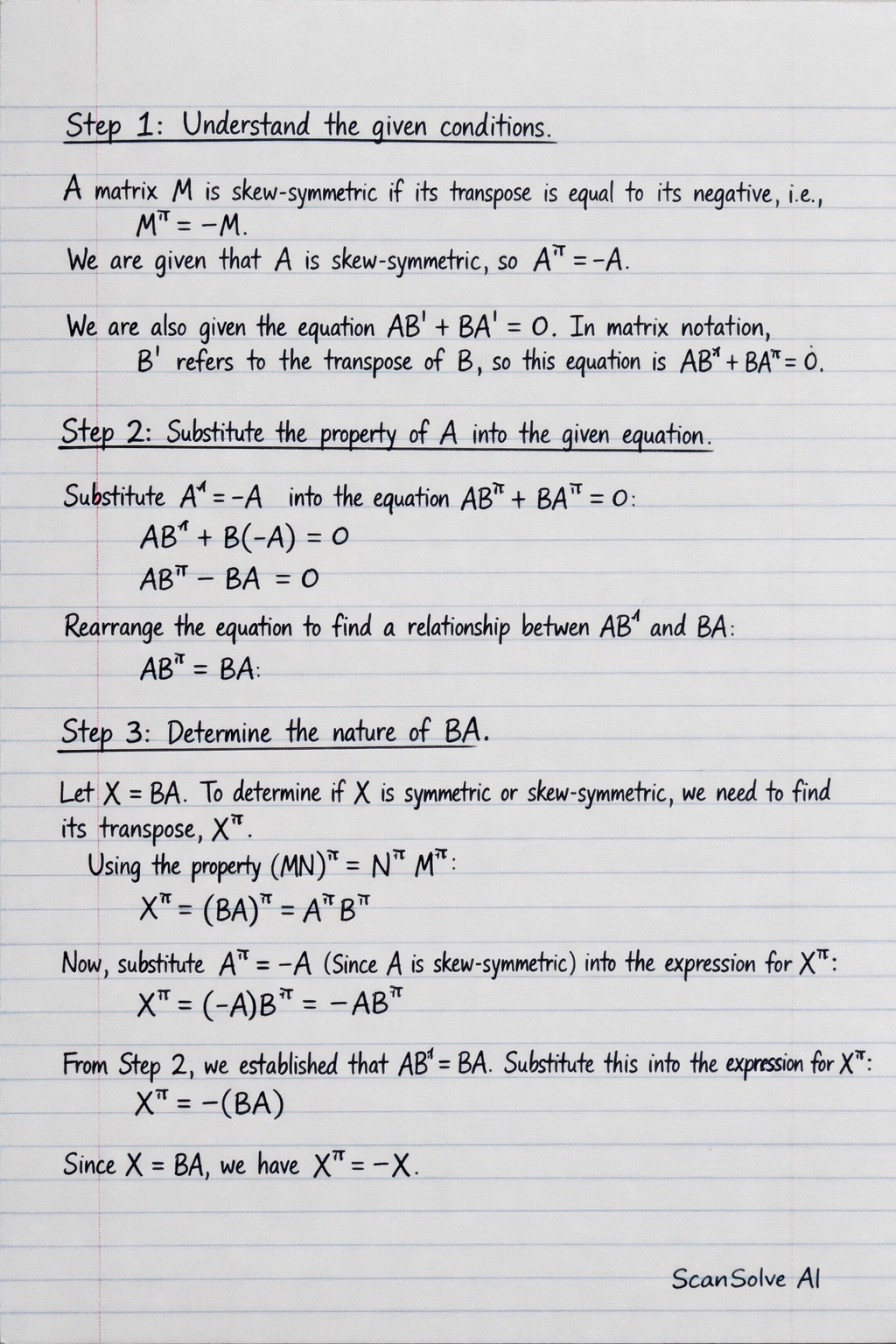
Step 1: Understand the given conditions. A matrix M is skew-symmetric if its transpose is equal to its negative, i.e., M^T = -M. We are given that A is skew-symmetric, so A^T = -A. We are also given the equation AB' + BA' = 0. In matrix notation, B' refers to the transpose of B, so this equation is AB^T + BA^T = 0. Step 2: Substitute the property of A into the given equation. Substitute A^T = -A into the equation AB^T + BA^T = 0: AB^T + B(-A) = 0 AB^T - BA = 0 Rearrange the equation to find a relationship between AB^T and BA: AB^T = BA Step 3: Determine the nature of BA. Let X = BA. To determine if X is symmetric or skew-symmetric, we need to find its transpose, X^T. Using the property (MN)^T = N^T M^T: X^T = (BA)^T = A^T B^T Now, substitute A^T = -A (since A is skew-symmetric) into the expression for X^T: X^T = (-A)B^T = -AB^T From Step 2, we established that AB^T = BA. Substitute this into the expression for X^T: X^T = -(BA) Since X = BA, we have X^T = -X. Step 4: Conclude the nature of BA. The condition X^T = -X means that X is skew-symmetric. Therefore, BA is skew-symmetric. The correct option is B. The final answer is B. Skew-symmetric. That's 2 down. 3 left today — send the next one.