We read your photo as:

If alpha and beta are the roots of the equation 3x2 − 2x − 1 = 0, find the equation whose roots are (alpha)/(beta) and (beta)/(alpha)?

Mathematics

ScanSolve AI Answer

Step-by-step solution

15 steps

Here are the solutions to problems 5, 6, 7, and 8.

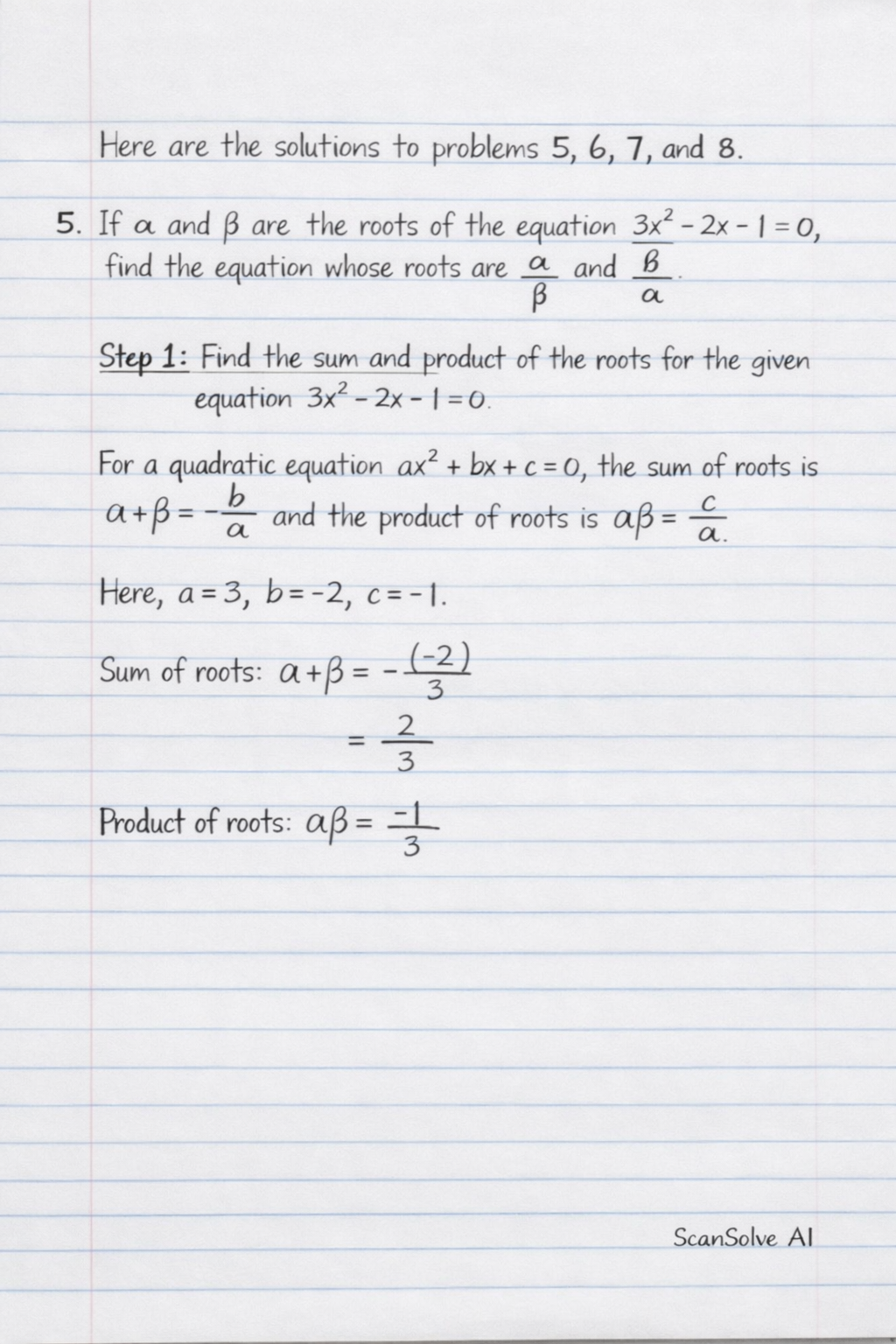
5. If α\alpha and β\beta are the roots of the equation 3x2−2x−1=03x^2 - 2x - 1 = 0, find the equation whose roots are αβ\frac{\alpha}{\beta} and βα\frac{\beta}{\alpha}.

  1. Find the sum and product of the roots for the given equation 3x2−2x−1=03x^2 - 2x - 1 = 0.

    For a quadratic equation ax2+bx+c=0ax^2 + bx + c = 0, the sum of roots is α+β=−ba\alpha + \beta = -\frac{b}{a} and the product of roots is αβ=ca\alpha\beta = \frac{c}{a}.
    Here, a=3a=3, b=−2b=-2, c=−1c=-1.
    Sum of roots: α+β=−−23=23\alpha + \beta = -\frac{-2}{3} = \frac{2}{3}.
    Product of roots: αβ=−13\alpha\beta = \frac{-1}{3}.

  2. Find the sum of the new roots, S′S'.

    The new roots are r1=αβr_1 = \frac{\alpha}{\beta} and r2=βαr_2 = \frac{\beta}{\alpha}.

    S′=αβ+βα=α2+β2αβS' = \frac{\alpha}{\beta} + \frac{\beta}{\alpha} = \frac{\alpha^2 + \beta^2}{\alpha\beta}

    We know that α2+β2=(α+β)2−2αβ\alpha^2 + \beta^2 = (\alpha + \beta)^2 - 2\alpha\beta.
    Substitute this into the expression for S′S':

    S′=(α+β)2−2αβαβS' = \frac{(\alpha + \beta)^2 - 2\alpha\beta}{\alpha\beta}

    Substitute the values of (α+β)(\alpha + \beta) and αβ\alpha\beta:

    S′=(23)2−2(−13)−13S' = \frac{\left(\frac{2}{3}\right)^2 - 2\left(-\frac{1}{3}\right)}{-\frac{1}{3}} S′=49+23−13S' = \frac{\frac{4}{9} + \frac{2}{3}}{-\frac{1}{3}}

    Find a common denominator for the numerator:

    S′=49+69−13=109−13S' = \frac{\frac{4}{9} + \frac{6}{9}}{-\frac{1}{3}} = \frac{\frac{10}{9}}{-\frac{1}{3}} S′=109×(−31)=−309=−103S' = \frac{10}{9} \times \left(-\frac{3}{1}\right) = -\frac{30}{9} = -\frac{10}{3}
  3. Find the product of the new roots, P′P'.

    P′=(αβ)×(βα)=1P' = \left(\frac{\alpha}{\beta}\right) \times \left(\frac{\beta}{\alpha}\right) = 1
  4. Form the new quadratic equation using the formula x2−S′x+P′=0x^2 - S'x + P' = 0.

    x2−(−103)x+1=0x^2 - \left(-\frac{10}{3}\right)x + 1 = 0 x2+103x+1=0x^2 + \frac{10}{3}x + 1 = 0

    Multiply the entire equation by 3 to eliminate the fraction:

    3x2+10x+3=03x^2 + 10x + 3 = 0

    The equation whose roots are αβ\frac{\alpha}{\beta} and βα\frac{\beta}{\alpha} is 3x2+10x+3=0\boxed{3x^2 + 10x + 3 = 0}.

    6. Without solving the equation, find the sum and product of the roots of 3x2+5x−2=03x^2 + 5x - 2 = 0.

  5. Identify the coefficients of the quadratic equation ax2+bx+c=0ax^2 + bx + c = 0.

    For 3x2+5x−2=03x^2 + 5x - 2 = 0, we have a=3a=3, b=5b=5, c=−2c=-2.

  6. Calculate the sum of the roots.

    Sum of roots =−ba=−53= -\frac{b}{a} = -\frac{5}{3}.

  7. Calculate the product of the roots.

    Product of roots =ca=−23= \frac{c}{a} = \frac{-2}{3}.

    The sum of the roots is −53\boxed{-\frac{5}{3}} and the product of the roots is −23\boxed{-\frac{2}{3}}.

    7. The product of two consecutive integers is 132. Find the integers.

  8. Define the integers.

    Let the first integer be nn.
    The next consecutive integer is n+1n+1.

  9. Formulate the equation based on the given information.

    The product of the two consecutive integers is 132:

    n(n+1)=132n(n+1) = 132
  10. Solve the quadratic equation.

    n2+n=132n^2 + n = 132 n2+n−132=0n^2 + n - 132 = 0

    Factor the quadratic equation:

    (n+12)(n−11)=0(n+12)(n-11) = 0

    This gives two possible values for nn:

    n=−12orn=11n = -12 \quad \text{or} \quad n = 11
  11. Find the pairs of consecutive integers.

    If n=11n=11, the integers are 11 and 11+1=1211+1=12.
    Check: 11×12=13211 \times 12 = 132.
    If n=−12n=-12, the integers are −12-12 and −12+1=−11-12+1=-11.
    Check: (−12)×(−11)=132(-12) \times (-11) = 132.

    The integers are 11 and 12\boxed{11 \text{ and } 12} or −12 and −11\boxed{-12 \text{ and } -11}.

    8. The length of a rectangle exceeds its width by 5 units. If the area is 104 square units, find the dimensions.

  12. Define the dimensions of the rectangle.

    Let the width of the rectangle be ww units.
    The length exceeds its width by 5 units, so the length l=w+5l = w+5 units.

  13. Formulate the equation using the area formula.

    The area of a rectangle is l×wl \times w. Given the area is 104 square units.

    (w+5)w=104(w+5)w = 104
  14. Solve the quadratic equation.

    w2+5w=104w^2 + 5w = 104 w2+5w−104=0w^2 + 5w - 104 = 0

    Factor the quadratic equation. We need two numbers that multiply to -104 and add to 5. These numbers are 13 and -8.

    (w+13)(w−8)=0(w+13)(w-8) = 0

    This gives two possible values for ww:

    w=−13orw=8w = -13 \quad \text{or} \quad w = 8
  15. Determine the valid dimensions.

    Since the width of a rectangle cannot be negative, we discard w=−13w=-13.
    So, the width w=8w = 8 units.
    The length l=w+5=8+5=13l = w+5 = 8+5 = 13 units.
    Check: Area =13×8=104= 13 \times 8 = 104 square units.

    The dimensions of the rectangle are length 13 units\boxed{13 \text{ units}} and width 8 units\boxed{8 \text{ units}}.

Was this helpful?

Still stuck on this one?

Ask a follow-up, and the answer starts from this question.

Got a different question?Ask your own question
Handwritten step-by-step solution preview

Handwritten Step-by-Step Solution

Get this as a handwritten image on WhatsApp — like a tutor wrote it for you.

Try on WhatsApp