

This mathematics problem involves applying core mathematical principles and formulas. Below you will find a complete step-by-step solution with detailed explanations for each step, helping you understand not just the answer but the method behind it.
ScanSolve AI Answer
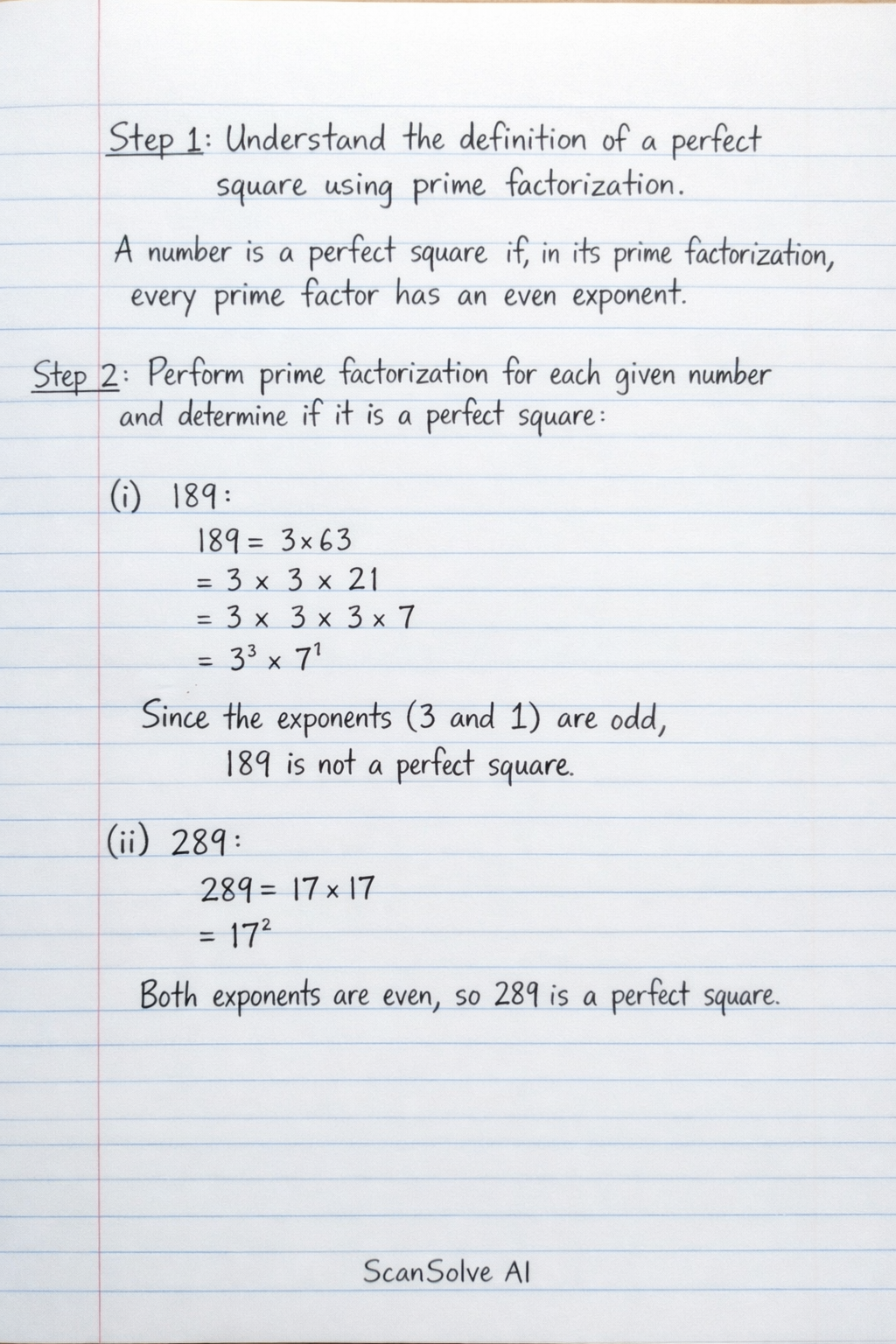
Step 1: Understand the definition of a perfect square using prime factorization. A number is a perfect square if, in its prime factorization, every prime factor has an even exponent. Step 2: Perform prime factorization for each given number and determine if it is a perfect square. (i) 189: 189 = 3 × 63 = 3 × 3 × 21 = 3 × 3 × 3 × 7 = 3^3 × 7^1 Since the exponents (3 and 1) are odd, 189 is not a perfect square. (ii) 289: 28