

This mathematics problem involves applying core mathematical principles and formulas. Below you will find a complete step-by-step solution with detailed explanations for each step, helping you understand not just the answer but the method behind it.
ScanSolve AI Answer
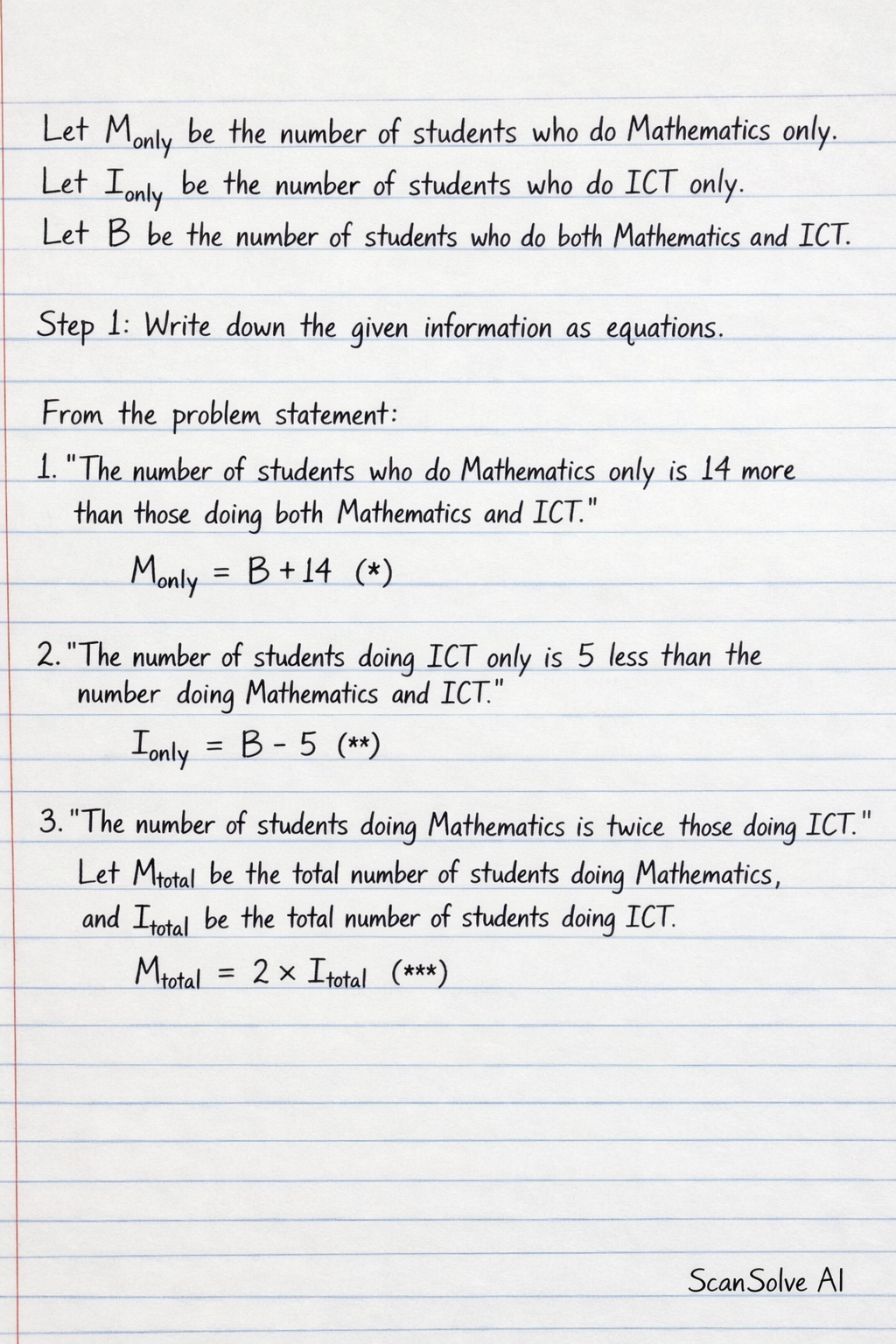
Let M_only be the number of students who do Mathematics only. Let I_only be the number of students who do ICT only. Let B be the number of students who do both Mathematics and ICT. Step 1: Write down the given information as equations. From the problem statement: 1. "The number of students who do Mathematics only is 14 more than those doing both Mathematics and ICT." M_only = B + 14 (*) 2. "The number of students doing ICT only is 5 less than the number doing Mathematics and ICT." I_only = B - 5 (**) 3. "The number of students doing Mathematics is twice those doing ICT." Let M_total be the total number of students doing Mathematics, and I_total be the total number of students doing ICT. M_total = 2 × I_total (*) Step 2: Express M_total and I_total in terms of M_only, I_only, and B. The total number of students doing Mathematics is the sum of those doing Mathematics only and those doing both: M_total = M_only + B The total number of students doing ICT is the sum of those doing ICT only and those doing both: I_total = I_only + B Step 3: Substitute equations () and (*) into the expressions for M_total and I_total. Substitute M_only = B + 14 into the equation for M_total: M_total = (B + 14) + B = 2B + 14 Substitute I_only = B - 5 into the equation for I_total: I_total = (B - 5) + B = 2B - 5 Step 4: Substitute the expressions for M_total and I_total into equation (*) and solve for B. Using M_total = 2 × I_total: 2B + 14 = 2 × (2B - 5) Distribute the 2 on the right side: 2B + 14 = 4B - 10 Subtract 2B from both sides: 14 = 2B - 10 Add 10 to both sides: 14 + 10 = 2B 24 = 2B Divide by 2: B = (24)/(2) B = 12 The number of students who do both Mathematics and ICT is B. The final answer is 12.