
We read your photo as:
In PQS, R is the mid-point of QS.
Mathematics
ScanSolve AI Answer
Answer
Step-by-step solution
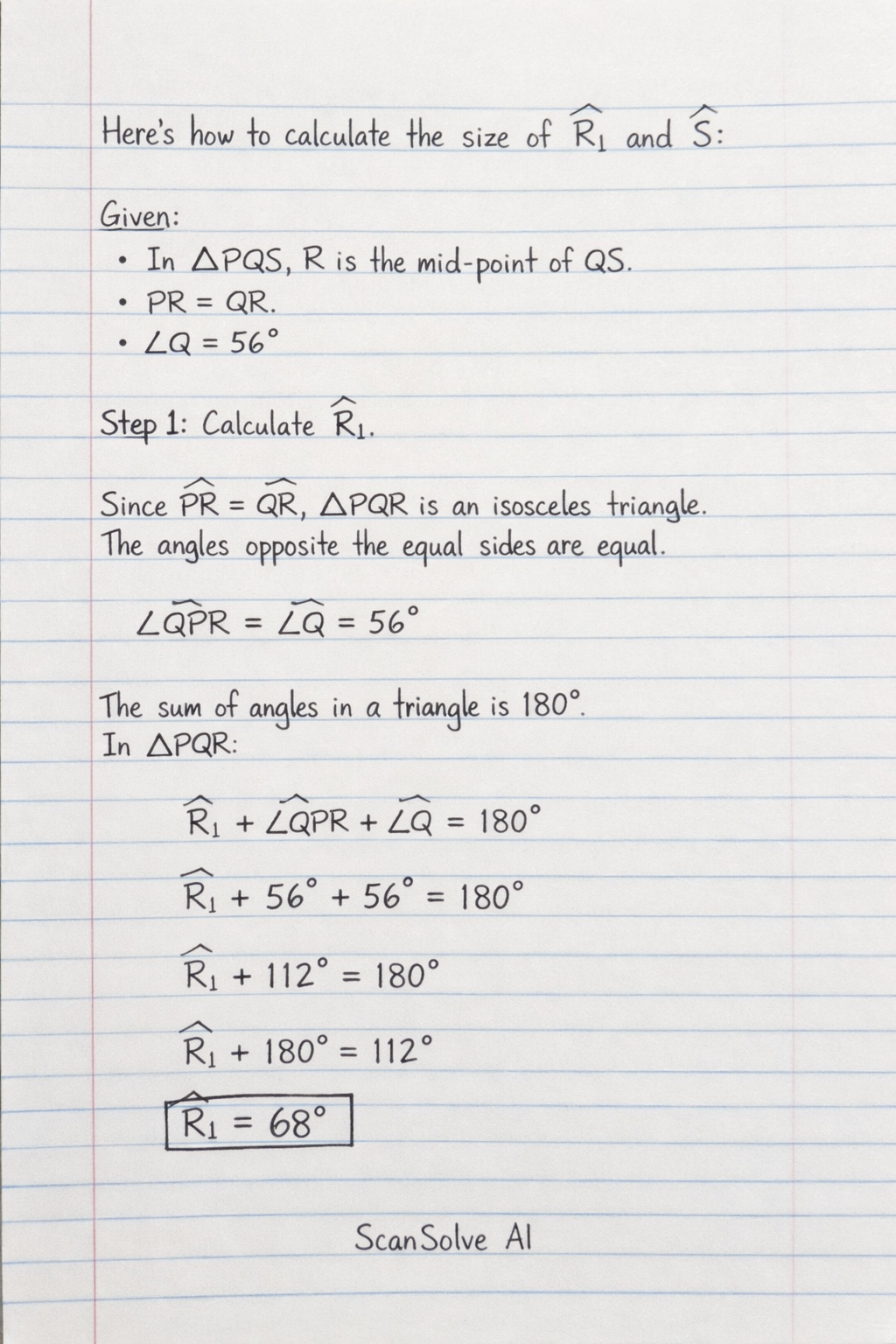
2 stepsHere's how to calculate the size of and :
Given:
- In , R is the mid-point of QS.
- .
- .
Calculate .
Since , is an isosceles triangle. The angles opposite the equal sides are equal.
The sum of angles in a triangle is . In :
Calculate .
Angles and (which is ) are supplementary angles because they form a straight line at R on QS.
Since R is the mid-point of QS, . We are given .
Therefore, . This means is an isosceles triangle.
The angles opposite the equal sides are equal:The sum of angles in is :
Was this helpful?
Still stuck on this one?
Ask a follow-up, and the answer starts from this question.
Got a different question?Ask your own question
More Mathematics Questions
QGiven that PQ:QR = 1:2, point Q divides the line segment PR in the ratio 1:2. Using the section…QGiven points P(0, 3), Q(4, 1), R(2, −3), S(−2, −1), show PR = QS, find the midpoint of QS (N), and…QPQRS is a cyclic quadrilateral. TPX is a tangent. RQX is a straight line. RPQ = 50^ . PRS = 25^ . If…QGiven PQS = 45^ and QPS = 45^.QGiven points P(0, 3), Q(4, 1), R(2, −3), and S(−2, −1), show that PR = QS, determine the coordinates…
Handwritten Step-by-Step Solution
Get this as a handwritten image on WhatsApp — like a tutor wrote it for you.
Try on WhatsApp