We read your photo as:

In the diagram below, P (1:0), Q (6:3) and R (9; -2) are the vertices of a triangle, such that PQ = QR and PQ ⊥ QR. T is the midpoint of PQ. S is the point of intersection of RQ and x-axis. V is a point on the x-axis such that ∠QSV = 121°. ∠QPS = θ

Mathematics

ScanSolve AI Answer

Step-by-step solution

17 steps

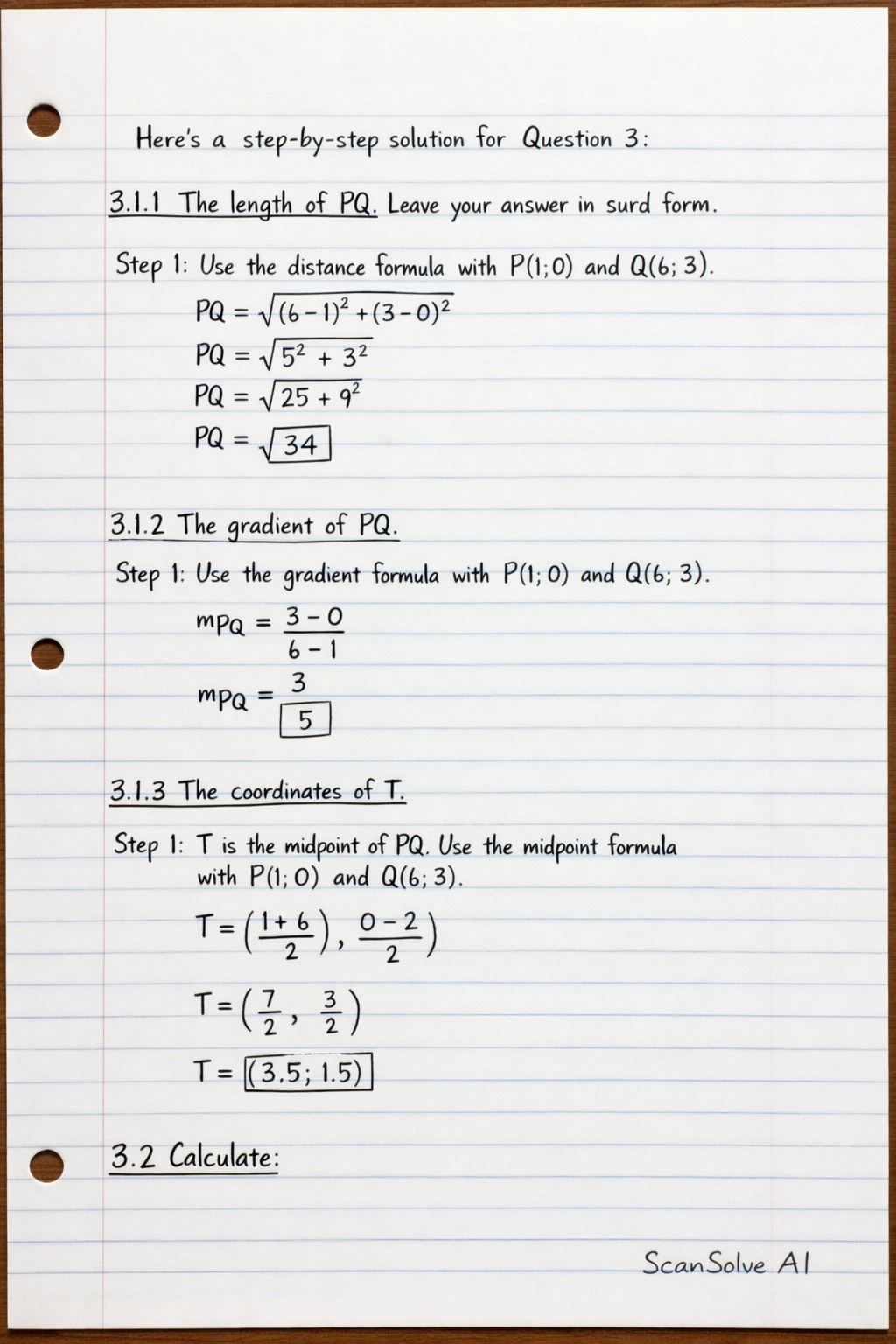
Here's a step-by-step solution for Question 3:

3.1 Determine:

3.1.1 The length of PQ. Leave your answer in a surd form.

  1. Use the distance formula d=(x2−x1)2+(y2−y1)2d = \sqrt{(x_2-x_1)^2 + (y_2-y_1)^2} with P(1;0)P(1;0) and Q(6;3)Q(6;3).

    PQ=(6−1)2+(3−0)2PQ = \sqrt{(6-1)^2 + (3-0)^2} PQ=(5)2+(3)2PQ = \sqrt{(5)^2 + (3)^2} PQ=25+9PQ = \sqrt{25 + 9} PQ=34PQ = \boxed{\sqrt{34}}

    3.1.2 The gradient of PQ.

  2. Use the gradient formula m=y2−y1x2−x1m = \frac{y_2-y_1}{x_2-x_1} with P(1;0)P(1;0) and Q(6;3)Q(6;3).

    mPQ=3−06−1m_{PQ} = \frac{3-0}{6-1} mPQ=35m_{PQ} = \boxed{\frac{3}{5}}

    3.1.3 The coordinates of T.

  3. T is the midpoint of PQ.

    Use the midpoint formula M=(x1+x22,y1+y22)M = \left(\frac{x_1+x_2}{2}, \frac{y_1+y_2}{2}\right) with P(1;0)P(1;0) and Q(6;3)Q(6;3).

    T=(1+62,0+32)T = \left(\frac{1+6}{2}, \frac{0+3}{2}\right) T=(72,32)T = \left(\frac{7}{2}, \frac{3}{2}\right) T=(3.5;1.5)T = \boxed{(3.5; 1.5)}

    3.2 Calculate:

    3.2.1 The area of △QTR\triangle QTR.

  4. Given PQ⊥QRPQ \perp QR, △PQR\triangle PQR is a right-angled triangle at Q.

    The area of △PQR=12×PQ×QR\triangle PQR = \frac{1}{2} \times PQ \times QR.

  5. Given PQ=QRPQ=QR and PQ=34PQ=\sqrt{34} (from 3.1.1), so PQ2=34PQ^2 = 34.

    Area of △PQR=12×PQ2=12×34=17 square units\text{Area of } \triangle PQR = \frac{1}{2} \times PQ^2 = \frac{1}{2} \times 34 = 17 \text{ square units}
  6. T is the midpoint of PQ, so QT=12PQQT = \frac{1}{2} PQ.

    △QTR\triangle QTR shares the same height (QR) as △PQR\triangle PQR relative to base PQ.

    Area of △QTR=12×QT×QR=12×(12PQ)×QR\text{Area of } \triangle QTR = \frac{1}{2} \times QT \times QR = \frac{1}{2} \times \left(\frac{1}{2} PQ\right) \times QR Area of △QTR=14×PQ×QR=14×PQ2\text{Area of } \triangle QTR = \frac{1}{4} \times PQ \times QR = \frac{1}{4} \times PQ^2 Area of △QTR=14×34=172\text{Area of } \triangle QTR = \frac{1}{4} \times 34 = \frac{17}{2} Area of △QTR=8.5 square units\text{Area of } \triangle QTR = \boxed{8.5 \text{ square units}}

    3.2.2 The size of θ\theta with reasons.

  7. θ=∠QPS\theta = \angle QPS.

    Since P and S are on the x-axis, ∠QPS\angle QPS is the angle of inclination of the line segment PQ with the positive x-axis.

  8. The gradient of PQ is mPQ=35m_{PQ} = \frac{3}{5} (from 3.1.2).

  9. The angle of inclination θ\theta is given by tan⁡θ=mPQ\tan \theta = m_{PQ}.

    tan⁡θ=35\tan \theta = \frac{3}{5} θ=arctan⁡(35)\theta = \arctan\left(\frac{3}{5}\right) θ≈30.9637∘\theta \approx 30.9637^{\circ} θ=30.96∘\theta = \boxed{30.96^{\circ}}

    Reason: The angle θ\theta is the angle of inclination of line PQ with the positive x-axis.

    3.2.3 The coordinates of S.

  10. S is the point of intersection of line RQ and the x-axis.

    First, find the equation of line RQ using Q(6;3)Q(6;3) and R(9;−2)R(9;-2).

  11. Calculate the gradient of RQ.

    mRQ=−2−39−6=−53m_{RQ} = \frac{-2-3}{9-6} = \frac{-5}{3}
  12. Use the point-slope form y−y1=m(x−x1)y - y_1 = m(x - x_1) with Q(6;3)Q(6;3).

    y−3=−53(x−6)y - 3 = -\frac{5}{3}(x - 6) y−3=−53x+303y - 3 = -\frac{5}{3}x + \frac{30}{3} y−3=−53x+10y - 3 = -\frac{5}{3}x + 10 y=−53x+13y = -\frac{5}{3}x + 13
  13. To find S (on the x-axis), set y=0y=0.

    0=−53x+130 = -\frac{5}{3}x + 13 53x=13\frac{5}{3}x = 13 5x=395x = 39 x=395=7.8x = \frac{39}{5} = 7.8 S=(7.8;0)S = \boxed{(7.8; 0)}

    Determine, with reasons, the gradient of a line through T and the midpoint of PR.

  14. Let M be the midpoint of PR.

    Use the midpoint formula with P(1;0)P(1;0) and R(9;−2)R(9;-2).

    M=(1+92,0+(−2)2)M = \left(\frac{1+9}{2}, \frac{0+(-2)}{2}\right) M=(102,−22)M = \left(\frac{10}{2}, \frac{-2}{2}\right) M=(5;−1)M = (5; -1)
  15. T is the midpoint of PQ (from 3.1.3), T=(3.5;1.5)T=(3.5; 1.5).

    M is the midpoint of PR.

  16. By the Midpoint Theorem, the line segment connecting the midpoints of two sides of a triangle is parallel to the third side.

    Therefore, TM∥QRTM \parallel QR.

  17. Since TM∥QRTM \parallel QR, their gradients are equal

    mTM=mQRm_{TM} = m_{QR}. We already calculated mQRm_{QR} in 3.2.3.

    mTM=mQR=−53m_{TM} = m_{QR} = \boxed{-\frac{5}{3}}

    Reason: By the Midpoint Theorem, the line segment connecting the midpoints of two sides of a triangle is parallel to the third side. Since T is the midpoint of PQ and M is the midpoint of PR, TM is parallel to QR. Therefore, their gradients are equal.

Was this helpful?

Still stuck on this one?

Ask a follow-up, and the answer starts from this question.

Got a different question?Ask your own question
Handwritten step-by-step solution preview

Handwritten Step-by-Step Solution

Get this as a handwritten image on WhatsApp — like a tutor wrote it for you.

Try on WhatsApp