We read your photo as:

In the diagram, WXYZ is a square of length 7 cm. Calculate, correct to three significant figures, the area of the shaded region. [Take pi = 22/7]

Mathematics

ScanSolve AI Answer

Step-by-step solution

5 steps

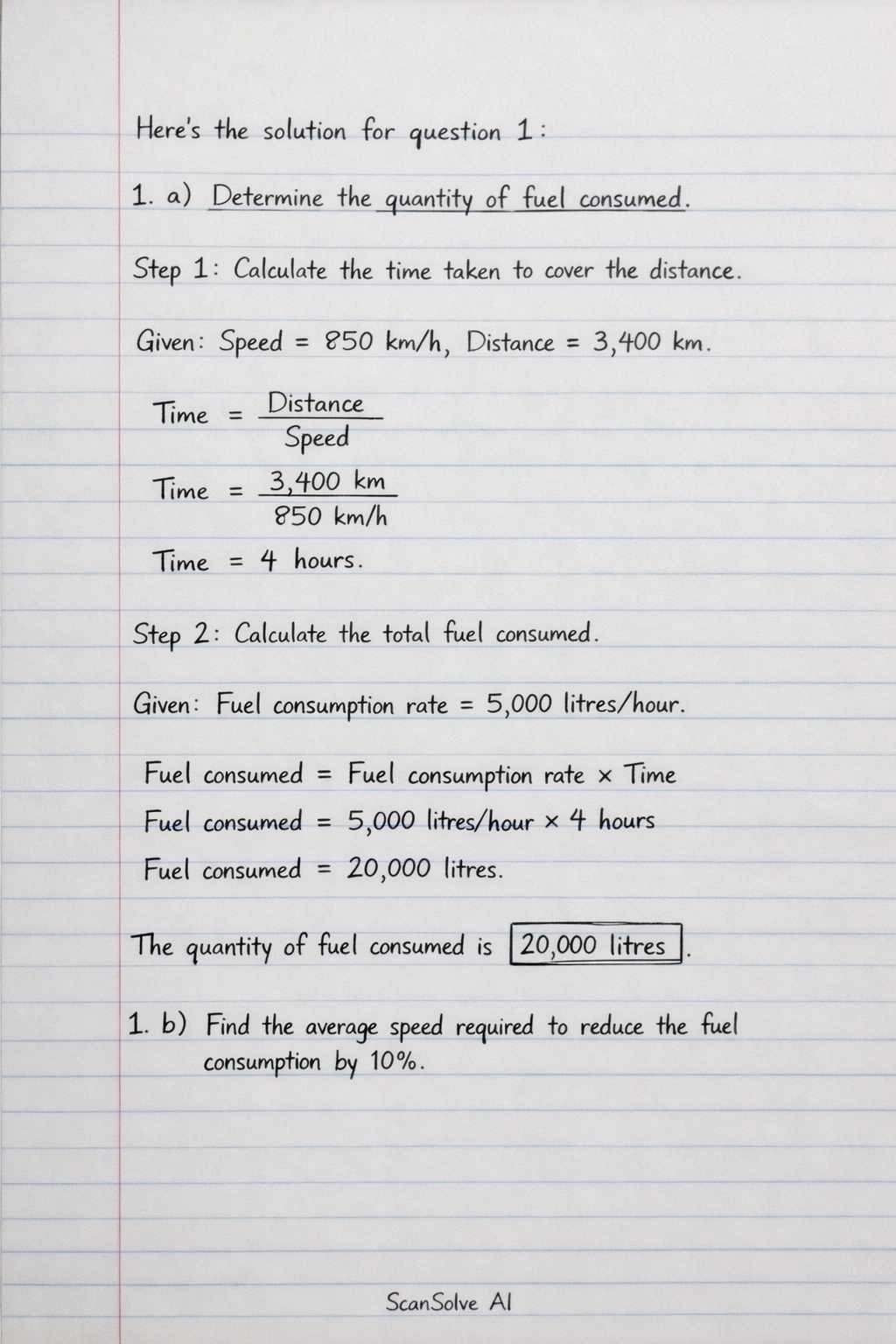
Here's the solution for question 1:

1. a) Determine the quantity of fuel consumed.

  1. Calculate the time taken to cover the distance.

    Given: Speed =850 km/h= 850 \text{ km/h}, Distance =3,400 km= 3,400 \text{ km}.

    Time=DistanceSpeed\text{Time} = \frac{\text{Distance}}{\text{Speed}} Time=3,400 km850 km/h\text{Time} = \frac{3,400 \text{ km}}{850 \text{ km/h}} Time=4 hours\text{Time} = 4 \text{ hours}
  2. Calculate the total fuel consumed.

    Given: Fuel consumption rate =5,000 litres/hour= 5,000 \text{ litres/hour}.

    Fuel consumed=Fuel consumption rate×Time\text{Fuel consumed} = \text{Fuel consumption rate} \times \text{Time} Fuel consumed=5,000 litres/hour×4 hours\text{Fuel consumed} = 5,000 \text{ litres/hour} \times 4 \text{ hours} Fuel consumed=20,000 litres\text{Fuel consumed} = 20,000 \text{ litres}

    The quantity of fuel consumed is 20,000 litres\boxed{20,000 \text{ litres}}.

    1. b) Find the average speed required to reduce the fuel consumption by 10%.

  3. Determine the new fuel consumption rate.

    Original fuel consumption rate =5,000 litres/hour= 5,000 \text{ litres/hour}.
    Reduction by 10% means the new consumption is 100%−10%=90%100\% - 10\% = 90\% of the original.

    New fuel consumption rate=0.90×5,000 litres/hour\text{New fuel consumption rate} = 0.90 \times 5,000 \text{ litres/hour} New fuel consumption rate=4,500 litres/hour\text{New fuel consumption rate} = 4,500 \text{ litres/hour}
  4. Use the proportionality between fuel consumption and speed to find the new speed.

    Let F1F_1 be the original fuel consumption rate and S1S_1 be the original speed.
    Let F2F_2 be the new fuel consumption rate and S2S_2 be the new speed.
    Since fuel consumption is proportional to speed:

    F1S1=F2S2\frac{F_1}{S_1} = \frac{F_2}{S_2} 5,000 litres/hour850 km/h=4,500 litres/hourS2\frac{5,000 \text{ litres/hour}}{850 \text{ km/h}} = \frac{4,500 \text{ litres/hour}}{S_2}
  5. Solve for S2S_2.

    S2=4,500 litres/hour×850 km/h5,000 litres/hourS_2 = \frac{4,500 \text{ litres/hour} \times 850 \text{ km/h}}{5,000 \text{ litres/hour}} S2=4,500×8505,000 km/hS_2 = \frac{4,500 \times 850}{5,000} \text{ km/h} S2=9×85010 km/hS_2 = \frac{9 \times 850}{10} \text{ km/h} S2=9×85 km/hS_2 = 9 \times 85 \text{ km/h} S2=765 km/hS_2 = 765 \text{ km/h}

    The average speed required is 765 km/h\boxed{765 \text{ km/h}}.

Was this helpful?

Still stuck on this one?

Ask a follow-up, and the answer starts from this question.

Got a different question?Ask your own question
Handwritten step-by-step solution preview

Handwritten Step-by-Step Solution

Get this as a handwritten image on WhatsApp — like a tutor wrote it for you.

Try on WhatsApp