
![Find L^-1\[\(1)/(s(s+1)(s+2))\]](/_next/image?url=https%3A%2F%2Fohijasnjvprzodcmxltt.supabase.co%2Fstorage%2Fv1%2Fobject%2Fpublic%2Fwhatsapp-images%2F1775231761405-86501be11890c8f9.png&w=3840&q=75)
This mathematics problem involves applying core mathematical principles and formulas. Below you will find a complete step-by-step solution with detailed explanations for each step, helping you understand not just the answer but the method behind it.
ScanSolve AI Answer
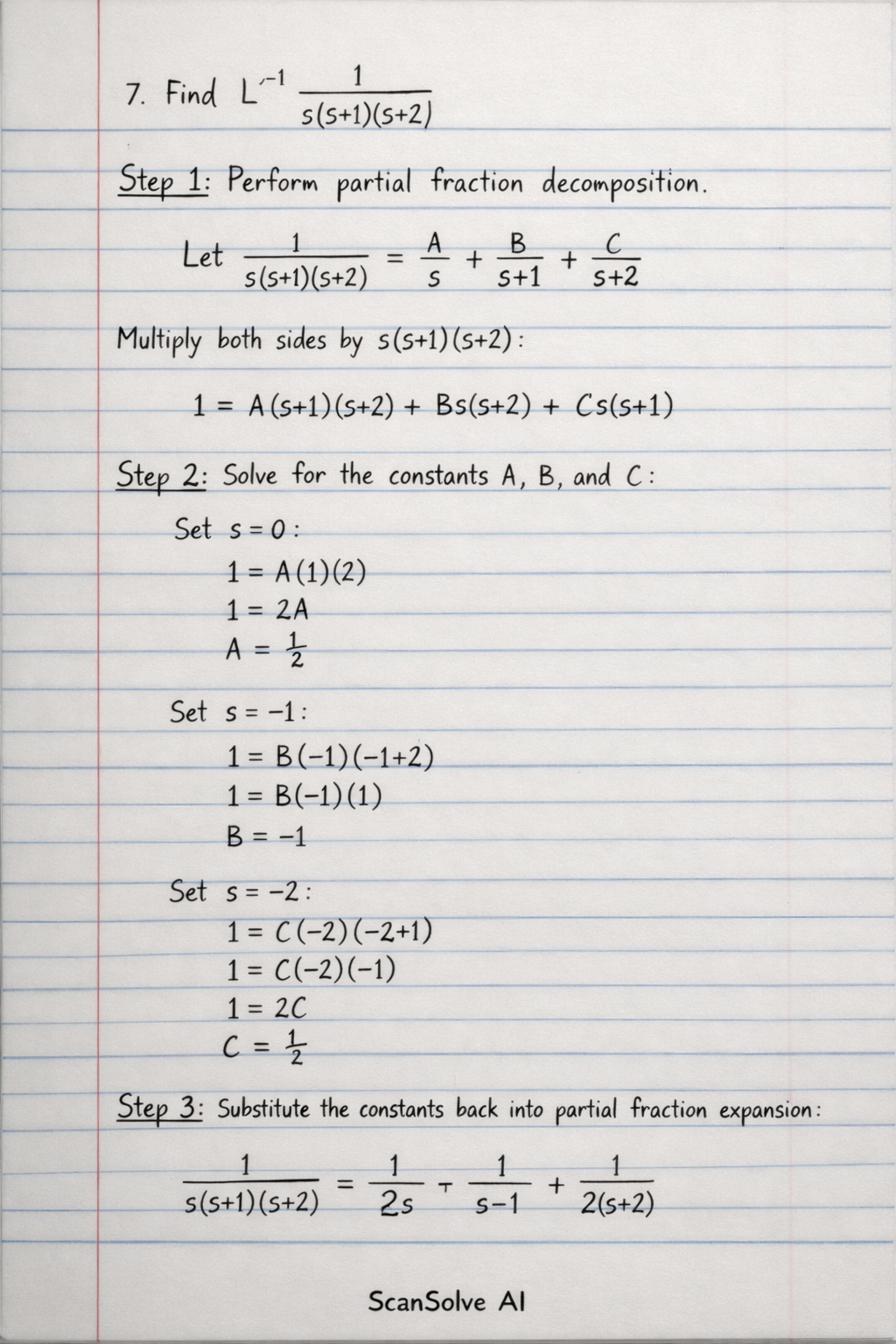
Here are the solutions for questions 7, 10, 11, and 12: 7. Find L^-1[(1)/(s(s+1)(s+2))] Step 1: Perform partial fraction decomposition. Let (1)/(s(s+1)(s+2)) = (A)/(s) + (B)/(s+1) + (C)/(s+2). Multiply both sides by s(s+1)(s+2): 1 = A(s+1)(s+2) + B s(s+2) + C s(s+1) Step 2: Solve for the constants A, B, and C. Set s=0: 1 = A(1)(2) 1 = 2A A = (1)/(2) Set s=-1: 1 = B(-1)(-1+2) 1 = B(-1)(1) B = -1 Set s=-2: 1 = C(-2)(-2+1) 1 = C(-2)(-1) 1 = 2C C = (1)/(2) Step 3: Substitute the constants back into the partial fraction expansion. (1)/(s(s+1)(s+2)) = (1/2)/(s) - (1)/(s+1) + (1/2)/(s+2) Step 4: Apply the inverse Laplace transform to each term. Using the formulas L^-1[(1)/(s)] = 1 and L^-1[(1)/(s-k)] = e^kt: L^-1[(1)/(s(s+1)(s+2))] = (1)/(2)L^-1[(1)/(s)] - L^-1[(1)/(s+1)] + (1)/(2)L^-1[(1)/(s+2)] L^-1[(1)/(s(s+1)(s+2))] = (1)/(2)(1) - e^-t + (1)/(2)e^-2t L^-1[(1)/(s(s+1)(s+2))] = (1)/(2) - e^-t + (1)/(2)e^-2t --- 10. Find L[t^3 e^at] Step 1: Identify the function f(t) and the power n. Here, f(t) = e^at and n=3. Step 2: Find the Laplace transform of f(t). F(s) = L[e^at] = (1)/(s-a) Step 3: Apply the property L[t^n f(t)] = (-1)^n (d^n)/(ds^n) F(s). For n=3: L[t^3 e^at] = (-1)^3 (d^3)/(ds^3)((1)/(s-a)) L[t^3 e^at] = - (d^3)/(ds^3)(s-a)^-1 Step 4: Calculate the derivatives. First derivative: (d)/(ds)(s-a)^-1 = -1(s-a)^-2 Second derivative: (d^2)/(ds^2)(s-a)^-1 = (-1)(-2)(s-a)^-3 = 2(s-a)^-3 Third derivative: (d^3)/(ds^3)(s-a)^-1 = 2(-3)(s-a)^-4 = -6(s-a)^-4 Step 5: Substitute the third derivative back into the formula. L[t^3 e^at] = - (-6(s-a)^-4) L[t^3 e^at] = 6(s-a)^-4 L[t^3 e^at] = (6)/((s-a)^4) --- 11. Find L[t e^t t] Step 1: Find the Laplace transform of t. Let f(t) = t. L[ t] = (1)/(s^2+1) Step 2: Apply the First Shifting Theorem for L[e^t t]. If L[f(t)] = F(s), then L[e^atf(t)] = F(s-a). Here a=1. L[e^t t] = (1)/((s-1)^2+1) Let G(s) = (1)/((s-1)^2+1). Step 3: Apply the multiplication by t property for L[t (e^t t)]. If L[g(t)] = G(s), then L[t g(t)] = - (d)/(ds) G(s). L[t e^t t] = - (d)/(ds)((1)/((s-1)^2+1)) L[t e^t t] = - (d)/(ds)((s-1)^2+1)^-1 Step 4: Calculate the derivative. (d)/(ds)((s-1)^2+1)^-1 = -1((s-1)^2+1)^-2 · (d)/(ds)((s-1)^2+1) = -1((s-1)^2+1)^-2 · (2(s-1)) = -(2(s-1))/(((s-1)^2+1)^2) Step 5: Substitute the derivative back into the formula. L[t e^t t] = - (-\