
We read your photo as:
La limite de f(x) lorsque x tend vers +∞ est
Mathematics
ScanSolve AI Answer
Answer
Step-by-step solution
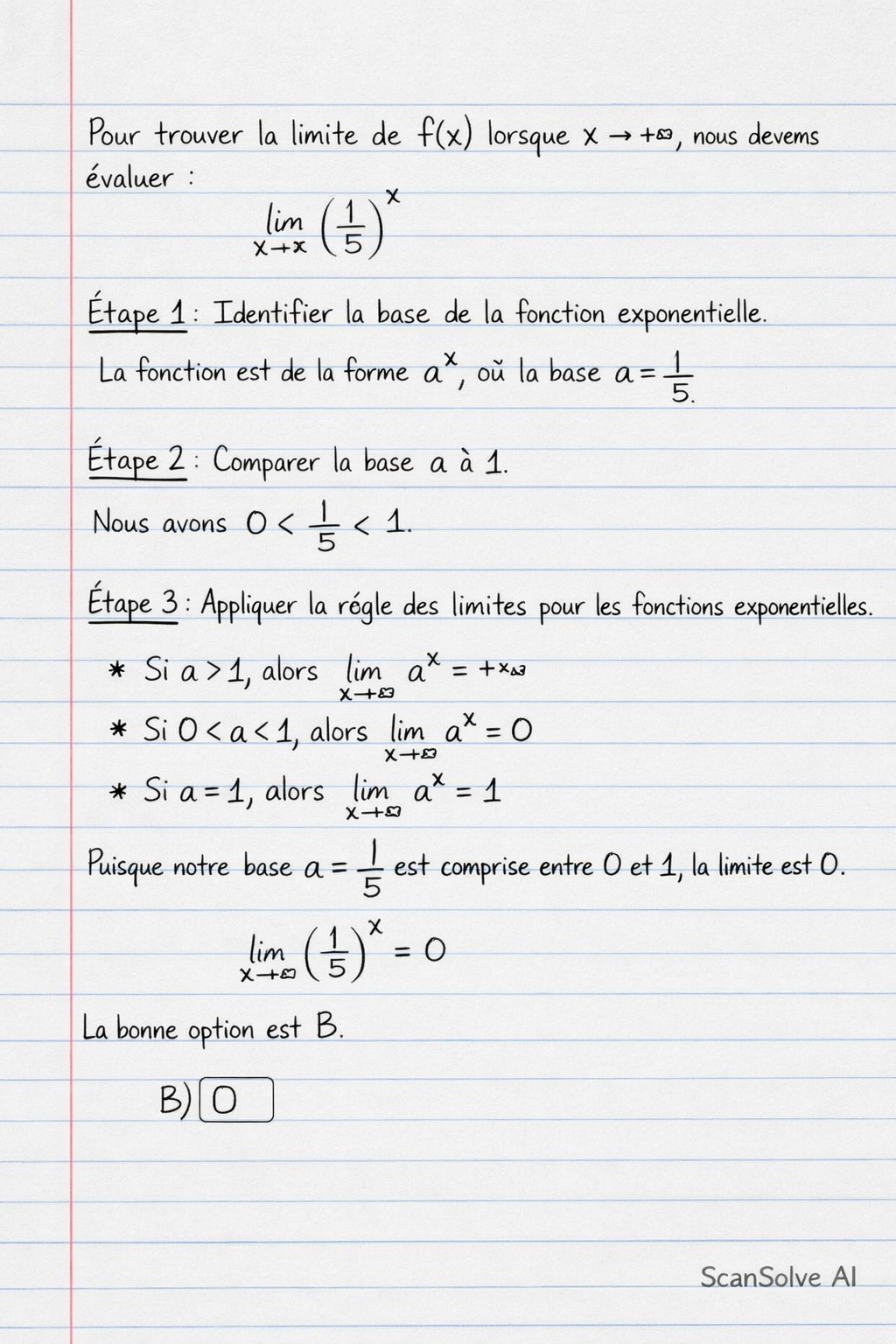
3 stepsPour trouver la limite de lorsque tend vers , nous devons évaluer :
Identifier la base de la fonction exponentielle.
La fonction est de la forme , où la base .
Comparer la base à 1.
Nous avons .
Appliquer la règle des limites pour les fonctions exponentielles.
Pour une fonction exponentielle :
- Si , alors .
- Si , alors .
- Si , alors .
Puisque notre base est comprise entre 0 et 1, la limite est 0.
La bonne option est B.
- B)
Was this helpful?
Try one yourself
A new problem that tests the same skill.
Still stuck on this one?
Ask a follow-up, and the answer starts from this question.
Got a different question?Ask your own question
More Mathematics Questions
QSoit la fonction f définie sur ]2, + extinfty[ par f(x) = x−1 + extln extleft( racx-2x+2 extright)…QCalculer la limite de f_n(x) - nx + 2 quand x tend vers -infinity et interpréter le résultat…QEn posant q = ln x / x. Donner la forme simple de (Un). Quelle est sa limite ?QCalculer la limite suivante : lim x→+∞ √(x² + 5x) − xQCalculer les limites suivantes: A = lim(x->+inf) (5x2+3x+7)/(x3-4x), B = lim(x->+
Handwritten Step-by-Step Solution
Get this as a handwritten image on WhatsApp — like a tutor wrote it for you.
Try on WhatsApp