

This mathematics problem involves applying core mathematical principles and formulas. Below you will find a complete step-by-step solution with detailed explanations for each step, helping you understand not just the answer but the method behind it.
ScanSolve AI Answer
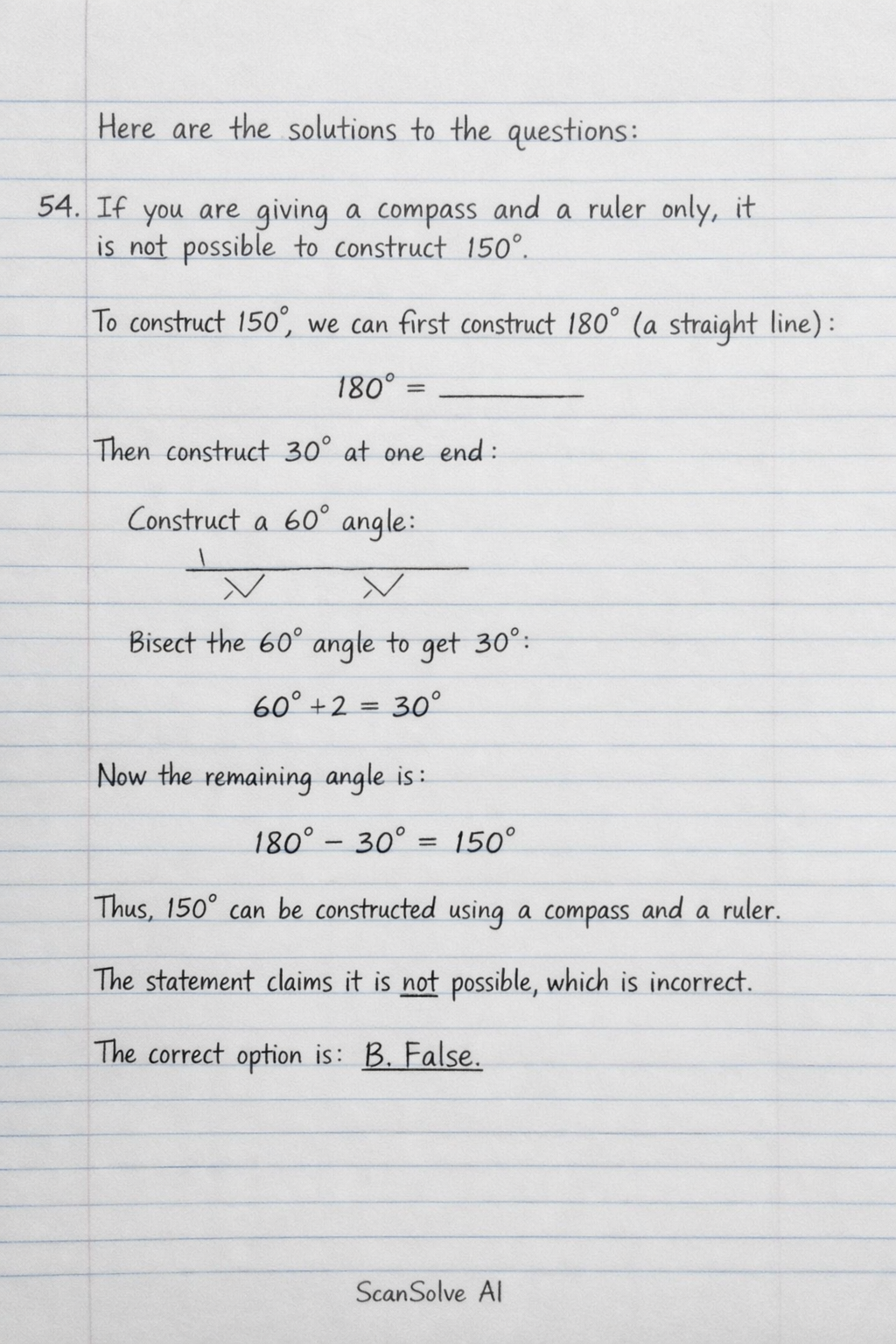
Here are the solutions to the questions: 54. If you are giving a compass and a ruler only, is not possible to construct 150^. To construct 150^, one can first construct 180^ (a straight line) and then construct 30^ from one end. The remaining angle will be 150^. Since 30^ can be constructed by bisecting a 60^ angle (which is constructible), 150^ is constructible using only a compass and a ruler. The statement claims it is not possible, which is incorrect. The correct option is B. False. 55. In the figure below, BOC represents 30^. The construction marks show: 1. An arc centered at O, passing through C. 2. An arc centered at C, with the same radius, intersecting the first arc at A. This implies OAC is equilateral, so COA = 60^. 3. An arc centered at A, with the same radius, intersecting the first arc at B. This implies OAB is equilateral, so AOB = 60^. Therefore, BOC = COA + AOB = 60^ + 60^ = 120^. The statement claims BOC represents 30^, which is incorrect. The correct option is B. False. SECTION C 1. a) A(28^ N, 25^ W) and B(32^ S, 25^ W) are two places on the earth's surface. Calculate the distance of AB measured along the meridian. (Take R = 6400km, and = 3.142). Step 1: Determine the angular difference between points A and B. Since both points are on the same meridian (25^ W) but on opposite sides of the equator (North and South), the angular difference is the sum of their latitudes. = 28^ + 32^ = 60^ Step 2: Calculate the distance along the meridian using the formula L = ()/(360^) × 2 R. L = (60^)/(360^) × 2 × 3.142 × 6400 km L = (1)/(6) × 2 × 3.142 × 6400 km L = (1)/(3) × 3.142 × 6400 km L = (20108.8)/(3) km L ≈ 6702.93 km The distance of AB measured along the meridian is 6702.93 km. 1. b) If = (5)/(13), 0^ < < 90^, find: i) . ii) . Given = (5)/(13) and is in the first quadrant. We can use the Pythagorean identity ^2 + ^2 = 1 or a right-angled triangle. Using a right-angled triangle: Opposite side = 5, Hypotenuse = 13. Adjacent side = sqrt(13^2 - 5^2) = sqrt(169 - 25) = sqrt(144) = 12. i) Find . = AdjacentHypotenuse = (12)/(13) Since is in the first quadrant, is positive. = (12)/(13) ii) Find . = OppositeAdjacent = (5)/(12) Since is in the first quadrant, is positive. = (5)/(12) 1. c) In a regular hexagon, each interior angle measures 120^. Find the measure of each exterior angle. For any polygon, the sum of an interior angle and its corresponding exterior angle is 180^. Exterior angle = 180^ - Interior angle Exterior angle = 180^ - 120^ Exterior angle = 60^ The measure of each exterior angle is 60^. 1. d) A bag contains 5 red marbles and 3 blue marbles. If two marbles are drawn at random without replacement, what is the probability of getting two red marbles? Step 1: Calculate the total number of marbles. Total marbles = 5 (red) + 3 (blue) = 8 marbles. Step 2: Calculate the probability of drawing the first red marble. P(1st Red) = Number of red marblesTotal number of marbles = (5)/(8) Step 3: Calculate the probability of drawing the second red marble, given the first was red and not replaced. After drawing one red marble, there are 4 red marbles left and 7 total marbles left. P(2nd Red | 1st Red) = (4)/(7) Step 4: Calculate the probability of drawing two red marbles. P(Two Red) = P(1st Red) × P(2nd Red | 1st Red) P(Two Red) = (5)/(8) × (4)/(7) P(Two Red) = (20)/(56) Simplify the fraction: P(Two Red) = (5)/(14) The probability of getting two red marbles is (5)/(14) . 1. e) Construct triangle XYZ, where |XY| = 5 cm, |YZ| = 7 cm and |XZ| = 9 cm. Construct the mediators of |XY| and |YZ| to meet at W, and hence with |XW| as radius, construct a circumcircle. Here are the steps for the construction: Step 1: Construct triangle XYZ. • Draw a line segment XY of length 5 cm. • With X as the center and a radius of 9 cm, draw an arc. • With Y as the center and a radius of 7 cm, draw another arc. • The intersection point of these two arcs is Z. • Join XZ and YZ to complete triangle XYZ. Step 2: Construct the perpendicular bisector (mediator) of XY. • With X as the center and a radius greater than half the length of XY, draw arcs above and below XY. • With Y as the center and the same radius, draw arcs that intersect the previous arcs. • Draw a straight line through these two intersection points. This line is the perpendicular bisector of XY. Step 3: Construct the perpendicular bisector (mediator) of YZ. • With Y as the center and a radius greater than half the length of YZ, draw arcs above and below YZ. • With Z as the center and the same radius, draw arcs that intersect the previous arcs. • Draw a straight line through these two intersection points. This line is the perpendicular bisector of YZ. Step 4: Locate point W. • The point where the two perpendicular bisectors (from Step 2 and Step 3) intersect is point W. This point W is the circumcenter of triangle XYZ. Step 5: Construct the circumcircle. • With W as the center and a radius equal to the distance from W to X (i.e., |XW|), draw a circle. This circle will pass through points X, Y, and Z, and is the circumcircle of triangle XYZ. That's 2 down. 3 left today — send the next one.