
We read your photo as:
Find the least number which when added to 10 is exactly divisible by 14, 35, 40 and 56.
Mathematics
ScanSolve AI Answer
Answer
Step-by-step solution
4 stepsFind the prime factorization of each number.
Calculate the Least Common Multiple (LCM) of 14, 35, 40, and 56.
The LCM is the product of all prime factors raised to their highest powers.
The prime factors are .
Highest power of 2 is .
Highest power of 5 is .
Highest power of 7 is .Set up the equation to find the required number.
Let the required number be .
According to the problem, when 10 is added to , the result is exactly divisible by and 56. This means must be equal to the LCM.Solve for .
The least number is .
Was this helpful?
Try one yourself
A new problem that tests the same skill.
Still stuck on this one?
Ask a follow-up, and the answer starts from this question.
Got a different question?Ask your own question
More Mathematics Questions
QFind the smallest number which when added by 5 is divisible by 12, 14 and 18.QFind the smallest number that is a multiple of all the numbers from 1 to 10, except for 7. 10. Find…QFind the greatest number which divides 290 and 538 leaving remainders 3 and 5 respectively.QThe problem states that when a number x is divided by 30, 45, or 54, the remainder is always 21…QWrite possible three-digit numbers using digits 4, 7, 9 and find the smallest and greatest among…
Browse by topic:Number Theory
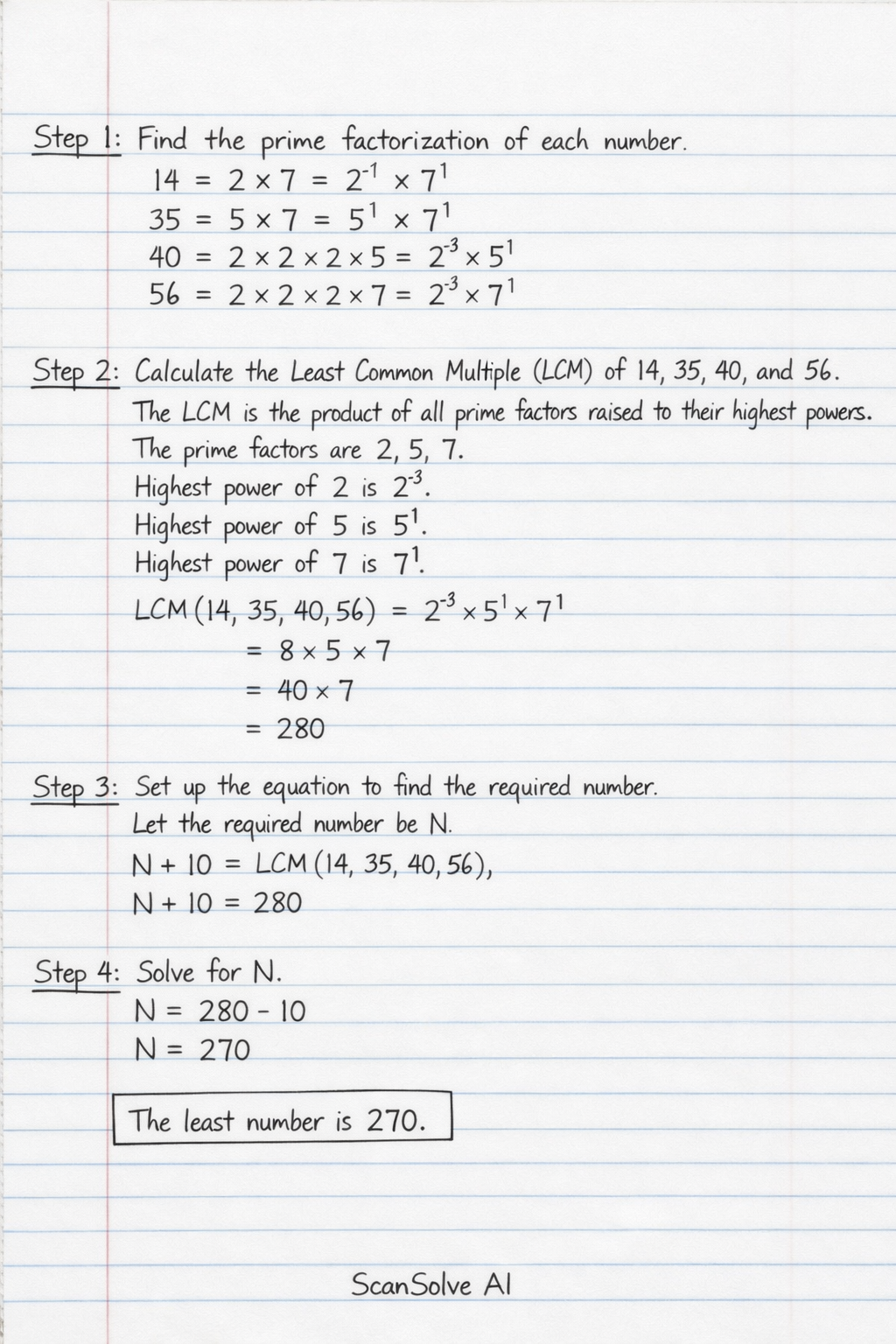
Handwritten Step-by-Step Solution
Get this as a handwritten image on WhatsApp — like a tutor wrote it for you.
Try on WhatsApp