
We read your photo as:
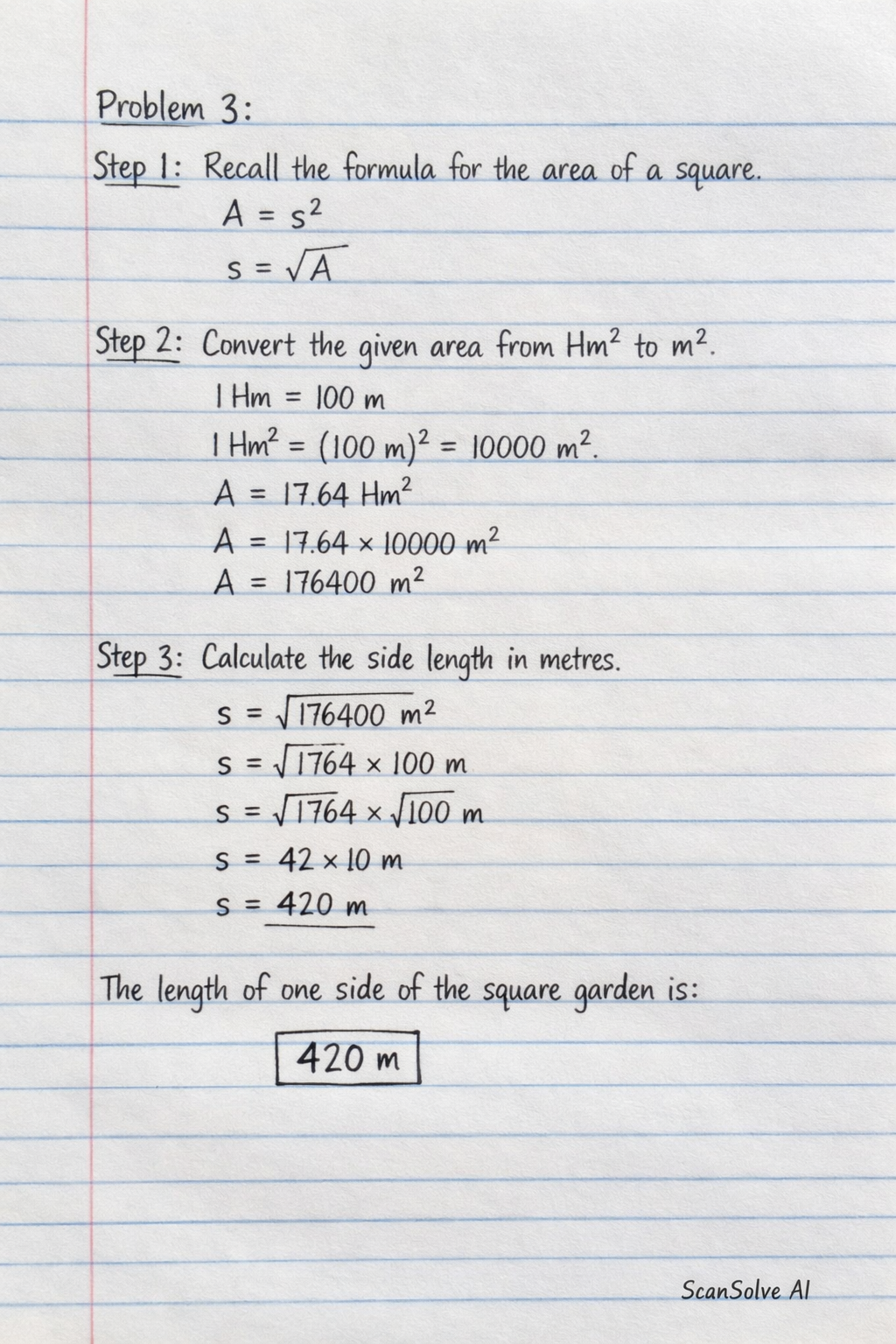
Find the length of one side of a square garden in metres, given its area in Hectometres squared.
ScanSolve AI Answer
Step-by-step solution
6 stepshere are the solutions to the problems.
:
The question asks to find the length of one side of a square garden in metres, given its area in Hectometres squared.
Recall the formula for the area of a square.
The area () of a square is given by the square of its side length ().
Therefore, the side length is the square root of the area.
Convert the given area from Hectometres squared () to metres squared ().
We know that .
So, .
Given area .Calculate the side length in metres.
The length of one side of the square garden is:
:
The question asks to write numbers in standard form, but no numbers are provided in the image for this question. Please provide the numbers you would like to convert to standard form.:
The question asks for the original number of learners given an increase ratio and the new number of students.Understand the ratio of increase.
The number of students increased in the ratio . This means the new number of students is to the original number of students as 8 is to 7.
Let be the original number of learners.
Let be the new number of learners.Substitute the given new number of students.
The number of students after the increase was 560. So, .
Solve for the original number of learners ().
Multiply both sides by to clear the denominators.
Divide by 8:
The original number of learners was:
Still stuck on this one?
Ask a follow-up, and the answer starts from this question.
More Mathematics Questions
Handwritten Step-by-Step Solution
Get this as a handwritten image on WhatsApp — like a tutor wrote it for you.
Try on WhatsApp