

This mathematics problem involves applying core mathematical principles and formulas. Below you will find a complete step-by-step solution with detailed explanations for each step, helping you understand not just the answer but the method behind it.
ScanSolve AI Answer
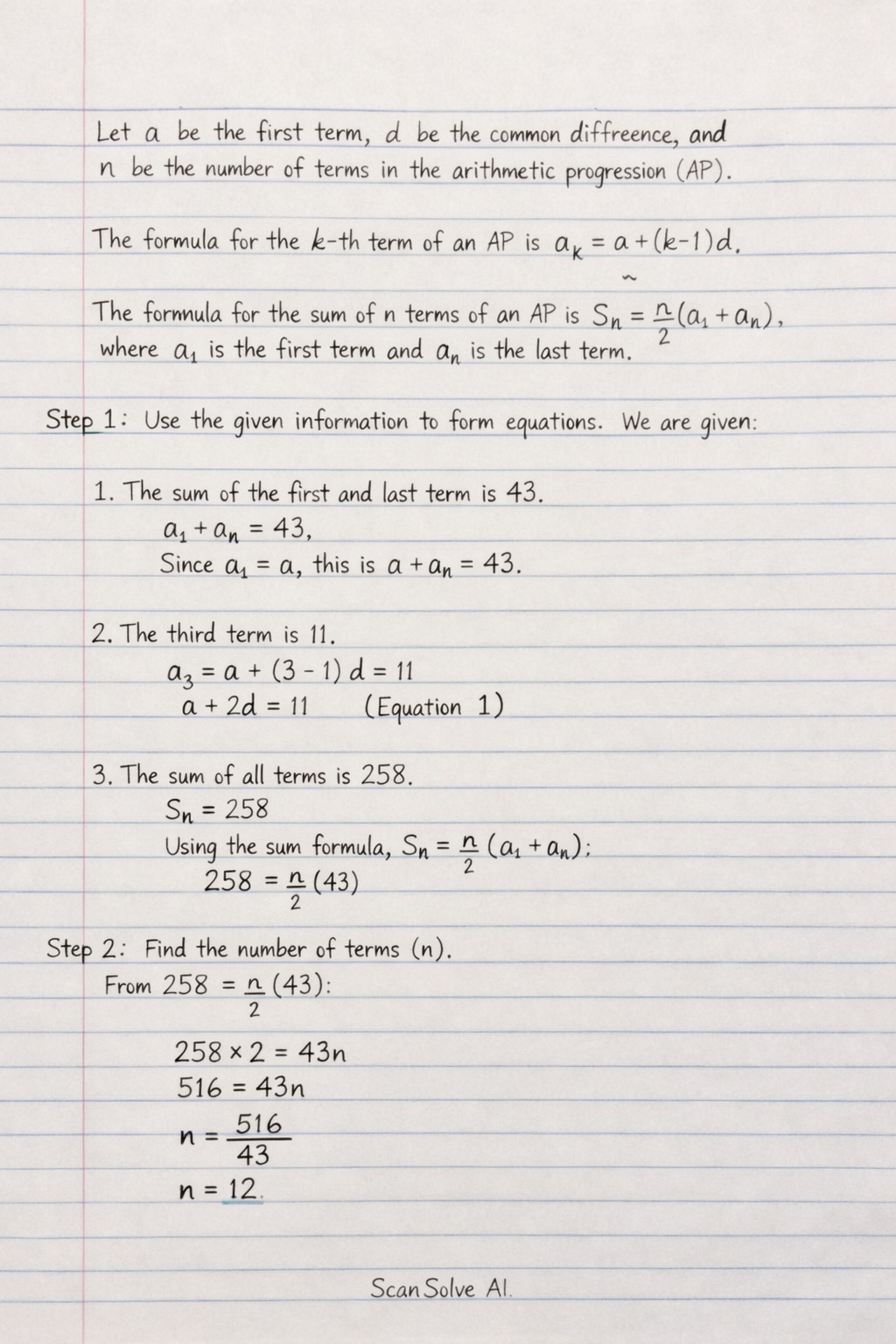
Let a be the first term, d be the common difference, and n be the number of terms in the arithmetic progression (AP). The formula for the k-th term of an AP is a_k = a + (k-1)d. The formula for the sum of n terms of an AP is S_n = (n)/(2)(a_1 + a_n), where a_1 is the first term and a_n is the last term. Step 1: Use the given information to form equations. We are given: 1. The sum of the first and last term is 43. a_1 + a_n = 43 Since a_1 = a, this is a + a_n = 43. 2. The third term is 11. a_3 = a + (3-1)d = 11 a + 2d = 11 (Equation 1) 3. The sum of all terms is 258. S_n = 258 Using the sum formula S_n = (n)/(2)(a_1 + a_n): 258 = (n)/(2)(43) Step 2: Find the number of terms (n). From 258 = (n)/(2)(43): 258 × 2 = 43n 516 = 43n n = (516)/(43) n = 12 Step 3: Use the number of terms to form another equation. Since n=12, the last term is a_12. We know a + a_n = 43, so a + a_12 = 43. The formula for a_12 is a + (12-1)d = a + 11d. Substitute this into the sum of first and last term: a + (a + 11d) = 43 2a + 11d = 43 (Equation 2) Step 4: Solve the system of linear equations for a and d. We have two equations: 1) a + 2d = 11 2) 2a + 11d = 43 From Equation 1, express a in terms of d: a = 11 - 2d Substitute this expression for a into Equation 2: 2(11 - 2d) + 11d = 43 22 - 4d + 11d = 43 22 + 7d = 43 7d = 43 - 22 7d = 21 d = (21)/(7) d = 3 Step 5: Find the value of a. Substitute d=3 back into the expression for a: a = 11 - 2(3) a = 11 - 6 a = 5 The first term is 5 and the common difference is 3. The first term is 5 The common difference is 3