We read your photo as:

Evaluate the line integral integral_C F * dr where F(x,y,z) = xz i - yz j + x k and C is the line segment from (-1, 2, 0) to (3, 0, 1).

Mathematics

ScanSolve AI Answer

Answer

5

Step-by-step solution

5 steps
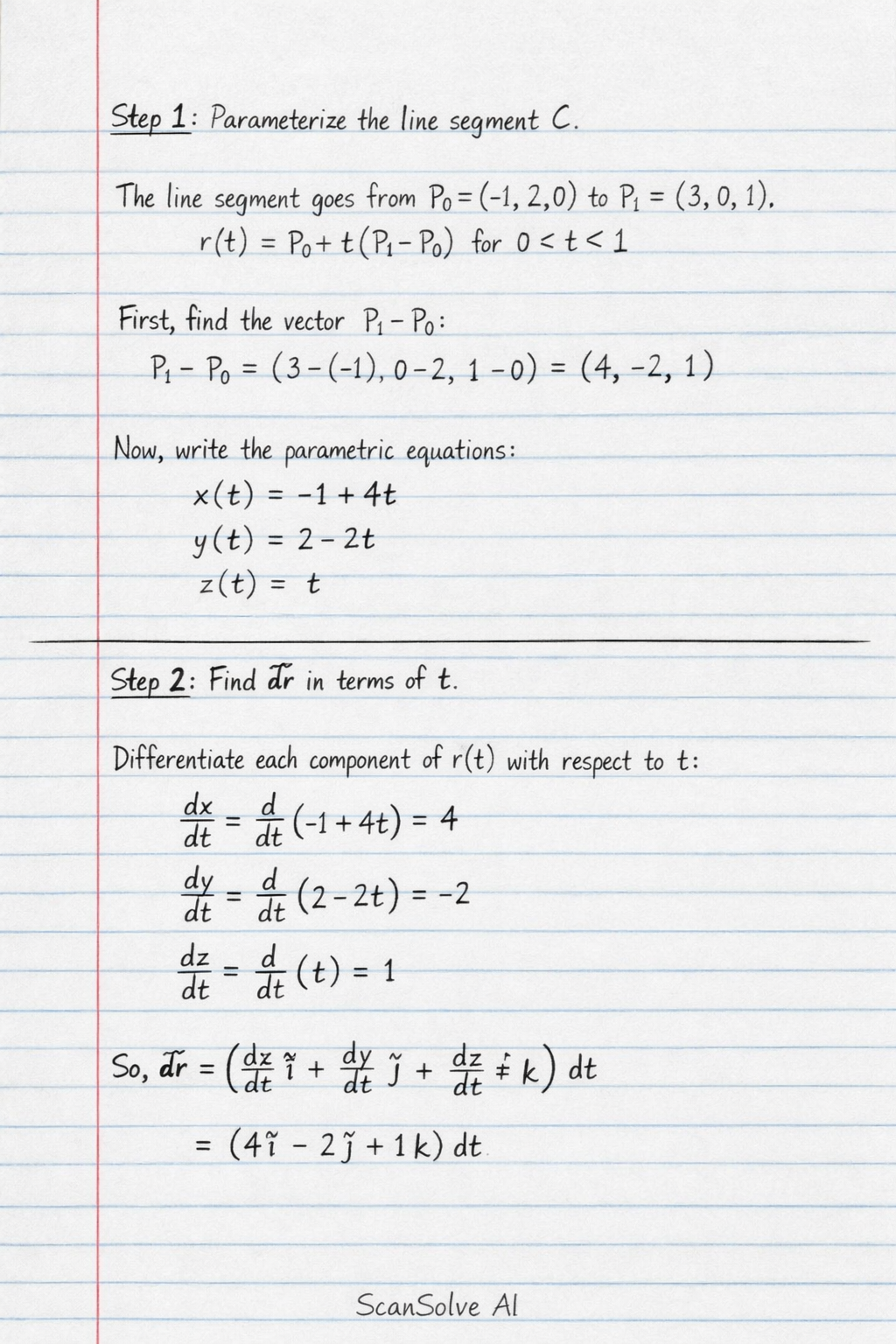
  1. Parameterize the line segment CC.

    The line segment goes from P0=(−1,2,0)P_0 = (-1, 2, 0) to P1=(3,0,1)P_1 = (3, 0, 1).
    A parameterization for a line segment is given by r(t)=P0+t(P1−P0)\mathbf{r}(t) = P_0 + t(P_1 - P_0) for 0≤t≤10 \le t \le 1.
    First, find the vector P1−P0P_1 - P_0:

    P1−P0=(3−(−1),0−2,1−0)=(4,−2,1)P_1 - P_0 = (3 - (-1), 0 - 2, 1 - 0) = (4, -2, 1)

    Now, write the parametric equations for x,y,zx, y, z:

    x(t)=−1+4tx(t) = -1 + 4t y(t)=2−2ty(t) = 2 - 2t z(t)=tz(t) = t
  2. Find drd\mathbf{r} in terms of tt.

    Differentiate each component of r(t)\mathbf{r}(t) with respect to tt:

    dxdt=ddt(−1+4t)=4\frac{dx}{dt} = \frac{d}{dt}(-1 + 4t) = 4 dydt=ddt(2−2t)=−2\frac{dy}{dt} = \frac{d}{dt}(2 - 2t) = -2 dzdt=ddt(t)=1\frac{dz}{dt} = \frac{d}{dt}(t) = 1

    So, dr=(dxdti+dydtj+dzdtk)dt=(4i−2j+1k)dtd\mathbf{r} = \left( \frac{dx}{dt} \mathbf{i} + \frac{dy}{dt} \mathbf{j} + \frac{dz}{dt} \mathbf{k} \right) dt = (4 \mathbf{i} - 2 \mathbf{j} + 1 \mathbf{k}) dt.

  3. Express the vector field F\mathbf{F} in terms of tt.

    The given vector field is F(x,y,z)=xzi−yzj+xk\mathbf{F}(x,y,z) = xz \mathbf{i} - yz \mathbf{j} + x \mathbf{k}.
    Substitute x(t)x(t), y(t)y(t), and z(t)z(t) into F\mathbf{F}:

    Fx=xz=(−1+4t)(t)=−t+4t2F_x = xz = (-1 + 4t)(t) = -t + 4t^2 Fy=−yz=−(2−2t)(t)=−(2t−2t2)=−2t+2t2F_y = -yz = -(2 - 2t)(t) = -(2t - 2t^2) = -2t + 2t^2 Fz=x=−1+4tF_z = x = -1 + 4t

    So, F(t)=(4t2−t)i+(2t2−2t)j+(4t−1)k\mathbf{F}(t) = (4t^2 - t) \mathbf{i} + (2t^2 - 2t) \mathbf{j} + (4t - 1) \mathbf{k}.

  4. Calculate the dot product F⋅dr\mathbf{F} \cdot d\mathbf{r}.

    F⋅dr=(Fxdxdt+Fydydt+Fzdzdt)dt\mathbf{F} \cdot d\mathbf{r} = (F_x \frac{dx}{dt} + F_y \frac{dy}{dt} + F_z \frac{dz}{dt}) dt F⋅dr=((4t2−t)(4)+(2t2−2t)(−2)+(4t−1)(1))dt\mathbf{F} \cdot d\mathbf{r} = \left( (4t^2 - t)(4) + (2t^2 - 2t)(-2) + (4t - 1)(1) \right) dt F⋅dr=((16t2−4t)+(−4t2+4t)+(4t−1))dt\mathbf{F} \cdot d\mathbf{r} = \left( (16t^2 - 4t) + (-4t^2 + 4t) + (4t - 1) \right) dt

    Combine like terms:

    F⋅dr=(16t2−4t2−4t+4t+4t−1)dt\mathbf{F} \cdot d\mathbf{r} = (16t^2 - 4t^2 - 4t + 4t + 4t - 1) dt F⋅dr=(12t2+4t−1)dt\mathbf{F} \cdot d\mathbf{r} = (12t^2 + 4t - 1) dt
  5. Evaluate the definite integral.

    The integral is from t=0t=0 to t=1t=1:

    ∫CF⋅dr=∫01(12t2+4t−1)dt\int_C \mathbf{F} \cdot d\mathbf{r} = \int_0^1 (12t^2 + 4t - 1) dt

    Integrate term by term:

    =[12t33+4t22−t]01= \left[ \frac{12t^3}{3} + \frac{4t^2}{2} - t \right]_0^1 =[4t3+2t2−t]01= \left[ 4t^3 + 2t^2 - t \right]_0^1

    Now, evaluate at the limits:

    =(4(1)3+2(1)2−1)−(4(0)3+2(0)2−0)= \left( 4(1)^3 + 2(1)^2 - 1 \right) - \left( 4(0)^3 + 2(0)^2 - 0 \right) =(4+2−1)−(0)= (4 + 2 - 1) - (0) =5= 5

    The value of the line integral is 5.

Was this helpful?

Try one yourself

A new problem that tests the same skill.

Still stuck on this one?

Ask a follow-up, and the answer starts from this question.

Got a different question?Ask your own question
Handwritten step-by-step solution preview

Handwritten Step-by-Step Solution

Get this as a handwritten image on WhatsApp — like a tutor wrote it for you.

Try on WhatsApp