
We read your photo as:
Mary drew a parallelogram on a grid. One side of the parallelogram passed through point (1,4) with a gradient of 1/2. Determine the equation of the line and the co-ordinates of the x-intercept of the line.
ScanSolve AI Answer
Answers
4 partsUse the left and right arrow keys to trace the curve, up and down to jump between key points, and plus and minus to zoom.
| Point | x | y |
|---|---|---|
| x-intercept | −7 | 0 |
| y-intercept | 0 | 3.5 |
Step-by-step solution
12 stepsHere are the solutions to your questions:
Part 28
Mary drew a parallelogram on a grid. One side of the parallelogram passed through point with a gradient of .
Part a
Determine the equation of the line.
Use the point-slope form of a linear equation, .
Given point and gradient .
Multiply both sides by 2 to eliminate the fraction.
Rearrange the equation into the form .
The final answer is .
Part b(-7, 0)
Determine the co-ordinates of the x-intercept of the line.
The x-intercept occurs when .
Substitute into the equation of the line.
Solve for .
Multiply both sides by 2:
The x-intercept is .
The final answer is .
Part 29
A Grade 8 learner moulded a solid in the shape of a cone. The slant height of the cone was . The base radius of the cone was . Calculate the total surface area of the solid, correct to 2 decimal places.
Write down the formula for the total surface area of a cone.
where is the base radius and is the slant height.
Substitute the given values and into the formula.
Calculate the numerical value and round to 2 decimal places.
Using :
Rounding to two decimal places:
The final answer is .
Part 30
A cylindrical tin of radius contains some water. A spherical ball bearing of radius is immersed in water in the tin. Determine the rise in the water level in the tin, correct to one decimal place.
Calculate the volume of the spherical ball bearing.
The formula for the volume of a sphere is .
Given radius of sphere .Relate the volume of the sphere to the rise in water level in the cylindrical tin.
The volume of water displaced is equal to the volume of the sphere. This displaced volume causes a rise in the water level in the cylindrical tin.
The volume of the cylindrical rise is , where is the radius of the tin and is the rise in water level.
Given radius of tin .Equate the two volumes and solve for .
Divide both sides by :
Round the rise in water level to one decimal place.
The final answer is .
Try one yourself
A new problem that tests the same skill.
Still stuck on this one?
Ask a follow-up, and the answer starts from this question.
More Mathematics Questions
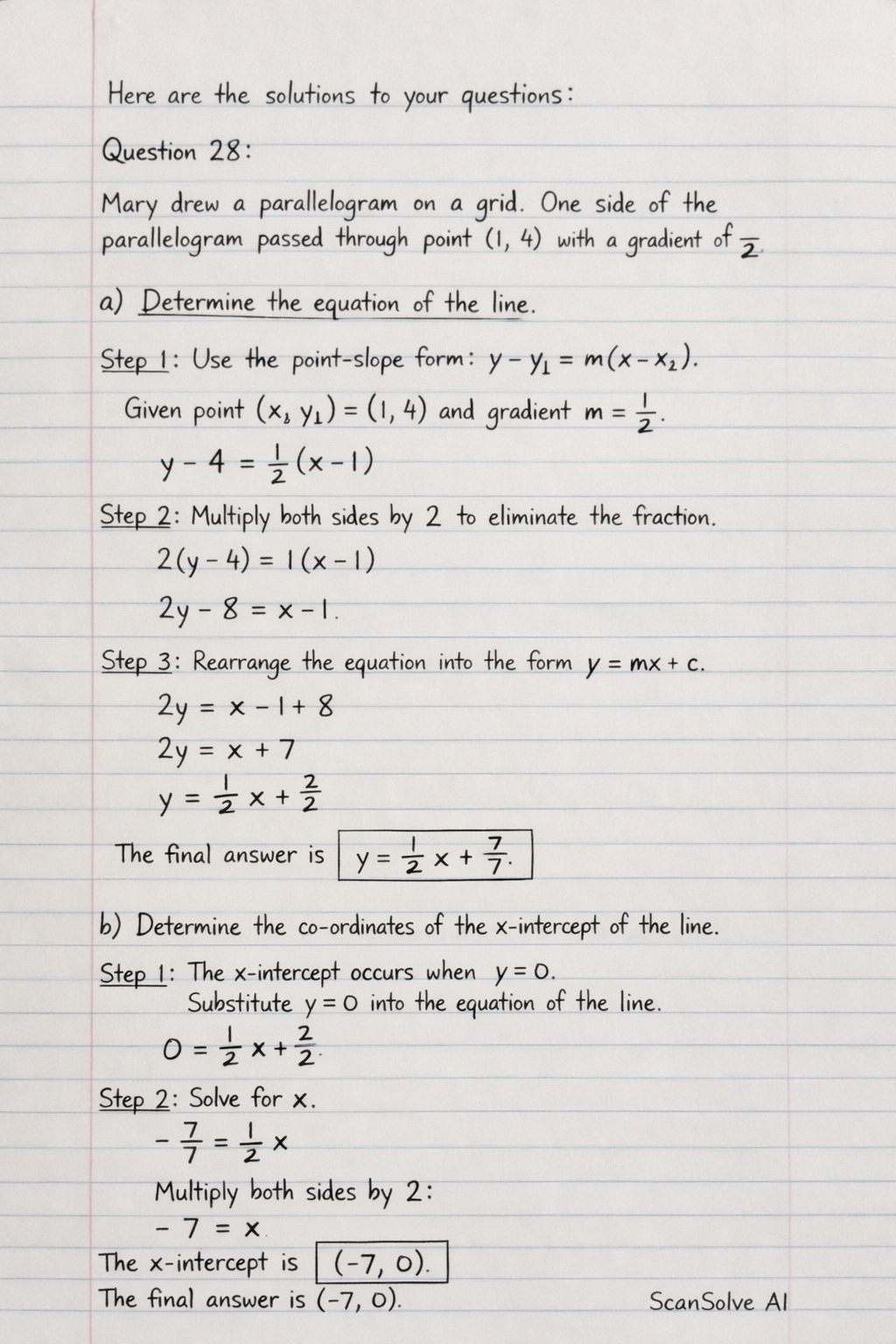
Handwritten Step-by-Step Solution
Get this as a handwritten image on WhatsApp — like a tutor wrote it for you.
Try on WhatsApp