
We read your photo as:
Find the maximum volume of a cone inscribed in a sphere of radius R.
ScanSolve AI Answer
Step-by-step solution
6 stepsDefine the volumes and variables.
Let be the radius of the sphere.
The volume of the sphere is .Let the inscribed cone have radius and height .
The volume of the cone is .Relate the cone's dimensions to the sphere's radius.
Consider a cross-section of the sphere and the inscribed cone. Let the center of the sphere be at the origin .
Let the height of the cone be . The vertex of the cone is at .
Let the center of the base of the cone be at .
The radius of the cone's base, , forms a right-angled triangle with the sphere's radius and the distance from the sphere's center to the cone's base center.
Let be the distance from the center of the sphere to the center of the cone's base.
Then .
From the Pythagorean theorem, , so .
Since the cone's vertex is at the top of the sphere, its height is .
The variable represents the distance from the center of the sphere to the base of the cone. can range from 0 (base passes through the center) to (base is a point at the bottom of the sphere).Express the cone's volume in terms of a single variable.
Substitute and into the volume formula for the cone:
Factor as :
We need to maximize with respect to . The domain for is .
Find the critical points by differentiation.
To find the maximum volume, we differentiate with respect to and set the derivative to zero.
Let .
Using the product rule, :Set :
Since and , cannot be zero.
Therefore, , which implies .
This value of is within the valid range .Verify that this critical point corresponds to a maximum.
We can check the sign of the derivative around :
If , then , so (volume is increasing).
If , then , so (volume is decreasing).
This confirms that corresponds to a local maximum.Calculate the maximum volume of the cone and compare it to the sphere's volume.
Substitute back into the expressions for and :
Now, calculate the maximum volume of the cone:
Now, compare this to the volume of the sphere :
Thus, the volume of the largest cone that can be inscribed in a sphere of radius is of the volume of the sphere.
Still stuck on this one?
Ask a follow-up, and the answer starts from this question.
More Mathematics Questions
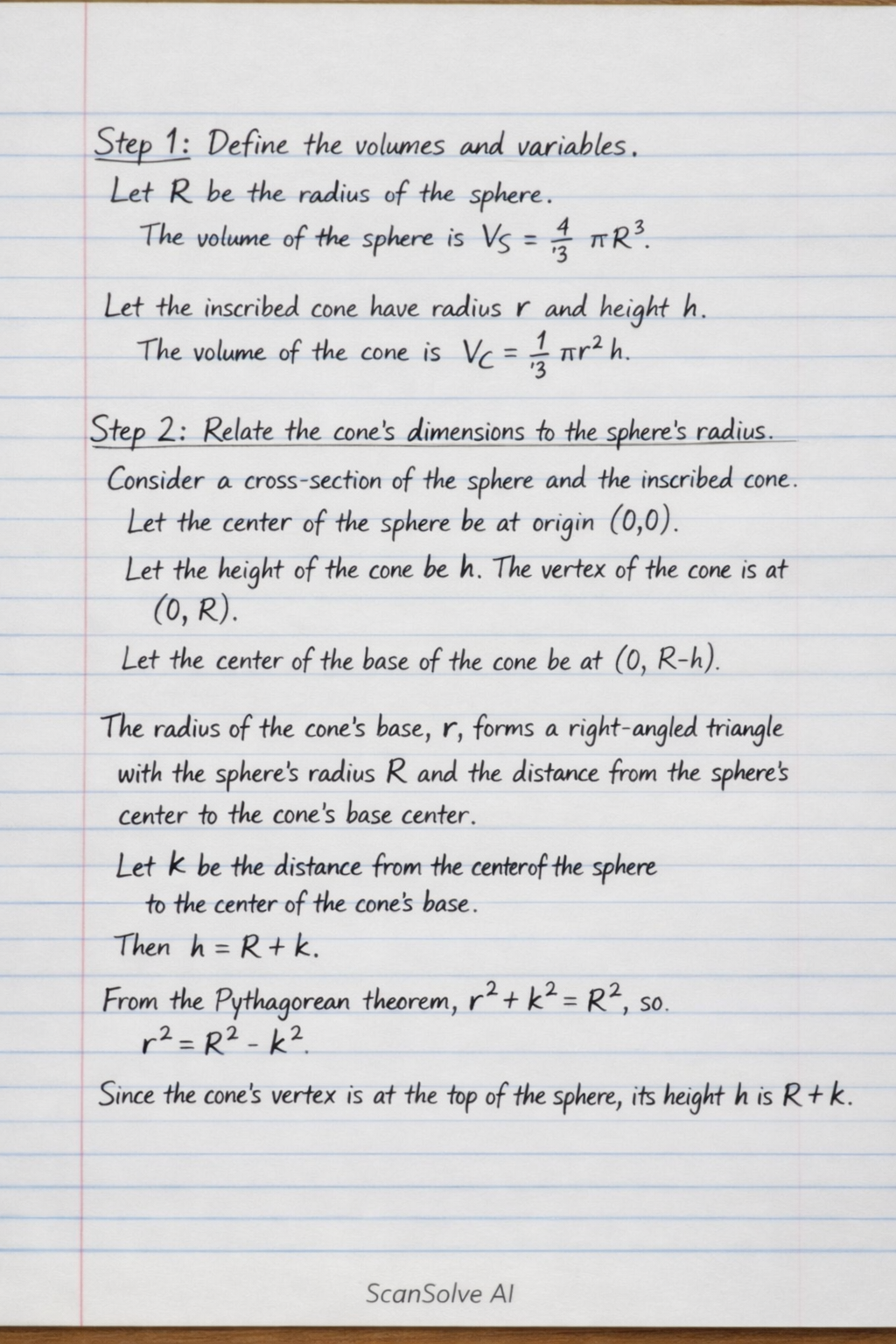
Handwritten Step-by-Step Solution
Get this as a handwritten image on WhatsApp — like a tutor wrote it for you.
Try on WhatsApp