

This mathematics problem involves applying core mathematical principles and formulas. Below you will find a complete step-by-step solution with detailed explanations for each step, helping you understand not just the answer but the method behind it.
ScanSolve AI Answer
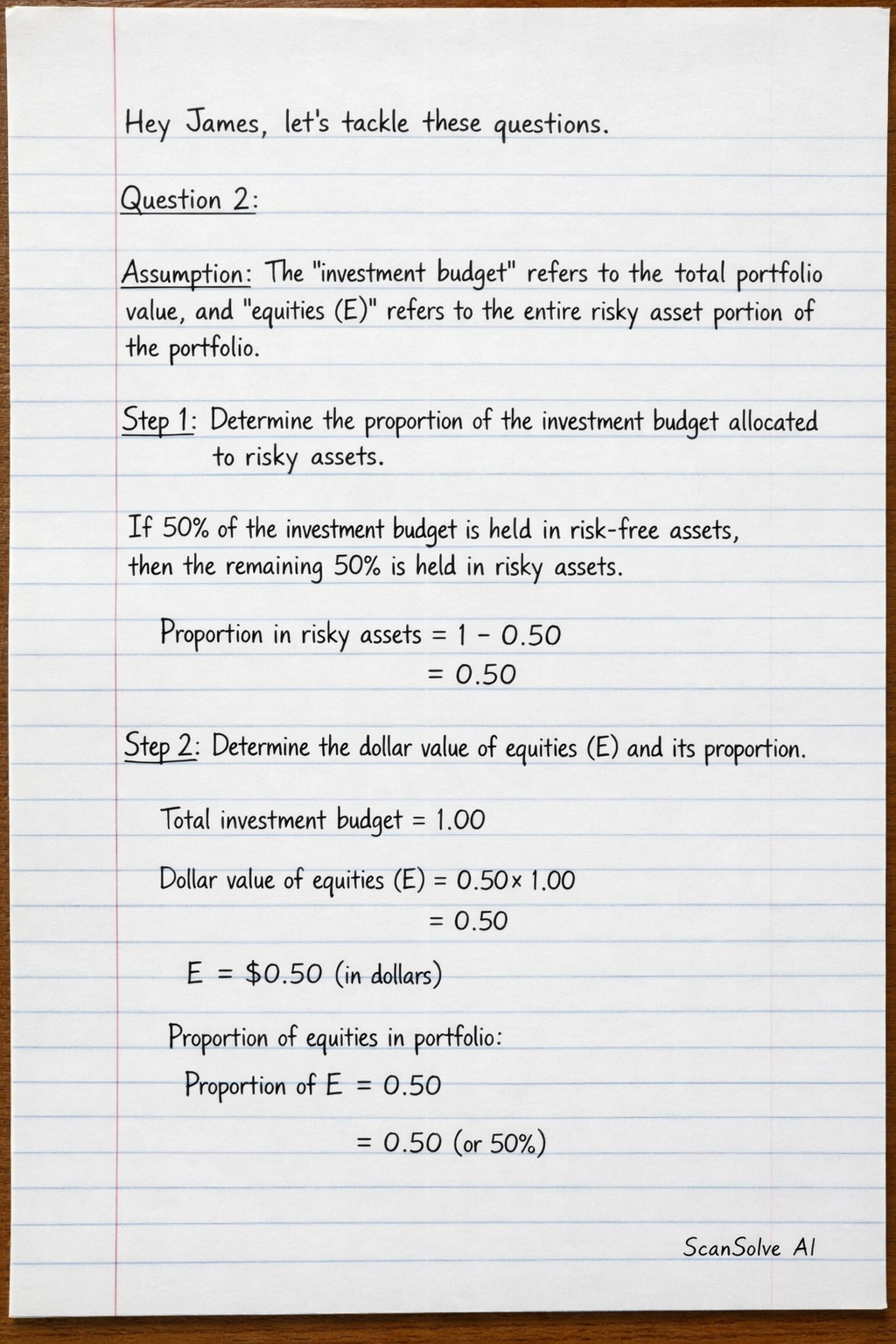
Hey James, let's tackle these questions. Question 2: Assumption: The "investment budget" refers to the total portfolio value, and "equities (E)" refers to the entire risky asset portion of the portfolio. Step 1: Determine the proportion of the investment budget allocated to risky assets. If 50% of the investment budget is held in risk-free assets, then the remaining 50% is held in risky assets. Proportion in risky assets = 1 - 0.50 = 0.50 Step 2: Determine the dollar value of equities (E) and its proportion. Assuming equities (E) constitute the entire risky asset portion, the dollar value of your position in equities (E) will be 50% of the total investment budget. Its proportion in your overall portfolio will be 50%. Question 3: Step 1: Calculate the total funds invested. Total funds invested = Investment budget + Borrowed funds Total funds invested = \600,000 + \240,000 = \840,000 Step 2: Calculate the leverage position (leverage ratio). Leverage ratio = Total funds investedInvestment budget Leverage ratio = (\840,000)/(\600,000) = 1.4 Step 3: Determine the type and amount of the position. Since the funds are used to invest in assets, it is a long position. Amount of the long position = Total funds invested = \840,000 The leverage position is 1.4, and the amount of the long position is \840,000. Question 4: a) What is the Net Asset Value (NAV) of the fund? Step 1: Calculate the total assets of the fund. Total assets = \120,000,000 Step 2: Calculate the total liabilities of the fund. Liabilities = \4,000,000 + \1,000,000 = \5,000,000 Step 3: Calculate the Net Asset Value (NAV) of the fund. NAV of fund = Total assets - Total liabilities NAV of fund = \120,000,000 - \5,000,000 = \115,000,000 Step 4: Calculate the NAV per share. NAV per share = NAV of fundNumber of outstanding shares NAV per share = (\115,000,000)/(5,000,000 shares) = \23.00 per share The Net Asset Value (NAV) per share is \23.00. b) If the fund charges a 4% load, what is the offering price? Step 1: Identify the load percentage. Load = 4\% = 0.04 Step 2: Calculate the offering price. Offering price = NAV per share1 - Load percentage Offering price = (\23.00)/(1 - 0.04) = (\23.00)/(0.96) ≈ \23.9583 The offering price is \23.96. Question 5: Investment companies perform several important functions for their investors: • Record Keeping and Administration: They handle all administrative tasks, such as issuing statements, distributing dividends, and preparing tax documents, simplifying the investment process for individuals. • Diversification and Divisibility: They allow investors to achieve broad diversification across many securities with relatively small investments, and to buy or sell fractional shares. • Professional Management: They employ experienced portfolio managers who conduct research and make investment decisions on behalf of investors, aiming to achieve specific investment objectives. • Lower Transaction Costs: Due to their large trading volumes, investment companies can execute trades at lower commission costs per dollar invested than individual investors typically can. Question 6: Buying on margin means purchasing securities with money borrowed from a broker. The investor uses their own cash for a portion of the purchase and borrows the rest, using the purchased securities as collateral for the loan. This strategy amplifies both potential gains and losses. Example: An investor wants to buy 10,000 worth of stock. With a 50% margin requirement, they pay 5,000 from their own funds and borrow the remaining 5,000 from their broker. Question 7: Step 1: Identify the total cost of the investment. Total cost of stock = \20,000 Step 2: Identify the investor's equity. Amount from Mr. Demo (investor's equity) = \12,000 Step 3: Calculate the initial margin. Initial margin = Investor's equityTotal cost of investment Initial margin = (\12,000)/(\20,000) = 0.60 The margin in the transaction is 60%. Question 8: Assumption: To calculate the new value of the investment, we need the original number of shares. Since it's not provided, we will assume an original price per share of 100. Step 1: Calculate the original number of shares. Number of shares = Original investment valueAssumed original price per share Number of shares = (\20,000)/(\100 per share) = 200 shares Step 2: Calculate the new market value of the stock. New market value of stock = Number of shares × New price per share New market value of stock = 200 shares × \70 per share = \14,000 Step 3: Sketch the balance sheet of the investment. Original loan from broker = Total cost - Investor's equity = 20,000 - 12,000 = 8,000. The loan amount remains constant unless a margin call occurs or the loan is repaid. |l|l| Assets & Liabilities \& Equity \\ Stock (Market Value) \14,000 & Loan from Broker \8,000 \\ & Investor's Equity \6,000 \\ Total Assets \14,000 & Total Liabilities \& Equity \14,000 \\ Step 4: Calculate the portfolio loss or gain. Loss = Original investor's equity - New investor's equity Loss = \12,000 - \6,000 = \6,000 Step 5: Determine how the gain or loss is distributed. The portfolio has incurred a loss of \$6,000. This loss is borne entirely by the investor (Mr. Thomas Demo), as it reduces his equity in the investment. That's 2 down. 3 left today — send the next one.