
No I was asking to take it as an example at first we had 2cos and the 2 had gone to the denominator of h now what if we only have cos
ScanSolve AI Answer
Answer
Step-by-step solution
5 stepsYou're asking what would happen if the initial expression, before any manipulation, was:
instead of having the '2' in front of the cosine term.
Separate the terms to isolate the part that needs manipulation for the standard limit.
Focus on the term .
To use the standard limit , we need the denominator to be . We currently have .
We can rewrite as .
So, .Substitute this back into the limit expression.
Evaluate the limit.
As :
- remains
- (using the standard limit where )
Multiply the results.
So, if there were no '2' in the numerator initially, the derivative would be . The '2' in the original problem was essential because it cancelled out the '2' that we introduced in the denominator to match the form. The cosine term itself doesn't need a special denominator because its limit can be found by direct substitution.
Try one yourself
A new problem that tests the same skill.
Still stuck on this one?
Ask a follow-up, and the answer starts from this question.
More Mathematics Questions
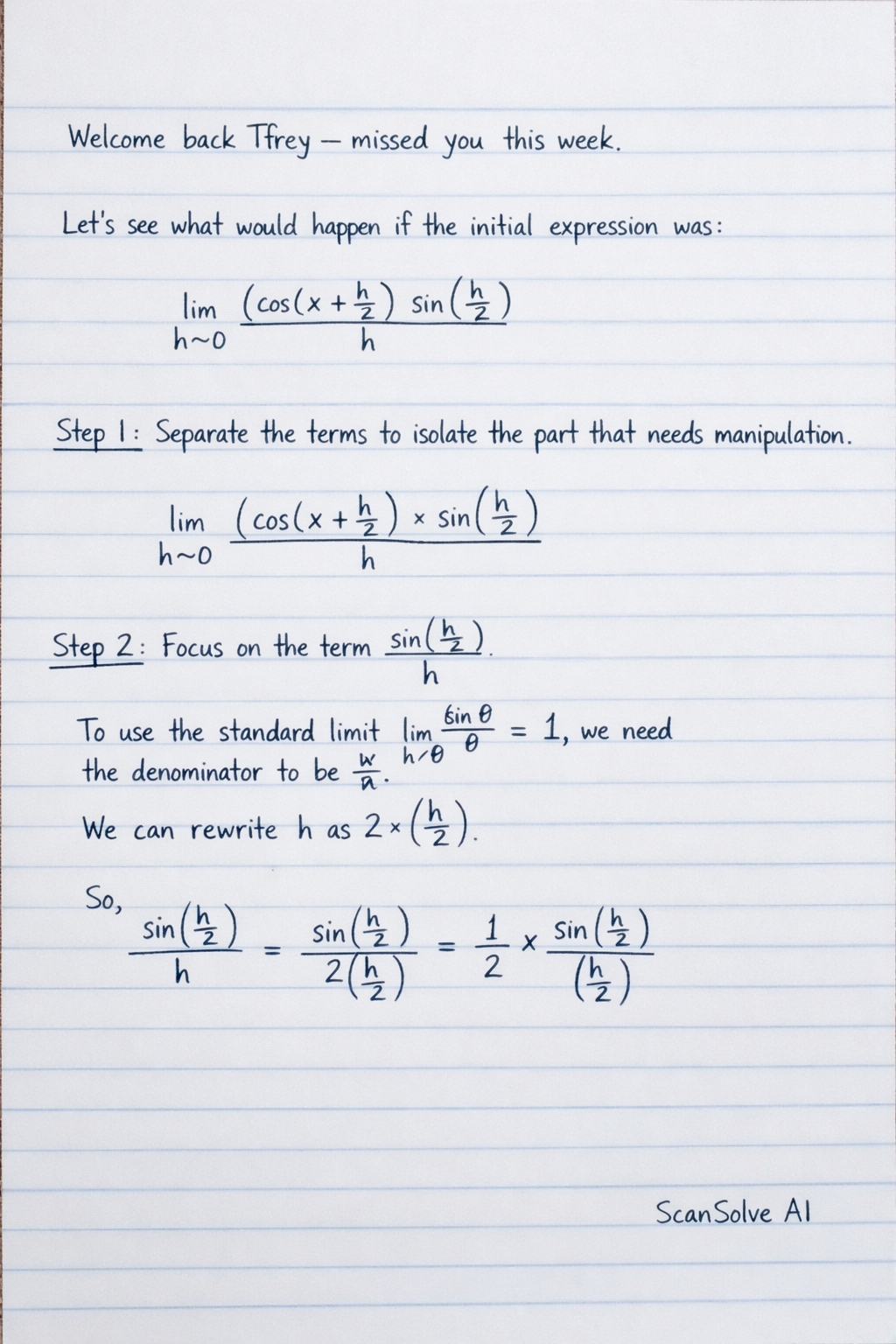
Handwritten Step-by-Step Solution
Get this as a handwritten image on WhatsApp — like a tutor wrote it for you.
Try on WhatsApp