

This mathematics problem involves applying core mathematical principles and formulas. Below you will find a complete step-by-step solution with detailed explanations for each step, helping you understand not just the answer but the method behind it.
ScanSolve AI Answer
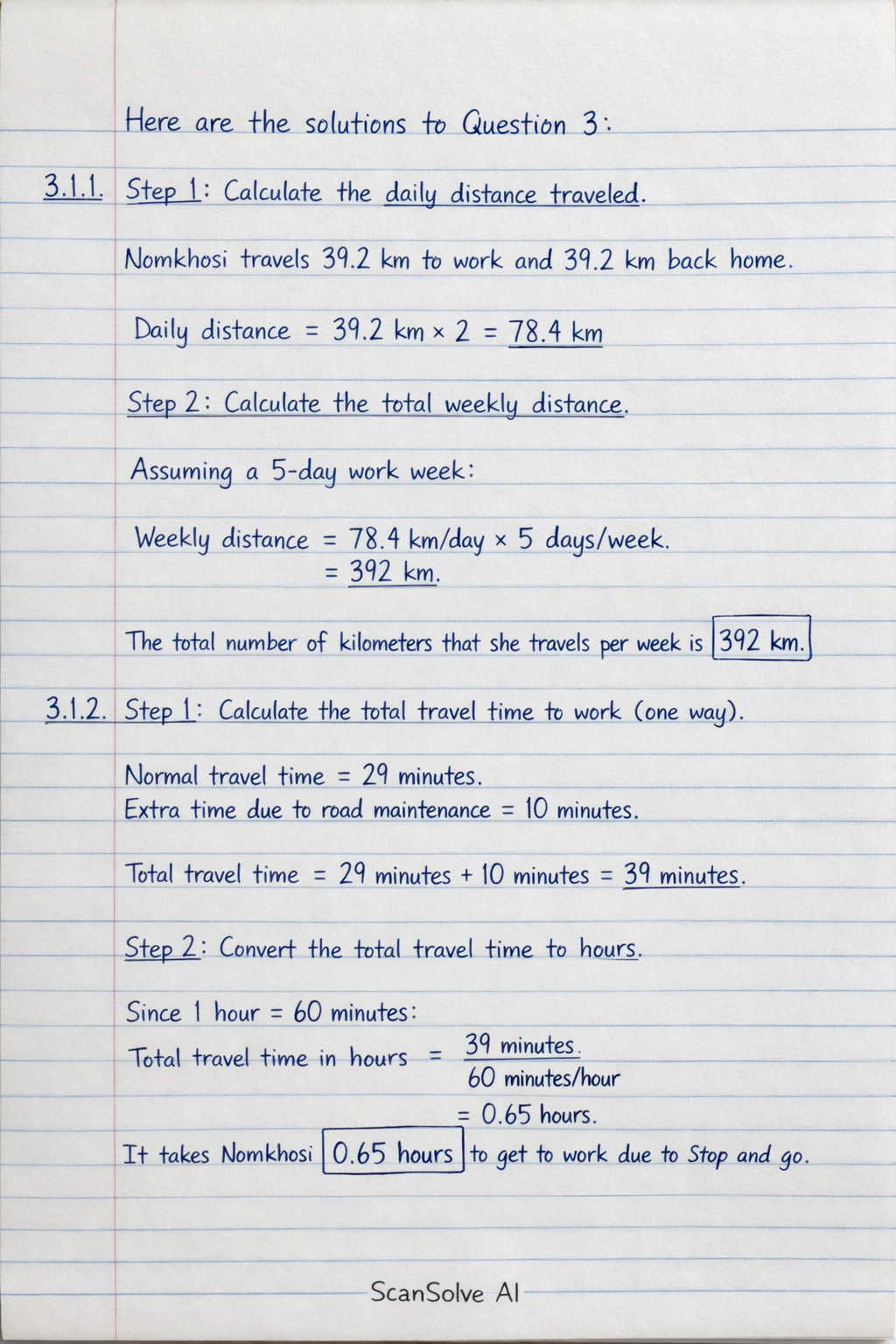
Here are the solutions to Question 3: 3.1.1 Step 1: Calculate the daily distance traveled. Nomkhosi travels 39.2 km to work and 39.2 km back home. Daily distance = 39.2 km × 2 = 78.4 km Step 2: Calculate the total weekly distance. Assuming a 5-day work week: Weekly distance = 78.4 km/day × 5 days/week = 392 km The total number of kilometers that she travels per week is 392 km. 3.1.2 Step 1: Calculate the total travel time to work (one way). Normal travel time = 29 minutes. Extra time due to road maintenance = 10 minutes. Total travel time = 29 minutes + 10 minutes = 39 minutes Step 2: Convert the total travel time to hours. Since 1 hour = 60 minutes: Total travel time in hours = 39 minutes60 minutes/hour = 0.65 hours It takes Nomkhosi 0.65 hours to get to work due to Stop and go. 3.1.3 Step 1: Determine the required arrival time at school. School starts at 07:30. Nomkhosi must be at school 10 minutes before school starts. Required arrival time = 07:30 - 10 minutes = 07:20 Step 2: Determine the travel time to work in minutes. From 3.1.2, the total travel time to work (one way) is 39 minutes. Step 3: Calculate the departure time from home. Departure time = Required arrival time - Travel time Departure time = 07:20 - 39 minutes To subtract 39 minutes from 07:20: 07:20 is 7 hours and 20 minutes. Subtract 20 minutes: 07:00. Remaining to subtract: 39 - 20 = 19 minutes. Subtract 19 minutes from 07:00: 06:41. Nomkhosi must leave her home by 06:41. 3.2.1 Step 1: Determine the total volume of diluted juice. 2 litres of Oros concentrate makes 8 litres of juice. Step 2: Convert the total volume of juice to milliliters. Since 1 litre = 1000 milliliters: Total juice volume = 8 litres × 1000 ml/litre = 8000 ml Step 3: Determine the volume of one cup. Given: 1 cup = 250 ml. Step 4: Calculate the number of cups that can be served. Number of cups = Total juice volumeVolume per cup = 8000 ml250 ml/cup = 32 cups 32 cups can be served from a 2-litre concentrate juice. 3.2.2 Step 1: Calculate the total number of scones sold. Mrs. Marais sold 58 packets, and each packet had 5 scones. Total scones sold = 58 packets × 5 scones/packet = 290 scones Step 2: Determine the amount of self-raising white flour per scone. The recipe uses 200 grams of self-raising white flour and "Serves 9 people". Assuming one serving is one scone, then one batch makes 9 scones. Flour per scone = 200 grams9 scones Step 3: Calculate the total amount of self-raising white flour used in grams. Total flour used = 290 scones × 200 grams9 scones = (58000)/(9) grams ≈ 6444.44 grams Step 4: Convert the total amount of flour from grams to kilograms. Since 1 kg = 1000 grams: Total flour used in kg = 6444.44 grams1000 grams/kg ≈ 6.44444 kg Rounding to two decimal places: Total flour used in kg ≈ 6.44 kg Approximately 6.44 kg of self-raising white flour was used. 3.2.3 Step 1: Identify the amount of butter from the recipe. The recipe uses 50 grams of butter. Step 2: Convert the amount of butter from grams to kilograms. Since 1 kg = 1000 grams: Butter in kg = 50 grams1000 grams/kg = 0.05 kg The amount of butter is 0.05 kg. 3.2.4 Step 1: Identify the amounts of butter and self-raising flour from the recipe. Butter = 50 grams Self-raising white flour = 200 grams Step 2: Write the ratio of butter to self-raising flour. Ratio = Butter : Flour = 50 grams : 200 grams Step 3: Simplify the ratio. Divide both sides by the greatest common divisor, which is 50. (50)/(50) : (200)/(50) = 1 : 4 The ratio of butter to self-raising flour in simplified form is 1:4. 3 done, 2 left today. You're making progress.