
We read your photo as:
Observe the bar graph carefully and answer the given questions: a) What information is given by the bar graph? b) Name the lowest of the given peaks and what is its height. c) Find the ratio of the he
ScanSolve AI Answer
Step-by-step solution
8 stepsHere are the solutions to questions 44 to 47.
44. Observe the bar graph carefully and answer the given questions:
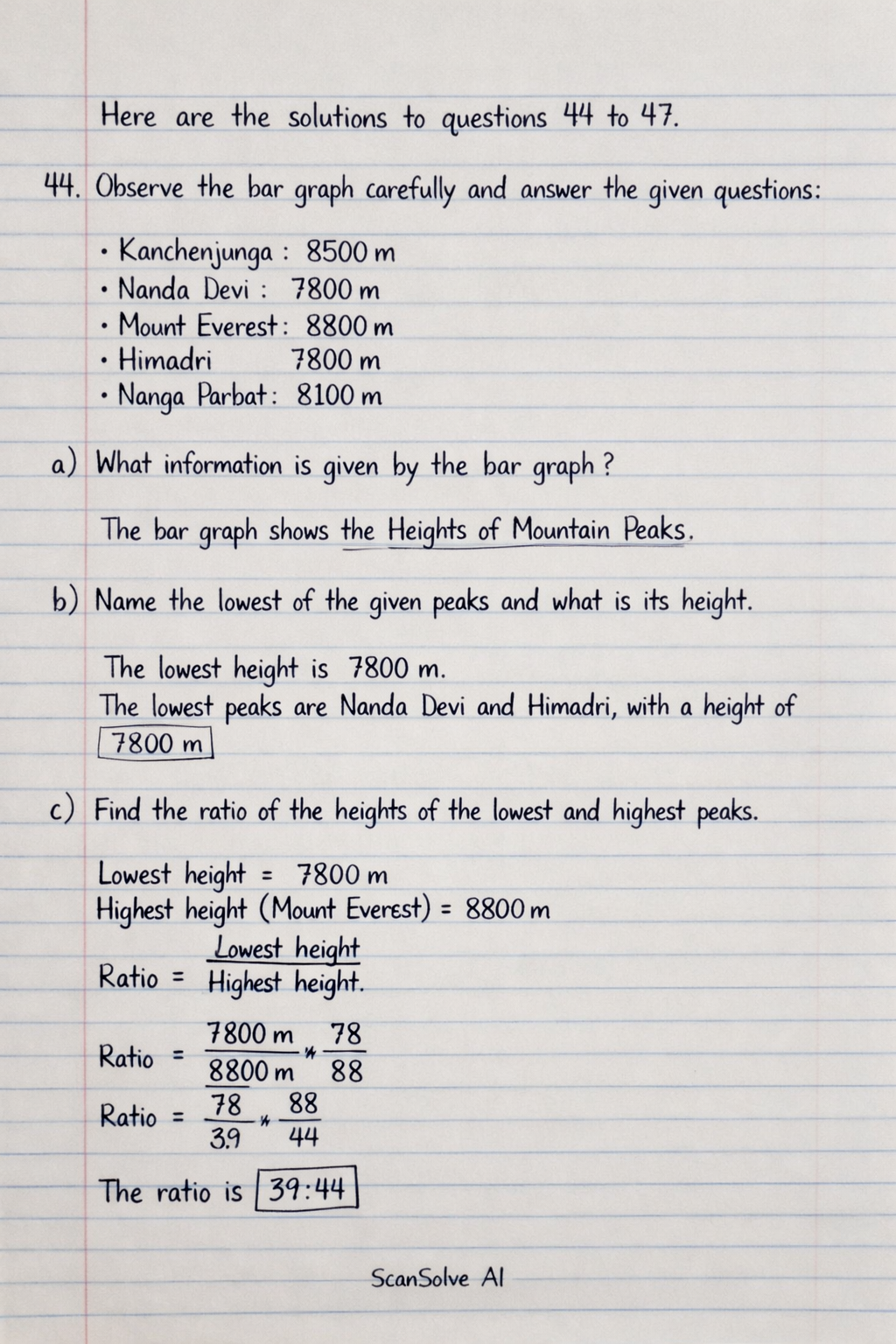
From the bar graph, the heights of the mountain peaks are:
-
Kanchenjunga:
-
Nanda Devi:
-
Mount Everest:
-
Himadri:
-
Nanga Parbat:
-
a) What information is given by the bar graph? The bar graph shows the Heights of Mountain Peaks.
-
b) Name the lowest of the given peaks and what is its height. The lowest height is . The lowest peaks are Nanda Devi and Himadri, with a height of .
-
c) Find the ratio of the heights of the lowest and highest peaks. Lowest height Highest height (Mount Everest) Ratio
The ratio is .
-
d) Write down the measurement of the heights of the peaks in the ascending order. The heights in ascending order are: Himadri (), Nanda Devi (), Nanga Parbat (), Kanchenjunga (), Mount Everest ().
45. Charu runs around a square park of sides . Pooja runs around a rectangular park of length and breadth . Who covers less distance?
Calculate the distance covered by Charu.
Charu runs around a square park with side .
Distance covered by Charu = Perimeter of squareCalculate the distance covered by Pooja.
Pooja runs around a rectangular park with length and breadth .
Distance covered by Pooja = Perimeter of rectangleCompare the distances.
Charu's distance
Pooja's distance
Since , Pooja covers less distance.
Pooja covers less distance.46. Diameter of a sphere is . What is its radius?
Use the formula relating diameter and radius.
The radius is half of the diameter.
Substitute the given diameter.
The radius is .
47. How many tiles whose length and breadth are and respectively will fit in a rectangular region whose length and breadth are and ?
Calculate the area of one tile.
Length of tile
Breadth of tile
Area of one tileCalculate the area of the rectangular region.
Length of region
Breadth of region
Area of rectangular regionCalculate the number of tiles.
Number of tiles
The number of tiles is .
Still stuck on this one?
Ask a follow-up, and the answer starts from this question.
More Mathematics Questions
Handwritten Step-by-Step Solution
Get this as a handwritten image on WhatsApp — like a tutor wrote it for you.
Try on WhatsApp