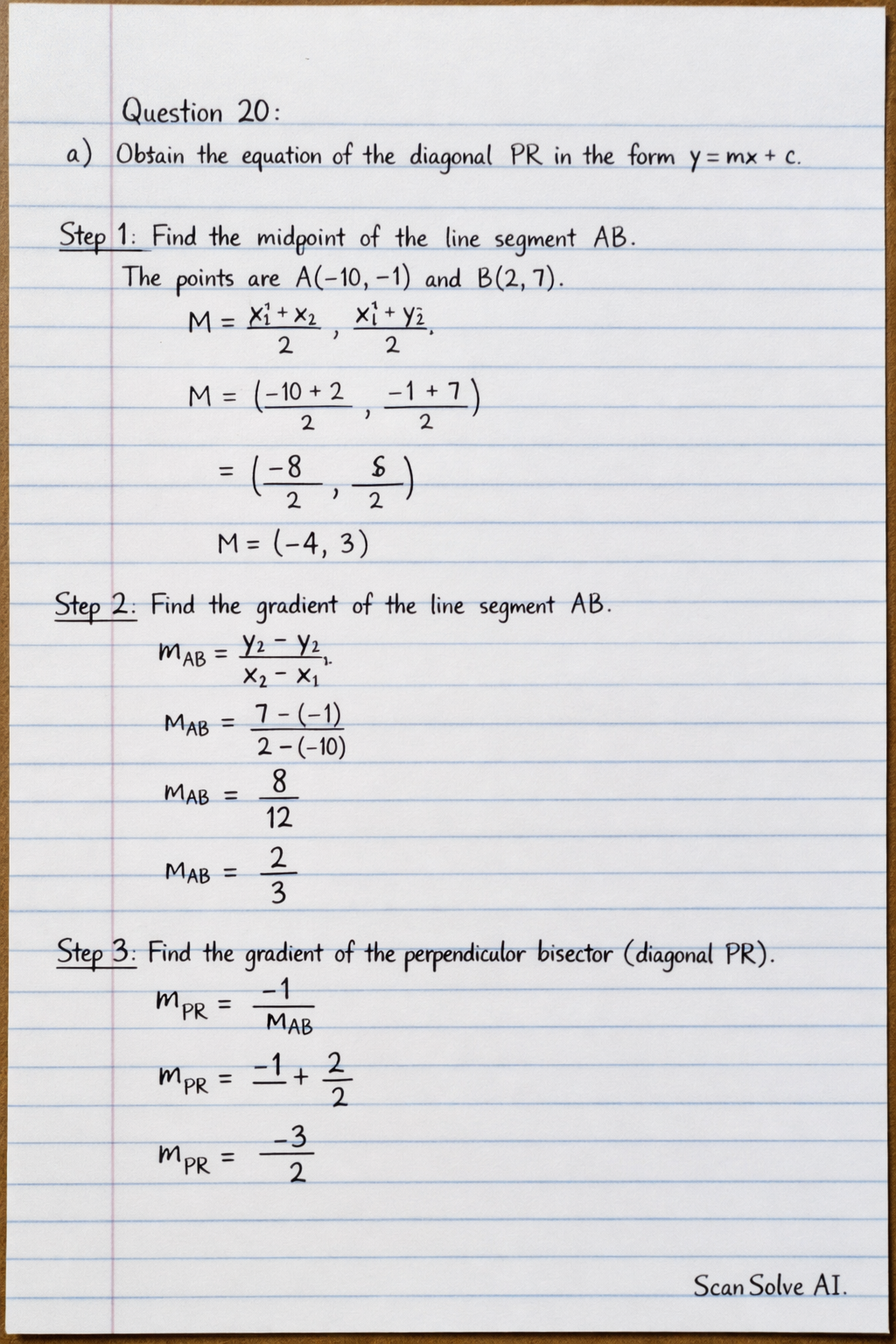
We read your photo as:

Obtain the equation of the diagonal PR in the form y = mx + c.

Mathematics

ScanSolve AI Answer

Answers

3 parts
a

y=−32x−3y = -\frac{3}{2}x - 3

b
(0, -3)

2x−3y=−42x - 3y = -4

(4, 4)
d

74\frac{7}{4}

Step-by-step solution

10 steps

Part 20

Part a

y=−32x−3y = -\frac{3}{2}x - 3

Obtain the equation of the diagonal PR in the form y=mx+cy = mx + c.

  1. Find the midpoint of the line segment AB.

    The points are A(−10,−1)A(-10, -1) and B(2,7)B(2, 7).
    The midpoint MM is given by the formula M=(x1+x22,y1+y22)M = \left(\frac{x_1+x_2}{2}, \frac{y_1+y_2}{2}\right).

    M=(−10+22,−1+72)=(−82,62)=(−4,3)M = \left(\frac{-10+2}{2}, \frac{-1+7}{2}\right) = \left(\frac{-8}{2}, \frac{6}{2}\right) = (-4, 3)
  2. Find the gradient of the line segment AB.

    The gradient mABm_{AB} is given by the formula m=y2−y1x2−x1m = \frac{y_2-y_1}{x_2-x_1}.

    mAB=7−(−1)2−(−10)=7+12+10=812=23m_{AB} = \frac{7 - (-1)}{2 - (-10)} = \frac{7+1}{2+10} = \frac{8}{12} = \frac{2}{3}
  3. Find the gradient of the perpendicular bisector (diagonal PR).

    Since PR is the perpendicular bisector of AB, its gradient mPRm_{PR} is the negative reciprocal of mABm_{AB}.

    mPR=−1mAB=−123=−32m_{PR} = -\frac{1}{m_{AB}} = -\frac{1}{\frac{2}{3}} = -\frac{3}{2}
  4. Obtain the equation of the line PR.

    The line PR passes through the midpoint M(−4,3)M(-4, 3) and has a gradient of −32-\frac{3}{2}. Using the point-slope form y−y1=m(x−x1)y - y_1 = m(x - x_1):

    y−3=−32(x−(−4))y - 3 = -\frac{3}{2}(x - (-4)) y−3=−32(x+4)y - 3 = -\frac{3}{2}(x + 4) y−3=−32x−32×4y - 3 = -\frac{3}{2}x - \frac{3}{2} \times 4 y−3=−32x−6y - 3 = -\frac{3}{2}x - 6 y=−32x−6+3y = -\frac{3}{2}x - 6 + 3 y=−32x−3y = -\frac{3}{2}x - 3

    The equation of the diagonal PR is y=−32x−3\boxed{y = -\frac{3}{2}x - 3}.

Part b(0, -3)

Given that the x and y-intercepts of the diagonal PR are the centre of the rhombus and the vertex R respectively. Find the coordinates of point R.

  1. Find the y-intercept of the diagonal PR.

    The equation of PR is y=−32x−3y = -\frac{3}{2}x - 3.
    The y-intercept occurs when x=0x=0.

    y=−32(0)−3y = -\frac{3}{2}(0) - 3 y=−3y = -3

    The y-intercept is (0,−3)(0, -3).
    According to the question, the y-intercept is vertex R.
    The coordinates of point R are (0,−3)\boxed{(0, -3)}.

    c) Point Q(-8, -4) is one of the vertices of the rhombus in (a) above. Obtain the equation of QS leaving it in the form ax+by=cax + by = c, where a, b and c are integers. Hence state the coordinate of point S.

  2. Find the gradient of the diagonal QS.

    In a rhombus, the diagonals are perpendicular. The gradient of PR is mPR=−32m_{PR} = -\frac{3}{2}.
    The gradient of QS, mQSm_{QS}, is the negative reciprocal of mPRm_{PR}.

    mQS=−1mPR=−1−32=23m_{QS} = -\frac{1}{m_{PR}} = -\frac{1}{-\frac{3}{2}} = \frac{2}{3}
  3. Obtain the equation of the line QS.

    The line QS passes through Q(−8,−4)Q(-8, -4) and has a gradient of 23\frac{2}{3}. Using the point-slope form y−y1=m(x−x1)y - y_1 = m(x - x_1):

    y−(−4)=23(x−(−8))y - (-4) = \frac{2}{3}(x - (-8)) y+4=23(x+8)y + 4 = \frac{2}{3}(x + 8)

    Multiply by 3 to clear the fraction:

    3(y+4)=2(x+8)3(y + 4) = 2(x + 8) 3y+12=2x+163y + 12 = 2x + 16

    Rearrange into the form ax+by=cax + by = c:

    2x−3y=12−162x - 3y = 12 - 16 2x−3y=−42x - 3y = -4

    The equation of QS is 2x−3y=−4\boxed{2x - 3y = -4}.

  4. Find the coordinates of the center of the rhombus.

    The center of the rhombus is the intersection of the diagonals PR and QS.
    Equation of PR: y=−32x−3y = -\frac{3}{2}x - 3
    Equation of QS: 2x−3y=−42x - 3y = -4
    Substitute the expression for yy from the PR equation into the QS equation:

    2x−3(−32x−3)=−42x - 3\left(-\frac{3}{2}x - 3\right) = -4 2x+92x+9=−42x + \frac{9}{2}x + 9 = -4

    Multiply by 2 to eliminate the fraction:

    4x+9x+18=−84x + 9x + 18 = -8 13x=−8−1813x = -8 - 18 13x=−2613x = -26 x=−2x = -2

    Substitute x=−2x = -2 back into the equation for PR to find yy:

    y=−32(−2)−3y = -\frac{3}{2}(-2) - 3 y=3−3y = 3 - 3 y=0y = 0

    The center of the rhombus, let's call it CC, is (−2,0)(-2, 0).

  5. Find the coordinates of point S.

    The center C(−2,0)C(-2, 0) is the midpoint of the diagonal QS. Let S=(xS,yS)S = (x_S, y_S).
    Using the midpoint formula C=(xQ+xS2,yQ+yS2)C = \left(\frac{x_Q+x_S}{2}, \frac{y_Q+y_S}{2}\right) with Q(−8,−4)Q(-8, -4):
    For the x-coordinate:

    −2=−8+xS2-2 = \frac{-8 + x_S}{2} −4=−8+xS-4 = -8 + x_S xS=−4+8x_S = -4 + 8 xS=4x_S = 4

    For the y-coordinate:

    0=−4+yS20 = \frac{-4 + y_S}{2} 0=−4+yS0 = -4 + y_S yS=4y_S = 4

    The coordinates of point S are (4,4)\boxed{(4, 4)}.

Part d

74\frac{7}{4}

Find the gradient of the line RS.

  1. Use the coordinates of R and S to find the gradient.

    From part (b), R=(0,−3)R = (0, -3).
    From part (c), S=(4,4)S = (4, 4).
    The gradient mRSm_{RS} is given by m=y2−y1x2−x1m = \frac{y_2-y_1}{x_2-x_1}.

    mRS=4−(−3)4−0m_{RS} = \frac{4 - (-3)}{4 - 0} mRS=4+34m_{RS} = \frac{4 + 3}{4} mRS=74m_{RS} = \frac{7}{4}

    The gradient of the line RS is 74\boxed{\frac{7}{4}}.

Was this helpful?

Try one yourself

A new problem that tests the same skill.

Still stuck on this one?

Ask a follow-up, and the answer starts from this question.

Got a different question?Ask your own question
Handwritten step-by-step solution preview

Handwritten Step-by-Step Solution

Get this as a handwritten image on WhatsApp — like a tutor wrote it for you.

Try on WhatsApp