

This mathematics problem involves applying core mathematical principles and formulas. Below you will find a complete step-by-step solution with detailed explanations for each step, helping you understand not just the answer but the method behind it.
ScanSolve AI Answer
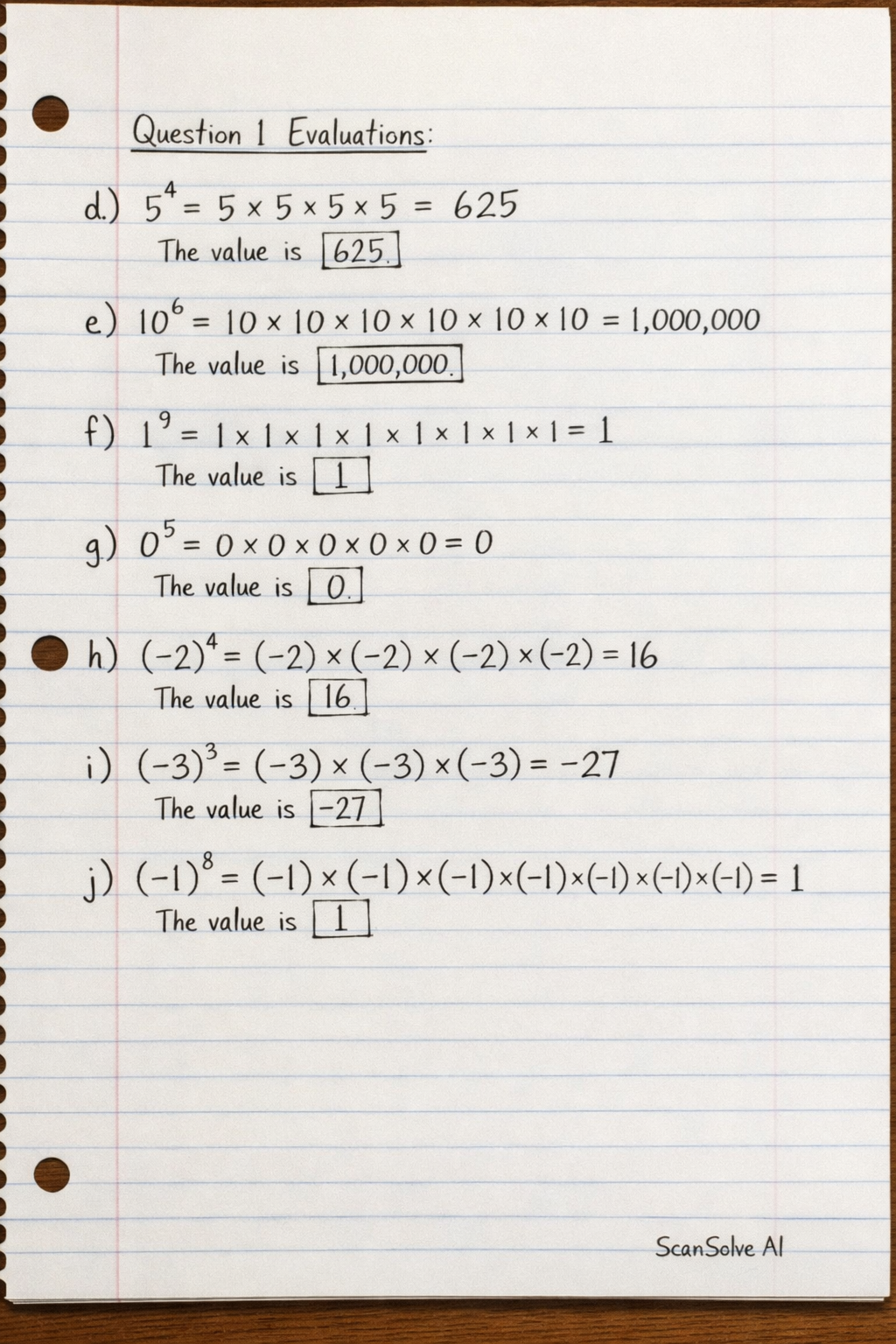
You're on a roll — Here are the evaluations for questions 1 to 8: Question 1: d) Evaluate 5^4 5^4 = 5 × 5 × 5 × 5 = 625 The value is 625. e) Evaluate 10^6 10^6 = 10 × 10 × 10 × 10 × 10 × 10 = 1\,000\,000 The value is 1\,000\,000. f) Evaluate 1^9 1^9 = 1 × 1 × 1 × 1 × 1 × 1 × 1 × 1 × 1 = 1 The value is 1. g) Evaluate 0^5 0^5 = 0 × 0 × 0 × 0 × 0 = 0 The value is 0. h) Evaluate (-2)^4 (-2)^4 = (-2) × (-2) × (-2) × (-2) = 16 The value is 16. i) Evaluate (-3)^3 (-3)^3 = (-3) × (-3) × (-3) = -27 The value is -27. j) Evaluate (-1)^8 (-1)^8 = (-1) × (-1) × (-1) × (-1) × (-1) × (-1) × (-1) × (-1) = 1 The value is 1. Question 2: a) Which scatter plot(s) could be modelled using a curve instead of a line of best fit? Explain. Both scatter plot a) and scatter plot b) show data points that follow a curved pattern rather than a straight line. A line of best fit would not accurately represent the trend in either case. Therefore, both plots could be modelled using a curve. Question 3: a) Make a scatter plot of the data. Draw a curve of best fit. To make a scatter plot, you would plot the 'Length (m)' values on the x-axis and the 'Deflection (cm)' values on the y-axis. For example, (1.0, 0.33), (1.5, 1.48), (2.0, 2.51), and so on. Once plotted, you would draw a smooth curve that best follows the trend of these points. The curve would start near the origin and increase, becoming steeper as the length increases, suggesting a non-linear relationship, possibly quadratic. b) Describe the relationship between the length of the beam and the deflection. As the length of the beam increases, the deflection also increases. The rate at which the deflection increases appears to accelerate, meaning that for each equal increment in length, the deflection increases by a larger amount than the previous increment. This indicates a non-linear, increasing relationship. c) Use your curve of best fit to predict the deflection of a 6.0-m-long beam. To predict the deflection for a 6.0-m-long beam, you would extend your curve of best fit to the x-value of 6.0 m. Then, read the corresponding y-value (deflection) from the curve. Based on the trend in the table, the deflection for a 6.0-m beam would be significantly higher than 16.72 cm. Let's estimate by observing the pattern of increase in deflection: Length (m) | Deflection (cm) | First Difference ---|---|--- 1.0 | 0.33 | 1.5 | 1.48 | 1.15 2.0 | 2.51 | 1.03 2.5 | 4.22 | 1.71 3.0 | 6.11 | 1.89 3.5 | 8.17 | 2.06 4.0 | 10.52 | 2.35 4.5 | 12.98 | 2.46 5.0 | 16.72 | 3.74 The first differences are increasing, suggesting a quadratic relationship. If we were to fit a quadratic model, we could get a more precise prediction. For an estimate, the increase from 4.5 to 5.0 m was 3.74 cm. The increase from 5.0 to 5.5 m would likely be even larger, perhaps around 4-5 cm, bringing it to about 21-22 cm. The increase from 5.5 to 6.0 m would be even larger. A rough extrapolation suggests the deflection for a 6.0-m beam would be approximately 25 cm to 30 cm. (A precise answer would require the actual curve or a regression model). Question 4: Use finite differences to determine whether each relation is linear, quadratic, or neither. a) | x | y | First Differences | Second Differences | |---|---|---|---| | 1 | 11 | | | | 2 | 18 | 18 - 11 = 7 | | | 3 | 27 | 27 - 18 = 9 | 9 - 7 = 2 | | 4 | 38 | 38 - 27 = 11 | 11 - 9 = 2 | | 5 | 51 | 51 - 38 = 13 | 13 - 11 = 2 | Since the second differences are constant, the relation is quadratic. b) | x | y | First Differences | Second Differences | |---|---|---|---| | -2 | -10 | | | | -1 | -2 | -2 - (-10) = 8 | | | 0 | 0 | 0 - (-2) = 2 | 2 - 8 = -6 | | 1 | 2 | 2 - 0 = 2 | 2 - 2 = 0 | | 2 | 10 | 10 - 2 = 8 | 8 - 2 = 6 | Since neither the first nor the second differences are constant, the relation is neither. c) | x | y | First Differences | Second Differences | |---|---|---|---| | -2 | -9 | | | | -1 | -6 | -6 - (-9) = 3 | | | 0 | -3 | -3 - (-6) = 3 | 3 - 3 = 0 | | 1 | 0 | 0 - (-3) = 3 | 3 - 3 = 0 | | 2 | 3 | 3 - 0 = 3 | 3 - 3 = 0 | Since the first differences are constant, the relation is linear. Question 5: The flight of an aircraft from Toronto to Montréal can be modelled by the relation h = -2.5t^2 + 200t. a) Graph the relation. The relation h = -2.5t^2 + 200t is a quadratic equation in the form h = at^2 + bt + c, where a = -2.5, b = 200, and c = 0. Since a < 0, the parabola opens downwards. The graph will be a downward-opening parabola starting at the origin (0,0), rising to a maximum height, and then descending back to h=0. b) How long does it take to fly from Toronto to Montréal? The flight starts and ends when the height h is 0. Step 1: Set h = 0 and solve for t. 0 = -2.5t^2 + 200t Step 2: Factor out t. 0 = t(-2.5t + 200) Step 3: Set each factor to zero. t = 0 or -2.5t + 200 = 0 t = 0 or 200 = 2.5t t = 0 or t = (200)/(2.5) t = 0 or t = 80 The flight starts at t=0 minutes and ends at t=80 minutes. It takes 80 minutes to fly from Toronto to Montréal. c) What is the maximum height of the aircraft? At what time does the aircraft reach this height? The maximum height occurs at the vertex of the parabola. Step 1: Find the time t at which the maximum height occurs using the formula t = -(b)/(2a). t = -(200)/(2(-2.5)) t = -(200)/(-5) t = 40 minutes The aircraft reaches its maximum height at 40 minutes. Step 2: Substitute t=40 into